Category Archives: Residencies

Exuberant Whimsy

Where we discuss mixed-up time, documenting, school, and other such things on the way to words.
I arrive at the penultimate point in the residency. In my head, there is one more week. Truth be told, though, I’m wrong. The contractual end date is the 15th. Incorrectly, I think it ends just before xmas. Fortuitously, Toi Pōneke offers me ongoing use of the space until the 3rd of February. I am saved from my error becoming awkwardly public. That said, the psychology of this time must end as contracted, as the next phase of work needs to begin. This entails the distilling, editing, mixing, and compiling of audio and other works for the June 2025 exhibition.

Audio recordings are only one documentation of this time. These words are another. It’s a purposeful decision to also record this time, this way, as a textural account of a sound experience. The motivation for this is based on personal frustrations. My frustration is that writing seems to be something I am only capable of doing while on tour, in another country, in a place I may not return to, recounting experiences of encounters with people I may never meet again. It is a conscious act to find the barriers I hold in regards to writing, and breach them. 

It surprises me when I think of my academic past, that this pen-to-paper process has become enjoyable. When I was at school, I barely made it to the end of the fifth form (year 11). Prior to exit, there was an escalation of trouble, detention, and conflict. Walking away from school, the idea that I might experience joy from the written word or learning seemed unimaginable.

However, the hunger for learning is resilient. My school experience did not quash it. As it turned out, I was ravenous, and lyrics were the literary form that fed me. I would read, learn by heart, sing along, and take learning from the words people put to music. I would be disappointed if an album did not have lyric sheets inside, along with accompanying art and/or photos. Maybe I thought it showed a lack of care for the listeners’ engagement, or whoever this band was was not serious enough in their intention and practice. Seems adolescent now, but it was really important at the time. And to be honest, I still appreciate and pay attention to that effort when I see it.

Fast forward some years. When I was lyric writing for the band, mr sterile Assembly, there was often a lot of reading involved. A story would be identified that held some contemporary relevance. I would look for key reference material such as text, books, articles, other songs, and footage and then digest. Some songs took years to complete, others less time. This process was really enjoyable, and I grew to appreciate the additional learning around a topic. Unsurprisingly, that process still remains relevant to the way I approach making work now.

The current project of vegetable.machine.animal continues to follow this process.  There is no lyrical content at this point in time, but who knows how that will develop. However despite the no-focus on lyrics, I continue to read broadly in relation to the ideas behind this project. What fascinates me is the think-shifting writing that is being published in both hard and popular sciences and the arts. There are many incredible discoveries being reported in these texts, awe inspiring ideas that make the world bigger, and provide evidence to dismantle some of the worst aspects of the Enlightenment Individual. That model of individuality that places certain humans higher than others, that elevates Humans out of nature, and that redefines almost everything as Resources available to take, consume, and exploit.

Some of the amazing examples of current findings:

  • Coral reefs have sonic soundscapes. Experiments are underway on coral reef repair after bleaching from warming waters and increasing acidity. Underwater speakers play the sounds of a healthy reef beside the damaged ones. The ‘healthy’ sounds invite familiar varieties of life to return and repopulate the habitat.
  • 50 communication signals have been identified via Mycelial networks – mushrooms talk?
  • Some plants can ‘hear’ themselves being eaten, adapt to be less tasty, and warn nearby kin of incoming bugs.
  • Trees can recognise their seedling kin, and favor them by providing additional nutrients via mycelial networks.
  • Species like Venus Fly-traps have proven that there is a capacity for something similar to memory.
  • Orca has different audible dialects of clicks, whistles, and pulsed calls between pods and clans. Some sounds/signals have been identified as continuous across decades, while other sounds evolve.  The young learn from these patterns from the older.
  • Somewhere in deep time, our evolutionary ancestors were a water dwelling species. As such, we evolved without the nervous receptors to detect the feel of water that surrounded us. We still do not have these receptors. All we can feel is the fluctuating temperature and the fluid motion. We can’t feel the real wet.

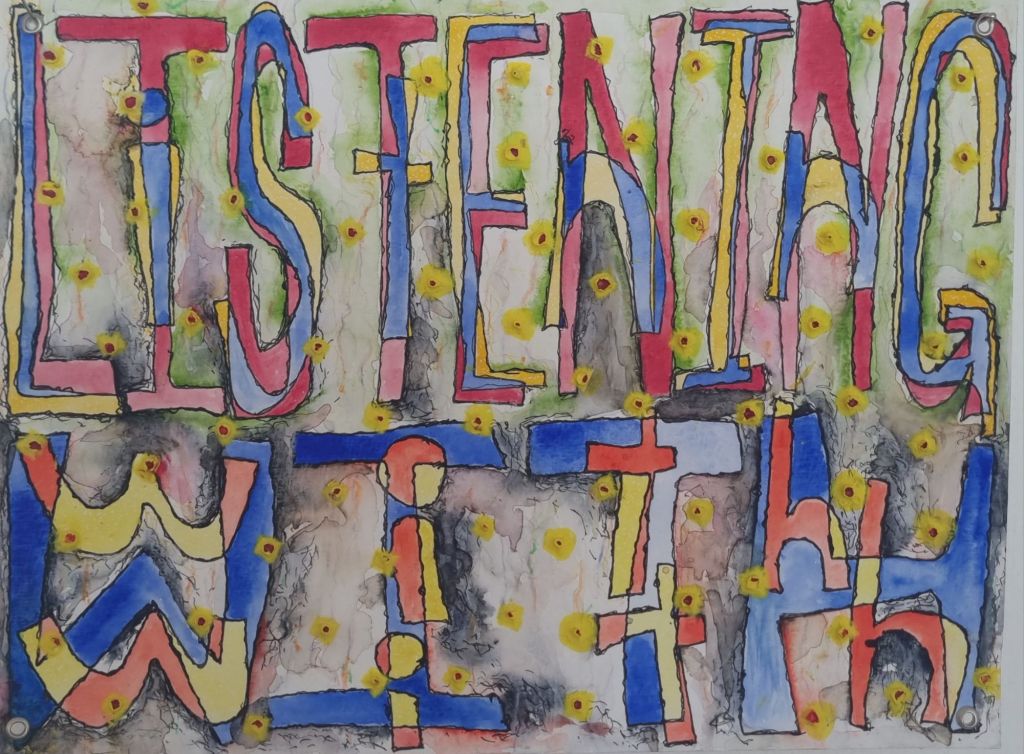
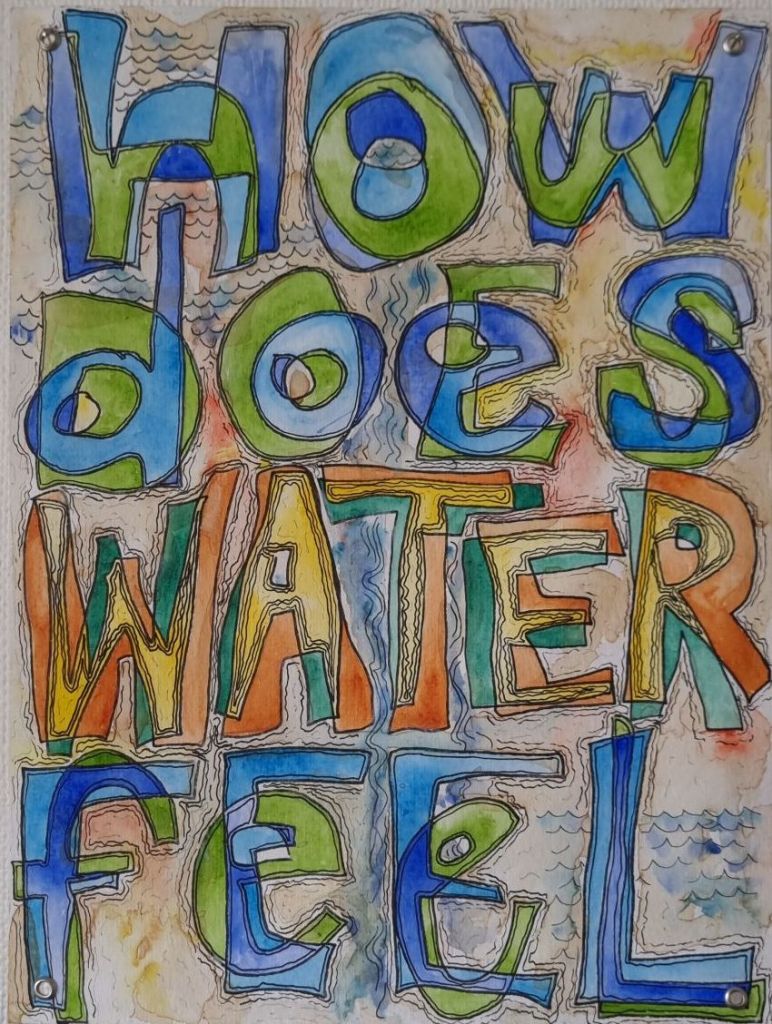
Words take on a life of their own. And all those words I’ve been reading have infiltrated my sonic explorations. Tiny ambiguous phrases began to be collected. On a single day in November 2023, I had a single thought to pass the time while I was between recordings. This resulted in a single doodle, I added some colour , and that doodle just has not stopped. 

I enjoy art practices built on multi-disciplinary approaches, representations of ideas that can not be contained into a single medium. My word posters have become integral parts of the sound work. The sound work is integral to the posters, different information delivered from differing mediums, but all from the same reasons.

What amuses me also is that this is the third time image-making has become a focused activity. The first show I had was in the Invercargill museum in 1991 with all the angst of adolescence on display. The second time, somewhere in the mid 90’s in Wellington, and those images were dark. 30 years later, me and mark-marking reconnect. Less desperate, more joyous, and nothing but an exuberant whimsy.

Reading List:
Entangled Life – Merlin Sheldrake | The Light Eaters – Zoe Schlager | ECOES Sonic Arts Press | Islands of Abandonment – Cal Flyn | Staying with the Trouble – Donna Haraway | Dark Ecology – Timothy Morton | An Immense World – Ed Yong | Death by Landscape – Elvia Wilk | Ways of Being – James Bridle | The Overstory – Richard Powers | The Sounds of Life – Karen Bakker | The Mushroom at the End of the World – Anna Tsing | Gaia and Philosophy – Lynn Margulis and Dorion Sagan | Future Stories – David Christian | Let’s Become Fungal! Mycelium Teaching and the Arts – Yasmine Ostendorf-Ridriguez | Eryk Salvaggio – Electric Mushrooms and the Circuitry that Loves Them

Soundbitten:

  1. It’s not blood in ears, so I sit here in silence, try to locate the fluid flow. Water sounds like water. It can also sound expensive. Yesterday, we heard the pop of the cylinder element, and now showers are cold. But this is not that. It’s the bruit of fluid in motion, the leaking valve of the outside tap, to the artery of garden hose. The Hydro-Phlebotomist makes a house call.
  2. Can you hear me sleep? I know I can not. But sometimes the noise I make wakes us. Conversations with my unhinged side, the dream-Me, a metaphoric I. I hear you sleep, read the depths by the sound of the breath. There is that first unconscious pursed-lipped exhalation, more out than in. It’s fragile, easily disturbed. Deep down, it’s much more quiet.
  3. Driller Killer on the back patch of a cut-off denim, covered in studs. Skin receives Vit D through holes at knees. Wear the emblems of Crust, signs of D-Beat, evidence of Grindcore. At home in a pub, front row, a tumble of mosh pit. Here in daylight, on the front row at graduation, with flowers in hand, lipsyncing as the house band plays summer grooves.
  4. Earmuffs blur the whining sander, coarse grit abrasive to the crud of ages. Pitch fluctuates, friction vs gnarled terrain. Scars in lumber from the bite of steel, piercing, render tree to plank. Before wood-fall, the sound of axe, saw, chainsaw, the graze of teeth of industry. And before Before, the upward creak of timber mobility, the birdsong, the raindrop, the seedpod.
  5. Dali’s boring, but Hugo Ball rules. 1916, Europe,  Karawane says it all! ‘Jolifanto bambla ô falli bambla, grossiga m’pfa habla horem… & …ü üü ü…’. 106 years later, Snakes in a Fijian café, reciting the poem into a handheld sound collector, and the curious ears of the overhearers, attach, and send.  I nest the file with the other .wavs. We are Hugo’s future. We sing Ba-Umf!

The Forward-Tense

Where we discuss the dilemma of formats for music, why formats are nice, AI Slop, and why it’s good that AI will never be able to lick an envelope

I love making music, but then what do I do with it?

There is a repetitious frequency among me, my friends, and other small-time music makers. It’s the cyclic dilemma of what to do with a collection of sounds that feels deserving of the title, Album.

What format to make? Tape? CD? Vinyl in a million colours? T-shirts? Or a shit-tonne of other paraphernalia to add congestion to the world? And how common is it to hear of homes that have no equipment to play any physical format on other than a bluetooth speaker? Very common.

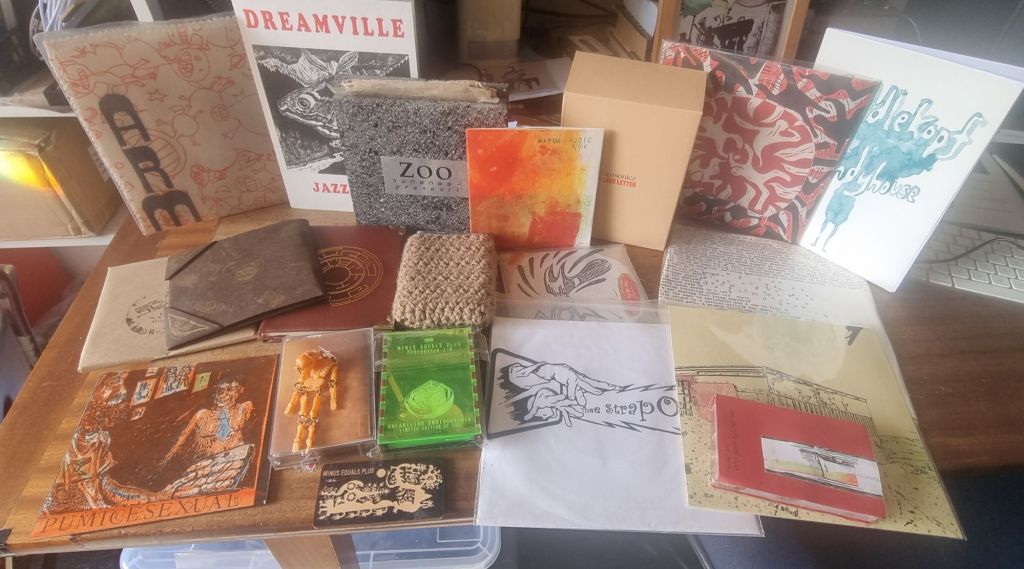
A table of pretty collected things

Once that’s been navigated and an idea has been committed to physically, you end up with something called Product. The question is “Then what”? Into shops, though some may not take the format you’ve made, and chasing up sales can still be extraordinarily cumbersome and archaic? Or online selling in the expandingly gargantuan sphere of the web? Online can be great, and it’s a wonderful surprise to have people in Alaska buy your stuff, but the postal costs to almost everywhere in the world from Aotearoa are truly crippling! Then how about touring to promote the recording? It’s still probably the best way to sell albums and merchandise, but not if you factor in flights to anywhere in the world, and the limitations of carrying bulky items (if touring on a tight budget) with all the other essentials of a touring band, such as equipment and clothes. And once in a new location there is the predilection that different regions have different tastes for different formats – some want cassettes, elsewhere t-shirts, others ask for vinyl, others laugh at CDs – who has a CD player? It is impossible to satisfy all tastes and fashions.
Another distribution outlet is online. There are streaming services for the absolute convenience of the listener and next to zero for the musician. Or the artist-focused platforms like Bandcamp and Bandwagon, which are trying to ensure more funds going to the makers of music. 

Vinyl holds pole position, the gold-standard evidence that somehow you have ‘made it’ as a successful musician. It is, of course, a myth. It was a fantastic dream when I was young, to aim for an album on vinyl. But it seems like a problematic proposition that seems difficult to justify for the sake of ego. New records these days can cost upwards of $100 in some cases. The average price these days seems to be $50. But if what you’re buying is a lot cheaper than that, you need to know that someone else is weathering the cost, striving to break even, let alone make a little extra to put towards the next project.

Then, there is the often under-discussed conversation about the environmental impacts of a large non-recyclable format made from fossil fuels. Great for culture, crap for climate.

But all that said, I still like things. I love the expression of confidence and commitment people display when whatever is used to protect the format becomes a work of art in itself. I adore a beautifully conceived and created artifact. Great design can contribute additional information beyond the recorded sound. 

Some stuff we’ve made, available on our bandcamp page

Recently, I’ve been playing with the idea that the making of a material item, as opposed to only online, is like throwing an idea into the future. If, in the lifespan of this item, it finds its way into general circulation, it becomes immediately unknowable who may stumble across it at some future time. It’s a microscopic idea, but it feels like a meaningful consideration to think in the forward-tense. It’s a tiny contemplation, but I have been the appreciative beneficiary of such small discoveries and so perhaps others might, years from now, also enjoy the efforts of my labour.

One other less considered idea is how these nearly obsolete formats sit alongside technology like Artificial Intelligence (AI)? These days it’s a challenge to differentiate between AI and human-made text/images. AI audio programs are sophisticated enough to fool the listener. A tune can be generated by providing instruction on genre, feel, vocal choice, lyric, and letting AI do the rest. These tools will only get more sophisticated.  As the processing capability becomes exponentially more powerful, so too does the increase in the deluge of content such as AI Slopbadly managed or improperly deployed AI systems, that deliver, unwanted, poor quality, inaccurate, and simply ‘spammy’ content”. This is now the junk of our everyday lives.

AI Slop!! NOT real life [lifted from the internet of course]

But no matter how advanced AI may become, it will never be able to lick an envelope. Maybe this is an area where physical formats are useful, islands of the handmade against the algorithm of the AI. The committing of sound to physical form requires more steps beyond that instant generator of music. Instant music that can be immediately uploaded to streaming services, swamping the stream with a perpetual deluge. Committing sound to form demands that the ephemeral must interact with the material. It makes a physical and revisitable part of the world. And anyways, it’s hard to flood the world with handmade.

I have no clear idea of what is the best course of action. Actually, I think there is no clear answer. But I remain committed to the idea of making artefacts in the hope that there are others who enjoy our paraphernalia. I enjoy the process of folding, cutting, and gluing. I love the act of making. AI algorithms are brilliant in the application of science, weather forecasting, and other such domains, but not in areas such as culture and information. Perhaps the act of making a ‘thing’ becomes a small defiance against the invisible coding and bias built into these systems.

Soundbitten:

  1. Who heard the tree fall? The bend, strain, snap, and the crack of it. Unlikely anyone during the midnight howl. Nests ejected from limbs, the dismembered wings of leaves, trees twisting from the earth to the eaves. Ferocious, roaring, the gale shouts at every single dislodgeable and launchable thing. With its ear to the ground, the limb finds no silence.
  2. Cocooned. Prepare for later, a T.V dinner for eye eyes. But there’s no victory lap after the hunt.  An assailant attacks the predator. Movement is frantic around the bounty.  I am deaf to the duel. Spiders ‘hear’ with their legs. A foot on each web strand, deciphering vibrations into meaning, eight lines of communication at a time. Battle breaks the web, and lunch is lost.
  3. Fresh batteries in walkman, listen and play. This was how I learned to play the drums. I thought what I heard had all been played at once. All that technical prowess delivered in real time by extraordinary musicians. Who knew about multi-tracking, layering up, and moving equipment around. On that one particular track, Stewart Copland played only the hi-hats, not the kit!
  4. Hallucinogens render me incompetent to play songs despite the urging of band mates. All tethers to reality lost. But shows must go on. I grab bits of metal and other sharp objects collected to make industrial sounds. Projectiles produce great sounds crash-landing, heads duck in very real danger. John sits on me for my safety, from myself, and from others.
  5. The cancer’s back, it’s a weird relief she says, she no longer has to wait its return. Now tho, it’s a mission to finish the album, her one document. Songs she’d written, words she’d wrote. The last time we met, there was not much of her left. The exhaustion near total, almost unable to do the last track, energy for one take only, and no space for mistake. I still hear to her sing.
The set up of Sophia Fudd on a collaborative recording

The Nothing of Us

Where we discuss Nothing, Something, Scenius, The Residents, Crass, Pyramid Club, and SABOT.

How can Something come from Nothing? It’s been a thought doing the rounds in my skull recently. Mostly in the context of how an act of creative hopefulness can turn a blank page into something less than blank or an empty recording session into something containing nuance, hidden surprises, and spectacular noise.

It is, of course, a silly idea. There is no such thing as Nothing for Something to come from. Something always comes from something else, evident, obvious, or otherwise. I did not start from a point that contains no things. I could not write this without a backstory, a previous, a moment leading up-to. There was no blank page. Nothing is an illusion that contradicts itself because an illusion is Something.

Nothing may be less about the actual absence of Something and more the actual evidence of a blindspot we carry with us as move through the world in our simplified way, waiting for a perceptive shift, an inspiration, that teaches us to see anew a thing that previous lived in the invisible.

At one point in the past, when the human eye looked into the smallest places of the World, they were unable to see anything. They thought these spaces were inhabited by nothing. The invention of the microscope changed that forever, and a whole new strata became evident and present, riddled with things. What was once invisible could now not be unseen.

Up here in the land of the human, there are those who are lauded for the ‘creating’ of something from nothing, often called Genius, or Artist. It is an idealistic concept of a rarified creative individual that others can put on a plinth. There are generally financial attachments and investments in such positions. But rarified is not the same as rare. Creativity is not rare at all.

Genius is an overused word. It amplifies the suggested brilliance of the individual.

Scenius is an underused word. It is a word that amplifies the brilliance of community.

Coined by musician Brian Eno scenius “…stands for the intelligence and the intuition of a whole cultural scene. It is the communal form of the concept of the genius.” A scene is an ecosystem where things feed other things. It can nurture and prune, hold spaces for exploration and fine-tuning of concepts. And scenes become incredible when they become intergenerational. A scene is also difficult to commodify and monetize.

For me, The Residents, from San Francisco, are a band who fit this bill. I first remember seeing them on the TV show, Radio with Pictures, on a Sunday night in the early 80’s. It was the video for the unforgettable “Moisture” from the Commercial Album. 

The first of the one-minute movies is the song Moisture

This band became infamous for its anonymity, iconic for the eyeball masks they wore. They made music, videos, visual art, concepts, performances and confusion. The line-up anonymously seemed to shift (around an unnamed core), change, adjust as required, and actively avoided centring on a personality. And around this act were a bunch of other bands, not sonically the same but connected into a scene, encouraged by a shared like-mindedness to explore the odder corners of music and art. 

Crass LOGO

The anarchist punk collective, Crass is another group that does this for me. They were overtly political in their sound, visuals, performances, and community-making. When I was young, I was in awe of what seemed like their overarching conceptual genius, but now I realise it was the brilliance of the many participants that enabled this effect. A cohesion of a community working together, each to their own strengths, creating something far greater than they could have done individually. This, in turn, inspired others, globally, to create and participate, make music, art, publishing, political activism, and much more beyond the output of Crass. 

Pyramid Club LOGO

Another more local example is the Pyramid Club. It is an incredible hub which is “…the home of experimental music and sonic arts in Te Whanganui-a-Tara, Aotearoa. As an artist-run organisation and venue dedicated to experimental practice, Pyramid Club provides a physical and conceptual space for artists whose work falls outside the scope of commercial performance venues.” And it does what it says it does.

Of course, there are people responsible for the administration, but the venue both fosters and flourishes from a vibrant and healthy community. There is such an incredible array of explorations and expressions of music making from across multiple generations. Prior to Pyramid was Freds, and before that was Happy, and before that, The Space. Nearly 30 years of continuous venues for the musical oddballs of this city. This story goes back further to the early 80’s when punk arrived in a very different city. Into this space came another scene, the Primitive Art Group, a free-jazz gathering, who have recently had their story told in the beautiful book, Future Jaw-Clap. Some of the Primitive Art Group can still be seen performing at The Pyramid Club today.

A scene is more than environment, it is ecosystem. Entangled connections going both ways in time. Like a fungal mycelial network, it has sought areas of nutrition and connection. Some connections sustain, others shift and change as people come and go, commitments and demands take precedent, and life changes. But there is enough of a mesh knitting this all together. Growth takes place in multiple areas, and in unpredictable ways. 

My introduction into this community started in the late 90’s at The Space in Newtown. It was a venue welcoming to my ideas of festivals, shows, film-nights and other events. I also learned from the exposures to new and unknown things. I am immensely thankful for the opportunities and exposures, the connections, friendships, concerts and opportunities experienced since then. I could not do now what I do without the brilliance of the local scenius, the individuals that make up this communities, playful, quizzical, committed, serious, and persistent.

These ideas all tie nicely into the concept of D.I.Y, Do it Yourself. An acronym that came from a time in punk rock when the only way to release music, organising shows etc was by doing it yourself. It made a lot of sense at the time. But I feel that it’s an idea that needs an update. Many of those original challenges are less of an issue now we have the internet. 

Sabot album cover

Then I think of the wonderful band SABOT. Originally from San Francisco, later resettling in Tabor, Czech Republic, where they embarked on a project of scene/community building. We met them on their first tour of Aotearoa, and for us it was another life-changing experience for the better. The album they were promoting on that tour is called D.I.O – Doing it Ourselves. It is a statement of the intent of the We, the Us. This is the update to the loneliness of the ‘Yourself’, a return to the brilliance of together.

None of this is from Nothing. And none of this is for Nothing either. Don’t let anyone tell you otherwise!

Soundbitten:

  1. It’s been a long time. When were we all last in one place? Since before the virus? I stand here, by the sounds of frying, and kitchen sink, preparing a meal for this celebration.  For us gathered. And I listen to all your voices. The details are missing but the chorus is sublime. The rise and fall of each other, the laughter, the comfortable silence between. What a song!.
  2. It’s there again! Is an angry wasp in my pillow? Something’s definitely hinting Wake up! I’m too sleepy to be really worried. There’s no pain, I am not roused to action. Space is sated in silence till the next bout of yelling. Wake up! The sleep is deep. No pain means no action. Shhh little bee, go back to sleep, enough of the buzzing, you’ll wake the neighbours!
  3. Hear unison from the second floor opposite. Go outside, get closer. Maybe Mandarin, Cantonese, a dialect? I wouldn’t know the difference. Some percussion holds time. Strings duet with the women of that room, singing songs of other places. Listen long enough, repetition, reprise. It’s free from the window, echoing between buildings, between worlds.
  4. Simple times and simple kids, the rules were clear, it was one or the other. Punk or Metal. Sex Pistols or Judas Priest, One-Way System or Iron Maiden, The Damned or Motorhead. Who set these demands, idiots most likely. Regardless, the Sex Pistols won, like a three-chord distorted religious epiphany. An earth-shifting energy bending these ears forever.
  5. Experiment: Three glass vessel, three pea-shoots. Observe patterns of root growth. No.1: Water flows into one corner. Observe: Roots grow towards the water. No.2:  No flowing water. Observe: Searching and branching root distribution. No.3: A speaker playing recorded water sounds. Observe: Root growth towards the sounds. Question: Do they hear?

Random Patterning

Photo: Michael Norris

I said flippantly, “Maybe the pattern is just a small section of something much bigger and actually random’. For example, if I take a small section from an ECG reading of my heart, I might see something very patternesque. But if I could see the ECG of my hearts entire lifespan, it would show something unique and unrepeatable. I’d wager that no two ECG’s from two humans’ entire lifespans would match. They would be unique and random patterns.

Ideas of Patterns and Randoms seems to be a thread that weaves its way through this week’s various conversations. The notion of a brain’s ability to find patterns, an imaginary line, between two points [and the imaginary path between them] is as old as the hills. Patterns hint of certainty, but certainty, mostly, is a pot of gold at the end of the rainbow. Is a pattern better defined as a most-likely event?

We hold to patterns in nature but these patterns have become unreliable as the climate presents one disruptive event after another. Maybe Big Random has just got smaller.

He was telling me of his experience visiting a natural cemetery. I’ve not visited one and was curious to hear what these new [old] developments in sending of the deceased are like. He says he was taken aback at first at how the plots were not delineated or clearly marked out. How ‘composty’ it was. There were no clearly defined plots. No permanent headstones. He could not help but think about the underground. Who was where? And how far had they been distributed? And then we talked about how the same was true of conventional plots. How the demarcation, the patterning of plots above ground, provided a psychological certainty which did not match the ongoing reality of the activity of the soil.

We had barely enough time to talk as I was due at another meeting. We would have had a better introduction if we had more time. I learned quickly of her research. It was investigating the indigenous relationship to certain plants, and the ‘songs’ that these peoples were able to intuit from each different plant family [apologies if this is incorrect], from a region in South America. I briefly explained my project. How I made connections with plant and fungal life in my exploration of music making with what I perceive as random signals. Almost immediately, we seemed to come at the notion of random from different directions. If I were to guess, I wonder if my idea of Random seemed contrary to her research findings? Was her research presenting patterns? Time ticking meant I could not stay. We could have talked for so much more, I hope we do again. 

Thinking about it now, I would try to clarify what I mean a bit more. Random, in this sense,  is Unexpected and Unpredictable. I am not attempting to interpret these signals as conveying meaning or communication. Other more robust research methodologies have detected signals traveling the mycellial network as a mode of transferring information from one point to another. Some have even broadly termed these as words.

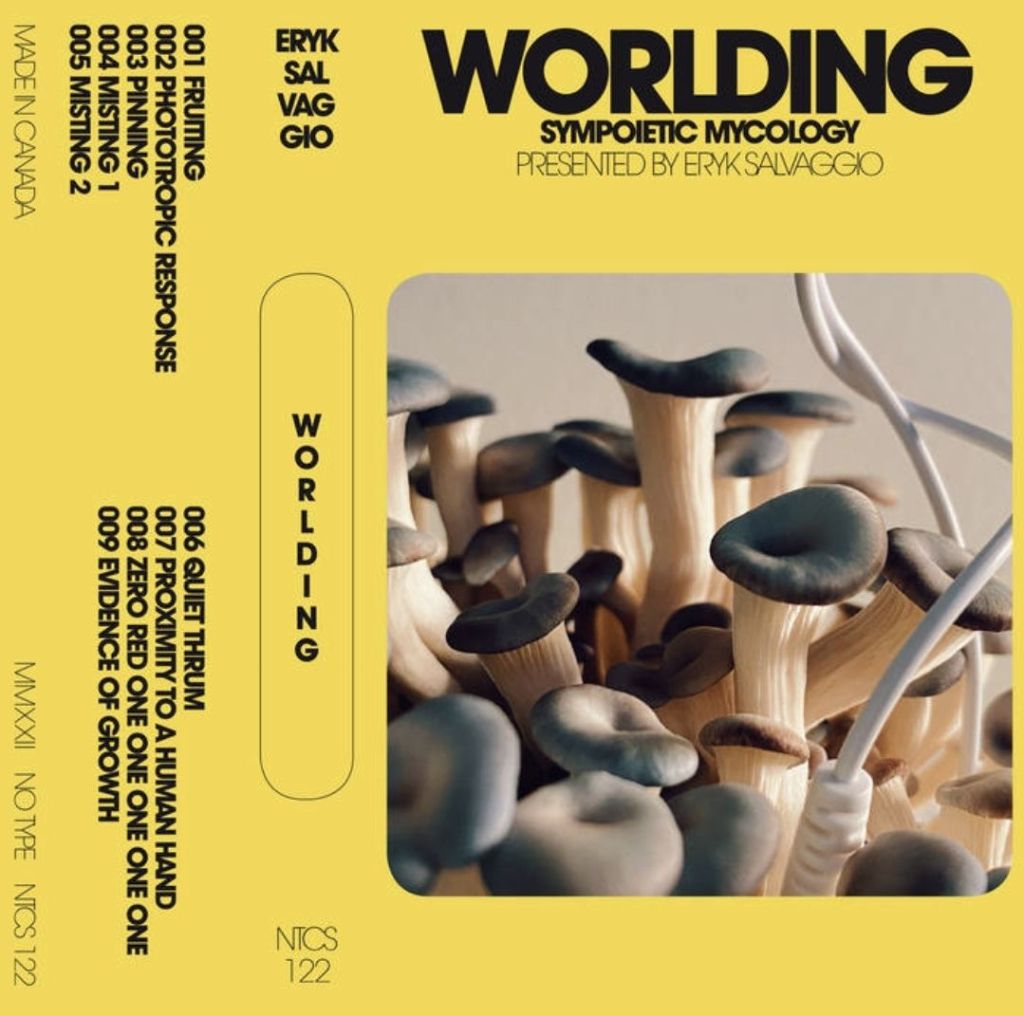
Worlding tape cover

It’s funny to me that the electronic world has become part of my regular environment. I’ve never really had a love for electronic music, still don’t. 

I was explaining again this past week,  how it was the electronic album Worlding by Eryk Salvaggio, which stole my ears and sent me on this current path. Salvaggio’s process used a modular synthesiser that was then connected to correct the biosignals of mushrooms. This is a process that I have attempted to emulate and develop. Worlding was on rotate for such a long time, for a period it became the only thing I listened to. ‘How does this music make sense to me?’, I wondered. “Why do these pieces feel like ‘songs’? Why can I hear time and tempo in these pieces when it does actually exist? There is not a line between these two beats but a hook. And a different hook briefly establishes between this and the next beat. Is this how Organic sounds? Why does this electronic instrument, when plugged into the actual world, sound more fascinating to me?”

I was drawn first to this album by its name. Worlding is a concept I first encountered in the Donna Haraway book Staying with the Trouble. To paraphrase, Worlding is something akin to the idea that the World is always in a process of being made, at all places, by all things, human, non-human, and all the rest of it, all the time. A world of unfolding patterns and unfolding randoms. Co-existent and in-extractable from each other. This is a world where trees communicate with trees via the intermediary of the mycellial network below ground, the threads and hyphe of the object that bears the mushroom fruit. The distributed and active networks that recognise no borders or plots. That explores and connects, which may exchange or attack, that find modes of adaption and survival in both healthy and toxic environments. 

An idea from a book roped me into Salvaggio’s album. That music tangled me into an electronic project. The project currently has me entangled into the networks of Toi Pōneke and the New Zealand School of Music – Te Kōkī. The threads of this had me at a table last night talking about different underground activities. What if this is random? What if this is a pattern? I will follow these lines to where.

Musician Bill Wood at the completion of our collaborative recording session

Soundbitten:

  1. Noise canceling off. The train can accompany the tune. Drone against drone. Pitch lowers as brakes engage. The electric hum of the door. A ticket collector’s new lyric, “Snapper?”. Ascension of acceleration, crescendo of the effort on the hill. It is a singalong to public transport, a chorus to communal travel. Where does music start? Where do the tracks stop
  2. By car for convenience. Slish, slish of wiper. Is that a rumble in the fender? It’s just things in the boot making racket. Slow. stop. Collect and hold those offenders. Next new sounds. Schlubb, schlubb. Schlubbing sound but two octaves down. From where the rumble was. Three times therclunk. Slow. Stop. Strain and clack of tyre iron, free the tyre, change the flat.
  3. Left, breath warmed sound, the boombox sounds chill. Right, can’t hear the walls echo. Diaphragm flutters, 90 degrees to gourds low tones. Feet hear cello first. Over head abuzz with scooter. Lie down, stone floor from unknown quarry. Up, four bass cables, earthquakes bracing jazz. Four flies fly, one moth dances, and nine blue suns in the sky of Ruby’s world.
  4. The Eye follows the Ear. The aural nerve is faster than the optic. Listen forward, listen to the back, listen up, listen down, listen near and at distance. Vision is at the center of In Front. I hear you first then catch your gaze. The Ear is older than the Eye. Things were heard before they were seen. We hear before we see. I hear you in the amniotic sea, I see you in the air.
  5. The kid wakes singing. From slumber to songbird in a blink of an eye. Is there anything more angelic than this unadulterated effervescence? Even before the feet touch the floor, the joy of the little one can be heard throughout the house. The only prayer I want to say is May I never be too old, too tired, too grown up to not recognize this wonderousness for what it is.
Ruby’s roof

The Physics of the Swing

“How do you stop the paper twisting?”, he asks.

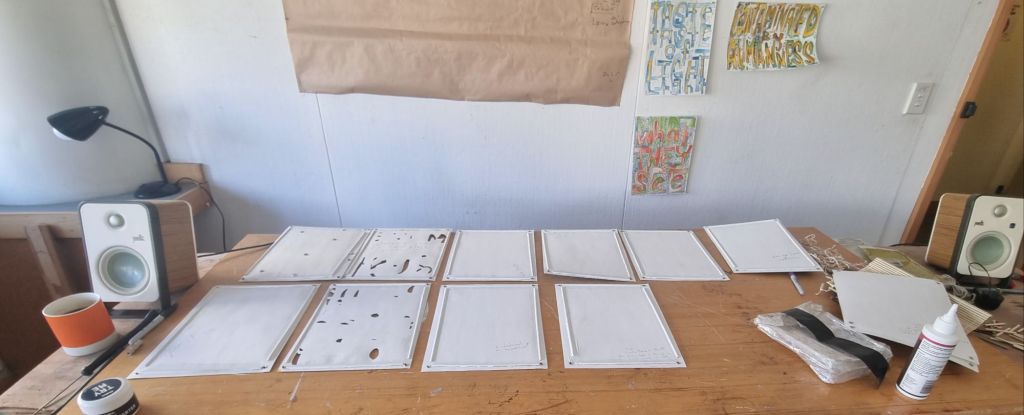
It’s something I’ve been thinking about for a while as I prepare some pictures for an exhibition. I want them to float off the wall, hanging from each other at 40mm distance, and have a breath-like flutter. Flutter is not the right word, I’m after a rigidity of movement, something like an articulation. If the paper is too paperly and the connections are lightweight, then the overall assemblage twists. I want to be able to dictate the physics of the swing.

The architecture of the paper needs to be bolstered. On the back of the sheets, disassembled bamboo mats become the near- invisible framing. For the pictures to hang from each other, I make something like a big staple from sturdier wire, which has less intrinsic movement. These are then spray painted with a bright orange to light the mood of its weightiness. It achieves what I’m looking for.

Tuesday. I can not make it work. I’ve spent the last 90 minutes trudging this equipment downstairs, setting it up to record, and now nothing. Has it been damaged it in the move? Why is that always the first thought? It was working fine before but now only silence. For 10 minutes, all the lights have been flashing like a trashy disco, but not a peep of sound. Check cables, sensors, connections, and power supplies. I look for the obviously simple reasons before catastrophising options arrive. 

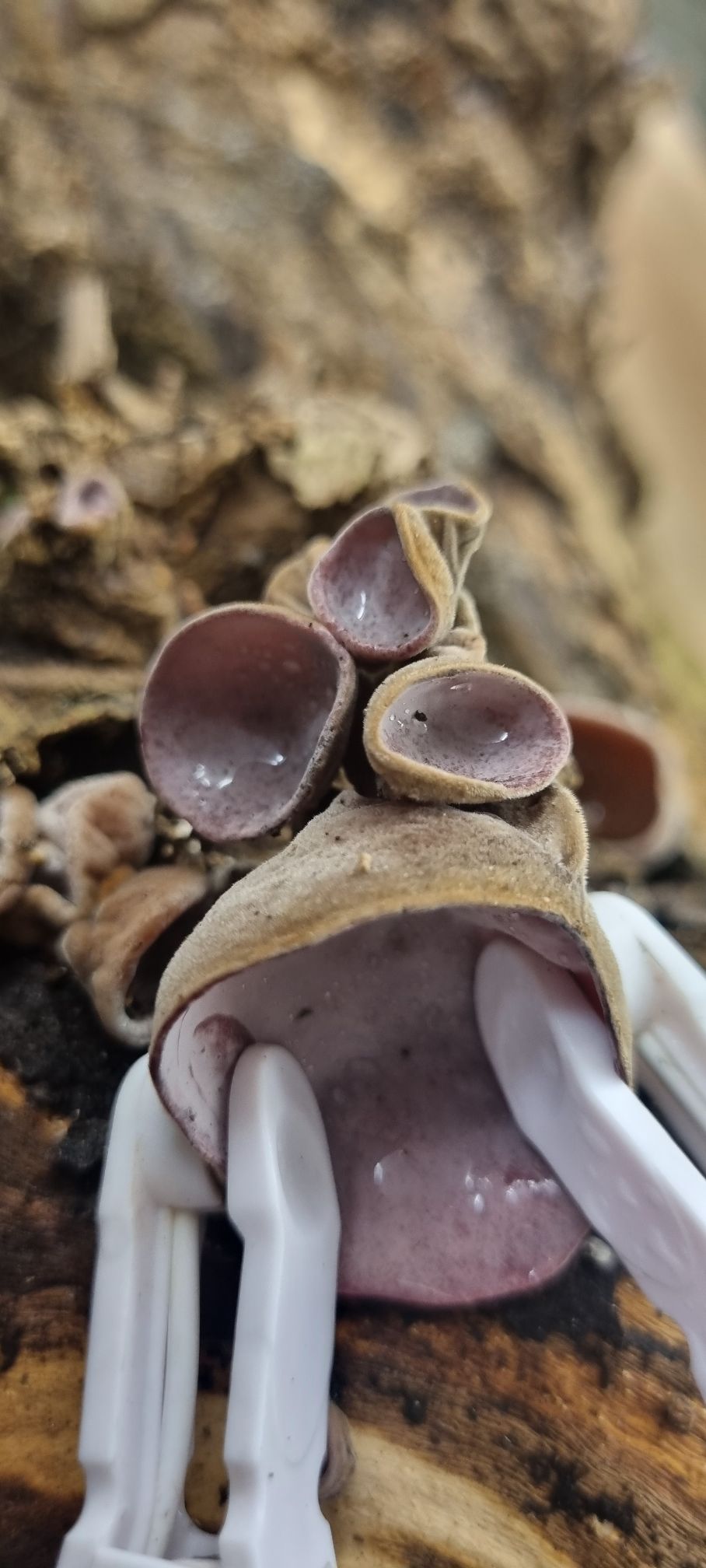
However, the answer to this issue is simpler. It appears that the fungi are withholding their signals. Sleepy fungi. I spray a bit of water onto the mushrooms. The moisture improves the transfer of signal-to-sensor. I reconnect the sensors to the damp flesh and sound bursts into life, with life, from life. 

I’ve made this mistake before.

In the beginning, before this project was a project, I had no idea what a modular synthesizer was. When my first modules arrived, I could not make them work. I leaned on the wisdom of Issac, the only person I knew locally who was informed about such arcane things. He generously lent me gear and knowledge.

Perhaps it was during the second ‘lesson’.

Isaac came over home one evening. Huddling over the equipment, watching closely as he looked skillful in his extraction bleeps and bloops of sound. We were completely focused on the machinery. At some point, though, without obvious reason, sound stopped. I watched on as Issac problem-solved – checking cables, connections, etc. He appeared mystified, I was beyond lost and unable to help. Some inkling prompted him to poke the plant. Then, as if re-energised, sound returned. Should I anthropomorphize the moment, I would think it was the plant playing tricks on us, going, “Oi!! … I’m here as well, get your head out of your geek, and pay attention!!” Such rude foliage. But it’s got a point.

This was a small act of relearning, of where ‘else’ to place attention and consideration. That it needs to be in more places than one. How often do I need to be reminded that invisible things have influence? The world is haunted by unseen things and their own connections. We are at the mercy of the obscure and opaque.

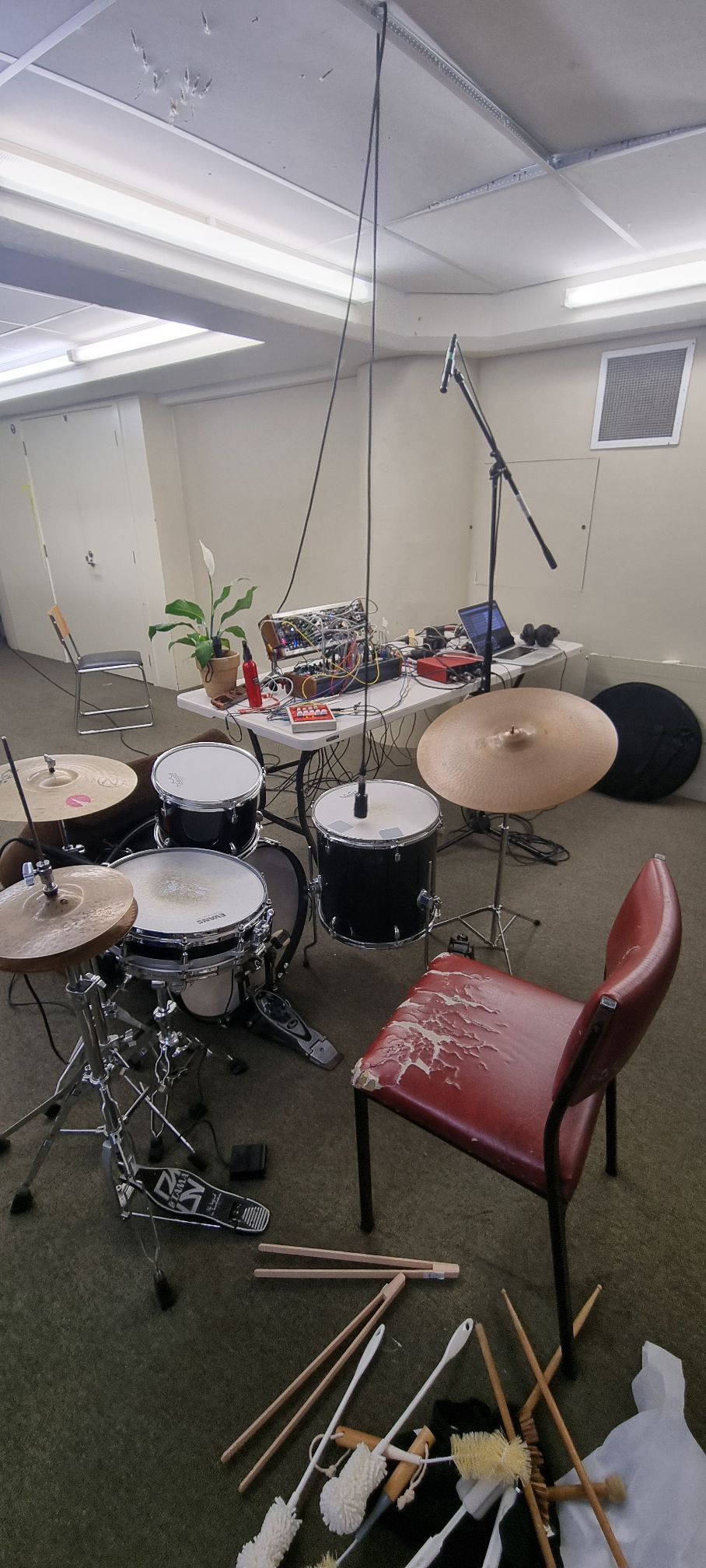
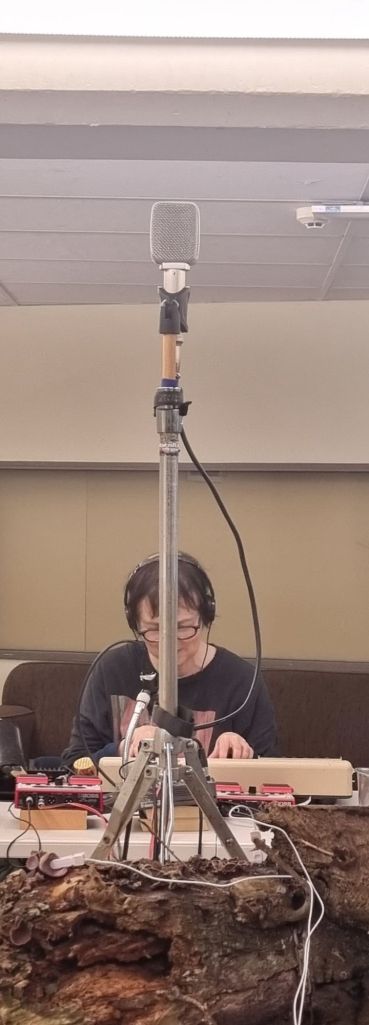
Back to Tuesday. With the sound issues resolved, I set about re-recording a piece from last week. I didn’t have enough microphone stands, so I dangled cables from the aluminum framing holding up the suspended ceiling. I suspended two microphones, one over the rack tom and the other over the floor tom. If I clumsily bump the mic, it will start to swing over the drum. The movement of the mic collected the sounds emanating from the skin as it approached, traveled across, and departed from the drum as it swung through its arc.

I realise I can use this clumsy action with good effect. I reset the mics over the drums and let them swing.  I press record and capture the movement in action. Timing, linked with tempo, are cornerstones in the act of metronomic drumming.  But in this instance, the timing is determined by the physics of the swing. As momentum diminishes from the swings’ natural reduction in distance, there is an audible increase in frequency of the beats.  I record several takes this way, using different mics and drums, building up a set of tracks that feels like it has some sort of regularity. I know it doesn’t.

[Later the Youtube algorithm shows me a piece of music by musician Steve Reich. He had used microphones in the same way but over guitar amps, playing with the feedback. I think I like my version more.]


In the afternoon I’m joined by visual and sound artist and guitarist Gemma Thompson. Gemma is also a regular inhabitant of Toi Pōneke. We have only recently met. We have chatted a couple of times in the kitchen, and have never heard of each others’ music, other than a short clip she played to me from her phone of a recent concert. It is an interesting way to meet someone through sound rather than words. There is a confidence required to be able to let go in the company of a stranger, the urge to self-censor, and self-limit can hobble opportunities like these. It’s a good practice to work against these things.

I host an open studio on Wednesday evening. It’s an open invitation to present the current work-in-progress. And I get to demonstrate how the machine/plants work together. I am both surprised and heartened at the number of people who come through. There seems to be genuine interest in the project,  and many are willing to take part in the chance to interact with sound making. 

One demonstration that gathers attention is where I place one sensor onto the plant/fungi and the other onto a persons’ finger. No sound is made until the circuit is closed by the person with the sensor connecting with the plant. We expand this by bringing in extra people, as long as they hold hands with the person connected to the sensor and the person at the end of the line touch the plant/fungi. It’s possible to hear audible changes in the sound from this bigger loop. Sometimes, it seems to take a little longer for sound to register, and the rapidity of the signal changing seems slower. But there seems to be something awe-inspiring for people when they have the chance to become part of an organic loop, part of a connection that makes this sound. It is almost as if the connection is more important than the aesthetic.

The week wraps up with a lichen-influenced mechanism playing metal chopsticks on a snare drum. It was a useful distraction as the swing states gave Trump his victory. So much had been written already with an air of certainty about what will come.  I’m no soothsayer, I’m making no predictions. I trust the fact that Trump is not breaking the rules of physics. Negative does not exist in a vacuum. For there to be a negative-in-charge, somewhere there exists a positive.  I’ve no idea what it is. It seems invisible. But if I must remind myself of one thing, it is that the invisible also has influence, and most things deemed certain never are.

SOUNDBITTEN:

  1. One door over, a Kango hammer bites into concrete. A metal tooth drumming on the solidity of the wall, intermittent in attack, dusty in effect. It has a jangle in it’s voice, bells chime as the engine powers up. Another machine over another fence chews into spring grass. It’s a two-stroke throatiness, undulating in pitch, as it works against the resistance of rapid weeds.
  2. A bird sings twice. First from the bough high up in the Eucalyptus, air astringent with fragrance. The second as the echo returns from the bricked house opposite. The quickest reverb. Sharp like a smell, piercing to the ear like molecules to the nose. Reminds me of a text that says the smell of fresh cut grass is, in the language of the garden lawn, screaming.
  3. The show was over 20 years ago. I’d been to plenty that had left my ears ringing in the past, it usually stops after two or three days. Not this time. Loud laptops, pure digital tone, my drums in the crosshairs of the P.A. I hear it now. I’ve got strategies to cope with the constant background sound. Stress is a volume knob, a red flag, a siren’s call to attend to some inner need if the ringing starts screaming.
  4. There were only partitions between the bed bays in the long corridor that slept 80. Mine is next to the Dorm master’s door. No privacy. No quiet space. Lights out. I would hide the walkman undercovers, listen to the Sex Pistols on headphones. Lights on. Dorm master had me on display to all, getting six of the best for my sonic indiscretion. It won’t stop me.
  5. I make mixtape for road trips in the car, all the favorite songs in one place. Pack the kids and go south for summer. Along the coast, the song Motorhead comes on. At the same time, kid 2 throws up. We stop, clean up, and carry on. Down the road Motorhead returns. And like an allergic reaction, kid 2 throws up again. Stop, clean up, put the tape away, and carry on.

The Floor Holds

Somewhere in my post-viral fuzziness, I lose all my keys to all the doors I need to open. Later, I make so many trips up and down the stairs because I forget one thing after another. I am not fastidious enough when plugging cables into boxes and discover later that I have recorded one channel of audio and one channel of silence. I tell myself to be careful with the marker while doing measurements around the pictures, a purple line glaringly appears unwelcome in a margin. I download some footage I captured to make a video, I manage to lose it all in the process, and only realised after I had deleted from my photo. Argh!

That’s how a week starts. Small and inconsequential irks when held in comparison to the big issues of the day.  In a doubtful moment, I ask, “What is this for?” “What does my art add in the scheme of things?” In a world of fear, anxiety, murder and massacre art can seem like a folly, a luxury, a something that’s “nice-to-have” as one politician recently spewed.

It makes me ask of myself:

  • What ways should I think about what Im doing?
  • Am I making escapism? 
  • Am I making something that helps me/we/us step outside of the pressures of the practical issues of today? 
  • Is my thinking captured or critical? 
  • Am I making something in context or am I decontexturalizing? 
  • Am I making a brand? 
  • Am I making something meaningful or grandiose? 
  • What do I think now that that gatekeeping position has shifted?
  • What in my work addresses the bread and butter issues of the day?

Big naval gazing questions. In fact sometimes the only response to questions such as these is a big ‘Fuck it and Fuck Off’. They have a time and a place. But if it’s inertia they create then it’s not welcome. A reflective pause is different from the dead air of being inert.

The last post contained a photo of the Bread and Puppets manifesto. I hadn’t really thought too hard about why I added it other than I think the words are good. Today, I think differently. It states ‘Art soothes pain, Art fights against War & Stupidity, Art is like good bread, Art is like green trees’.

Art is like Green Trees. It makes something that makes it easier to breathe. 

It amazes me how easily something so ephemeral can remind us that we CAN imagine something different, sweeter, better, and fully welcoming. Everything constructed we see starts in the imagination. If it can be thought of, then it can be done. The algorithm of feeds, the corralling of ‘If-it-bleeds-it-leads’ news reporting, the shouting of opinionated anybodys online sucking up airspace, and the limitations of the corporate storytellers shut down the notion that the world remains full of options, opportunities and alternatives. Here we say, “Fuck it and Fuck off!”

Dunedin, 1988

I think of my own experience. Music has always made sense to me, captured and captivated me. It ‘spoke’ to me before I could speak for myself or even figure myself out. It gave me a hand up when I needed help. If you knew the young adolescent me you would have known I was trouble, or trouble was on its was to find me. But music gave me an option. In fact, I think music gave me my first real confidence. When my own mental world was at it’s bleakest, most slippery, I could always find some purchase in some musical expression to grasp. 

And I would never meet the makers of these sounds. Or in some random rare and precious moment I might. But on the whole they would never, ever, know the tiny but deeply meaningful impact they installed in this small life. And the way we obsess about things like bands, books, and such, I’m feeling confident that it happens all over the place, all the time. Small individual acts of making things better. That’s a gift to give. So massive thanks, love, applause and appreciation to all those, everywhere, who give without expectation of return.

If you’re a maker, keep making! 

Soundbites:

  1. Clocks! I hear clocks. The kind with hands and mechanisms making noise. Big ones. Ticking away in seconds. They sound close, overhead, omnipresent, inside my head. Your poor house has no clocks like these. There’s a timekeeper on the oven only. I am being haunted by time, hallucinating time, imaging time as if it were there. It’s just the solvent talking.
  2. Listen back to recording, time wobbles. A snare hit’s untidy. Out of Time. I demand the snare’s attention! To human time. Timed time. My Time. But here’s the But. What did I hear that threw my strike? Distracted tight time? Mmpatient time? Glide time. I listen to something in its Own time. Can I be brave and accept organic time? Messy time? Not My-time.
  3. Sounds like the ocean. The wet is beer and sweat. I am driftwood on a wave in a moshpit. Together it’s both dangerous and safe. I look for the band. I’ve lost the song. I cannot tell where we are or what comes next. Beats flails after beats. The bass is a weighted blanket. The guitar is the Cheshire Cat’s grin. The music holds me. It is ferocious and full of smiles.
  4. She listens small. There’s something inside it. A fragment of action, a shout from friction. If she can find the start, that doesn’t exist, and the end, that doesn’t exist, she will have made something that does exist. And repeat. Turn fractal into pattern, turn figment into rhythm. Something that was not there. But she could hear it, she just needed to find it. Here it is.
  5. I fell in love with Foley through Star Wars. I saw a demonstration of how the sounds of stormtrooper blasters was made. Somewhere in a desert, large pylons were anchored with cables, securing them to the earth. Hit the wound steal, cymbals made of metal strings. Zap! The ordinary everydayness of things became the sounds of the future.
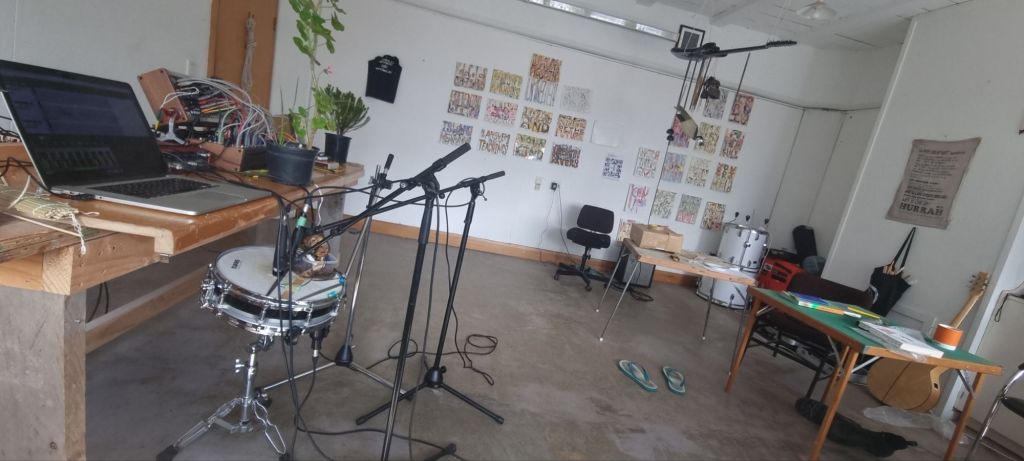
Modular synth, Peace Lily and drum kit set up for recording.
V.M.A recording set up with swinging mic.

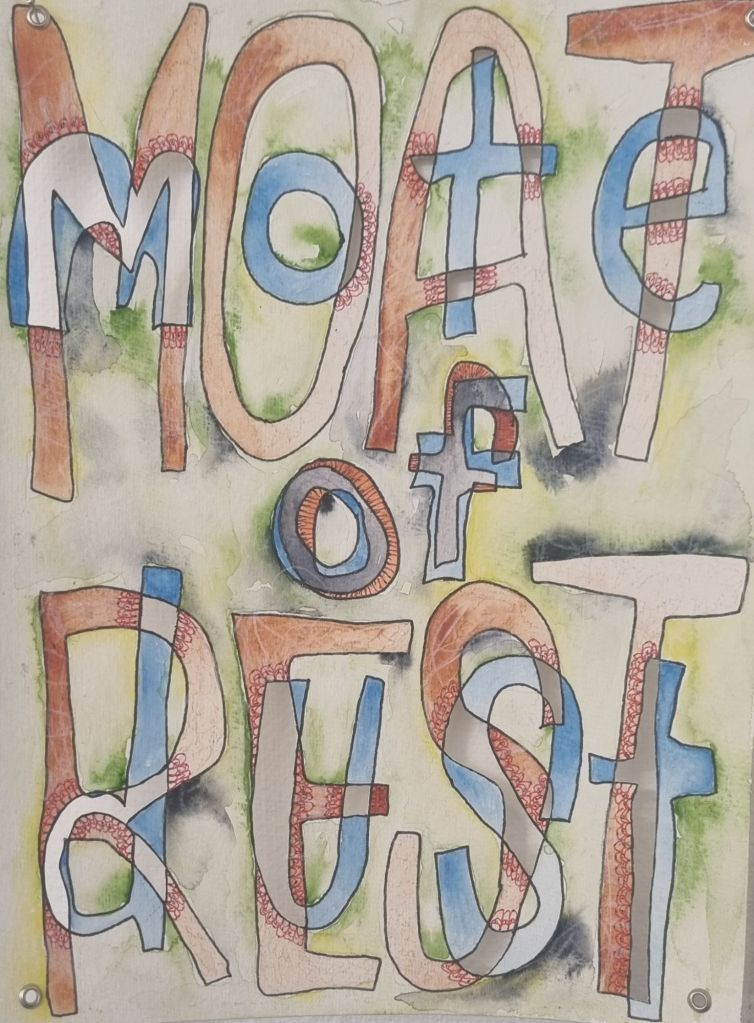
Moat of Rest

Quietly, we go into the week. a lot of sound waves were generated last week, in studio and at shows. Some calm is welcome. There are some practical tasks to complete.

I have been invited to contribute a set of posters for an exhibition, opening in December. The gallery is called Te Atamira, a purpose-built ‘community arts and cultural space’ in Queenstown. I spend Monday figuring out the logistics of hanging when I am unable to assist with the physical installation. I want the posters to have some movement as they hang out from the wall. Hanging/floating parallel to the wall, I want the space between the paper and the surface to contract and expand, but not twist.

Adding structural integrity to the paper

The drawing project developed as an accidental pastime during the DCR residency, November 2023. It was never intended to become a thing. I had just planned to take some paper and paints to doodle in the downtime. I haven’t had the inclination to write big songs like we sung in sterile, committing 3-4-5 words to a piece of paper seemed satisfying enough.

It was a pastime without expectation. I enjoyed scratching out the blockiness of the letters. Abstracted shapes presented themselves when I wrote the second text over the first, I’ve always had a thing for negative space.  I like the vagueness and flexibility of context and interpretation when punctuation is removed. And the chance to just play with colour brought it’s own pleasure.

Many of the phrases came from text that I was reading, descriptors that had extra possibilities tucked inside when lived out of the original context, multiple meanings presenting from a very economic sentence.

This will be the third time I have been able to display publicly this year, not bad for an accident.

And then I became inhabited. The last week or so has been more social than usual. Maybe someone from a bus ride, a cafe, or an audience was feely poorly, perhaps, or maybe not, was harboring a virus that has made me home. Nothing too bad, not CoVID, according to the RAT, but it’s bad enough for me to isolate at home for a few days.

It’s made some space to catch up on the accumulated recordings so far. Re-listening is a time-intensive task that requires a distant objectivity, not always easy to maintain. If listening back is too close to the recording session, then the excitement of the experience can get in the way of discernment. Things that were called mistakes at the time of recording may still sound like errors. With some distance, though, those ‘errors’ may blur into something more inspired, an accident of greater interest. Errors may be hypercritical reflections from a fragile ego. Inspired accidents may be discovered when the ego is belted down firmly in the backseat. These unexpected musical deviations can often be the thing that captures and maintains interest over multiple listens.

Also, ideas start to swirl in relation to the exhibition to be installed in June 2025 at Toi Pōneke. First ideas are not final ideas, but I’m often in a much more comfortable space once I have something to edit. 

DSLB v.m.a setup

Patience for admin has never been a strong streak. When the motivation is brewing, all i want to do is just get on with the doing. However, this unplanned pause from the studio has actually been pretty helpful. For example, I was listening to the collaborated recordings with Chrissie and her DSLB project today. To be honest, I was uncertain about them directly after, I didn’t think my playing was as interesting as it could have been. But on listening today, with a good few weeks in between, I hear new patterns, textures, bursts of interest, and surprise. I have a few more sessions planned to add to this collaboration project. It’s off to a great start.

However,  all that said, I’m over the calm, I’m ready to get back the studio.

Soundbites

  1. Trees roil like kelp in a sea of wind. Birds swim in currents. I wonder, do fish hear the bull-kelp roar? It’s night’s middle, listen to the norwester, crest first, then bear down. Whipping all tall growth that stands above scrub. Every leaf and branch a wood/wind reed. Everything that rattles will. I feel pressure change from an ocean of air inside ears.
  2. Chest Sounds: wheeze, stridor, crackles, rhonchi. rasp, pleural rub. Auscultation – play the skin of drum, hear the resonance and density from percussion. An ear to a wall, listen for the In’s, the out’s, the rate and delay, for wet sounds, other sounds, no sound. Pay attention when Cheyne-Stokes sings, the song of the lungs soon end.
  3. Susurration is a burble in rainfall. It shimmer in choir as puddles, rivers, Oceans return. The chatter of uncountable billions when surface tension meets matter. The blurred accents of drops on wood, earth, tin, skin, wing, and kin. Wet squall murmurate, shift, accommodate the fluid response to gust, current, and eddy. Sleep well inside weathers lullaby.
  4. Guns at the front door of the farmhouse, none in the new home in town. I make a replica of wood. Find a single bullet in the garage. “That’ll look cool”! Make it fit, hit with hammer.                      !Silence!              Mum calling, runs to me, eyes up, I hear Nothing. Absolute Quiet. Did hearing return? Yes. In time to be berated, rightly so, as she digs pellets from skin with a pin.
  5. The night wind has hands, it lifts liberated cans, and throws down the road. Notes are released, tuned into the tin dents from kicks and wheels. Hear patterns: settled, gusts, roll… duk duk duk..duk….duk! Long, flat streets are best. On main drags, like Dee or Don, you could hear extended canned music. If lucky, it echoes. If extra lucky, power poles wire add their voice in unison.

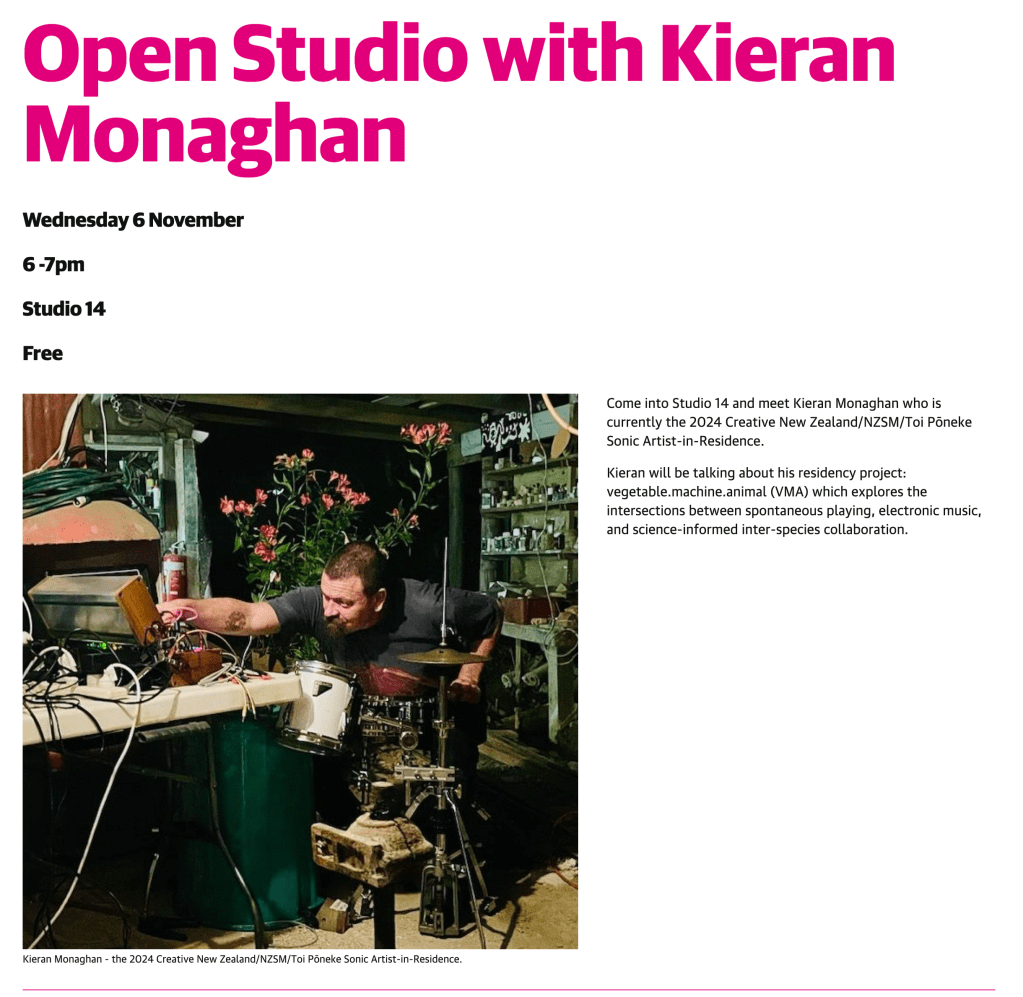
Open Studio: Toi Pōneke

Screenshot of the Toi Pōneke website. Top text: Open Studio with Kieran Monaghan, Wednesday 6 November, 6-7pm, Studio 14, Free.
On the left is a photo of Kieran reaching over his drumkit to make adjustments on the modular synth on the table in front of him. His action bends him towards the left. There is a large flowering plant behind him. The location is in an open, but covered, space at night at the Driving Creek Railway in Coromandel. 
Text on the left of the image says:
Come into Studio 14 and meet Kieran Monaghan who is currently the 2024 Creative New Zealand/NZSM/Toi Pōneke Sonic Artist-in-Residence.

Kieran will be talking about his residency project: vegetable.machine.animal (VMA) which explores the intersections between spontaneous playing, electronic music, and science-informed inter-species collaboration.

Kia ora all. This is an open invite to come and visit me in Studio 14 on Wednesday 6 November, between 6 – 7pm, to check out what Im up to.

I will be happy to offer sound demonstrations of the project at work , discuss questions you might have, be confounded at the same time if I don’t have answers, offer you some kai to nibble. Will be 100% family friendly. Studio 14 is located on the second floor, lift access is available.

FACEBOOK EVENT
Toi Pōneke original LINK

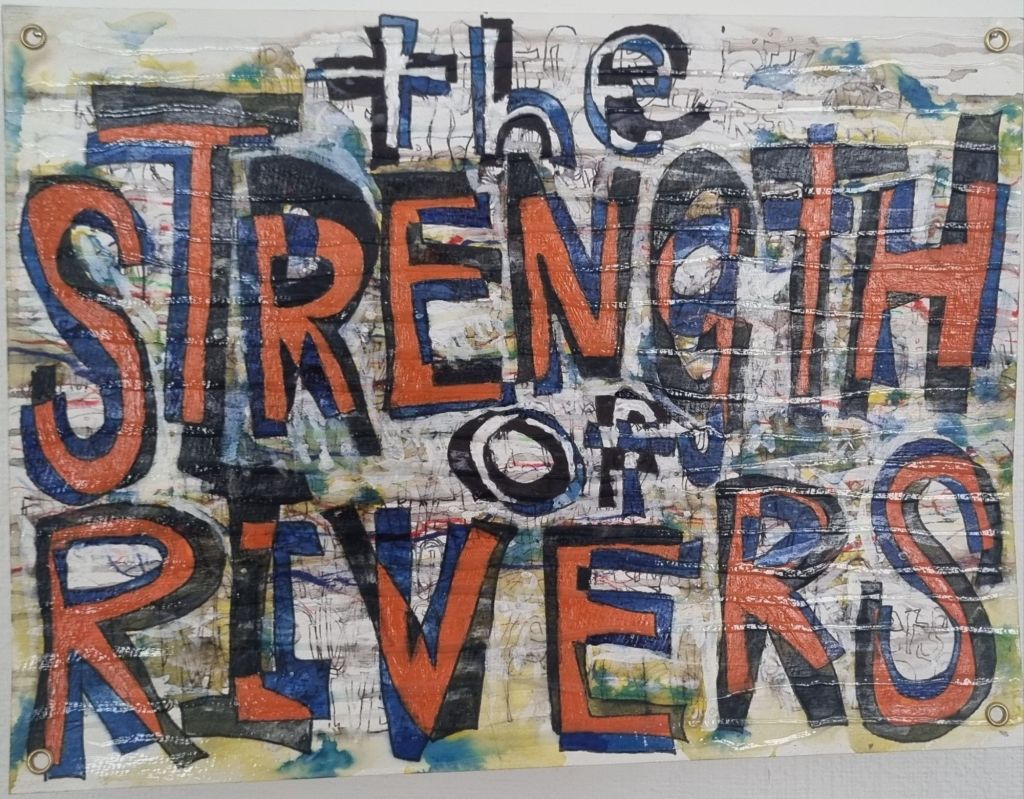
The Strength of Rivers

A picture by Kieran. It says:
the Strength of Rivers.
The words Strength and Rivers are uppercase, in black, orange and blue.
The words the and of, are lower case in blue, black and white.
The background is scratchy, drawn on, and covered-over streaks of ink, splashes of yellow and blue watercolour.
the Strength of Rivers

Life in the little room, on the edge of a city, edge of an island, edge of the Pacific, and on the edge of the big world, has been good this week. Settling-time is past, and my stride is underway. Pieces of music seem to find themselves somewhere near completion. My energies and disposition have found their rhythm in this residency. I treat it like work. I spend the full day working till home time. I have a meal break in the middle of the day for lunch with the staff, when able, like all good unionists.

In the studio paintings are strewn on the table in various stages of dress, notebooks open for spontaneous scratching, piles gather in disheveled messes from previous efforts of image or sound making, sentinels of stands hold cymbals and microphones, others lean against the walls, books on the table open and inviting, there is a rotting Taupata log from home with dried-up fungi, and the Peace Lily is still making its way to flower.

One book of interest this week is the Collected Poems of John Berger. A good friend introduced me to Berger several years ago. He gave me ‘Hold Everything Dear’, a small book containing some of Berger’s essays on his connection with Palestine, among other topics.  The book arrived as a beacon in a personal dark time. And what a rope-ladder Berger has been for me since. By now I have read much of his work. Berger’s ability to strike a light in the bleakest of stories was a story I needed, and still need, to hear.

And in the grass of this rain
flowers
which grew with the strength of rivers
       –o the pockets of the ferryman
        packed with the letters
        silences and promised. numbers
        of those who left!
which grew with the strength of rivers 
into estuaries.

An excerpt from the poem Twentieth Century Storm is one such example from Berger. Like all good poetry, the more I read it, the more I read into it. A reminder that whatever ‘today’ may throw our way, the ‘tomorrow’ is waiting and open. The estuary is not a ‘Me’ moment. It is an ‘Ours’ event.

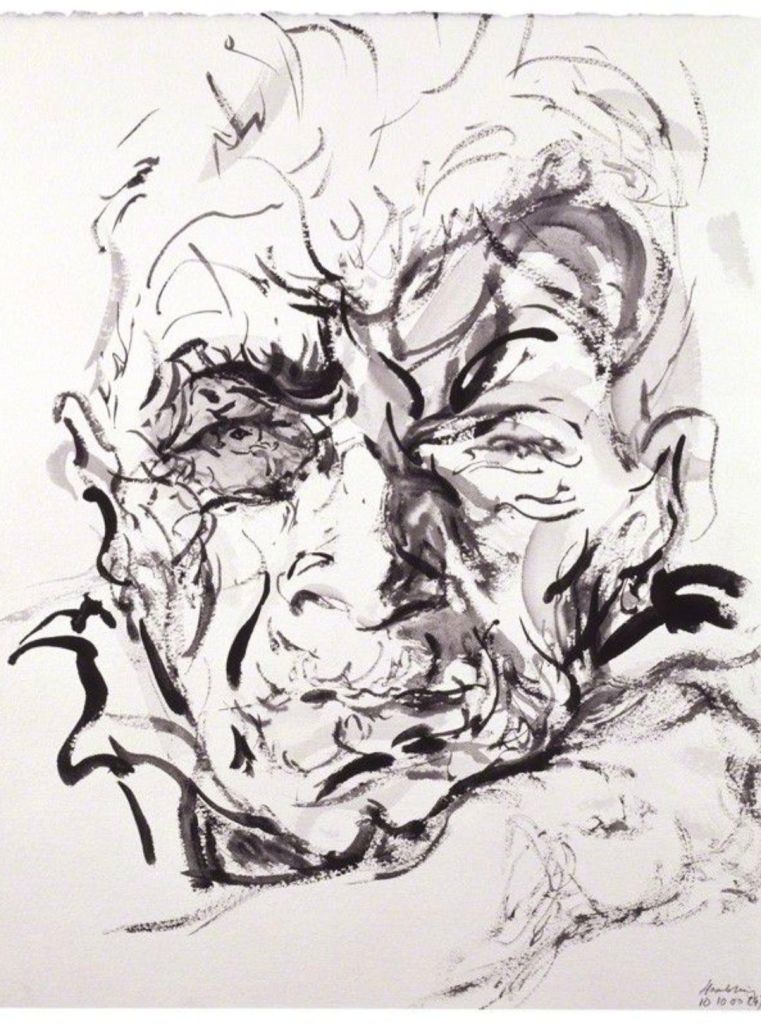
An ink drawing of John Berger, drawn by Maggi Hambling. The lines are very loose, barely scratched onto the paper, there are only a few heavy black lines. But in the lightness of this drawing Bergers intensity stares out at the viewer.
Portrait of John Berger, drawn by Maggi Hambling

Between Me and Ours

A question has bounced around my head since winning this residency. I have been appreciative of the enthusiasm and support given by friends on gaining this privilege. Yet there’s been several times when people have stated, well-meaningly and with the warmest intent, that it is something I “deserve”, that it seems right to have it bestowed upon me in light of what has gone before. 

I really struggle with this idea, of ‘deserving’. I cannot help but think that the opposite of this is that there must be a battalion of ‘others’ that do not deserve it. I know this to be grossly inaccurate. I can rattle off a long list of extraordinary creative people from all walks who would make great use of such opportunities, benefiting both themselves and the communities they work within. I also think it accentuates the cruel myth that those who work hard get their due rewards. Next time you’re in a hospital, ask a cleaner about all the rewards they have gathered for their hard work. Privilege is not evidence of hard work.

False humility is also unattractive. I would be lying to say I am not making the most of this privilege/opportunity. All I can say is that what I think We All Do Deserve is safety from each other, from despots in power playing politics, from ideologies which lift up only themselves while targeting ‘others’, a place to live, a meal to eat, a person to love, a chance to play. We deserve the chance to be curious and explore, the opportunity to be wrong and learn, to dream and escape, to be trusted and responsible. You can add your own suggestion to my incomplete list.

It’s not strange to feel that the Political networks of the current day are doing their best to push one into states of disappear. But the political actors are not a ‘We’, it’s most often a He, acting like Dams would on a river, to obstruct, block, and bottleneck. So where ever you put your energy, whatever your cause for better might be, think of yourself and your crew, your people, your mob and your kin as something in flow towards, to be part of something that grows “… with the strength of rivers into estuaries.”

(Here is something uplifting, an incredible story of water, persistence, and restoration).

I finish the week with two vegetable.machine.animal shows. 

The first is the celebratory afterparty of Wellington Zinefest. An impressively wonderful event with multiple spaces considered and made available so people can access the party in whatever way they find comfortable and welcoming. I play in the main foyer of Trade’s Hall.

The entrance to this beautiful space became infamous in 1981. A suitcase packed with explosives was left at the entrance. It seems likely the intended targets were some of the Union organizations within. However it was the cleaner Ernie Abbott who picked up the suitcase and died in the explosion. The perpetrators were never found.

The second was a fundraiser for the Neil Roberts Memorial Day. Neil Roberts was a punk anarchist who died when the explosives he was carrying detonated at the entrance of the Wanganui Computer as the target, on 18 November 1982.  Located in the city of Whanganui, the computer was the NZ government’s first database of accessible information on citizens, used by police and other surveillance services. His act is seen as a protest against the government’s growing surveillance mechanisms. 

The fundraising show was held at a newish Wellington venue, Underworld, which seems to be comfortable with bands of a noisier and heavier disposition. It was an evening of assertive music in multiple styles, and me and the houseplant.

Picture of kieran on drums, taken from his left side. The venue is the foyer of the Wellington Trades Hall. There is beautiful light on stage, he is leaning back, looking up, maybe eyes closed, as both hands seem to be heading to the snare drum together.
Trades Hall, photo Chrissie Butler

SOUNDBITES

1. The cat on the pillow talks, ‘Feed Me’. I drag the window behind me open and hope she jumps out , just like she does every other morning [or is she pushed?]. The dawn chorus calls into our room, the trees are close, sound-laden with feathered fruits. The doppler of another sound moves slowly through this song. It is a six am flight to somewhere awake.

2. I’m listening to ‘No Title As Of 13 February 2024, 28340 Dead’, the newest album by Godspeed You! Black Emperor. The band lock this piece of their art as a statement on the carnage against the Palestinian civilian population. It confounds me that this music can seem both futile and essential. Music holding hopes and sorrows together, a bit like Berger’s words. 

3. My ears are still asleep. THAT sound upstages somnolence. I am immediately aware of the risk of being breakfast. ThE steady buzz cuts through the blur of early morning. I pull my anxious head undercover. Steady? Mosquito’s can be many things, but steady is not one of them. I hear the buzz again, I listen, realising it’s the whine of the machine grinding coffee beans.

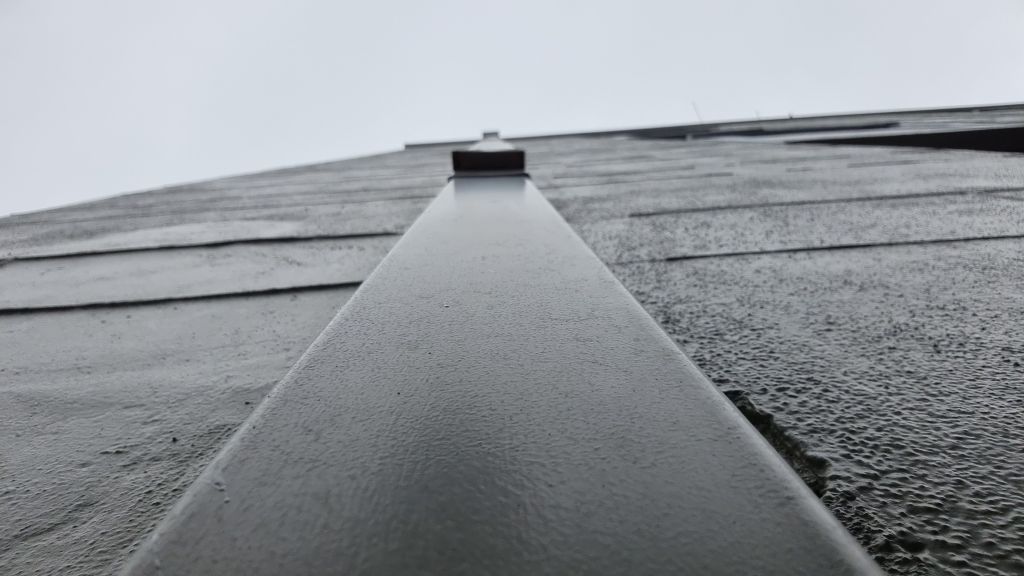
4. I’m holding my phone to the downspout. As if I know where the pipes ears are, and I’m helping it take a call. The rain has only stopped falling outside. Inside, drops descend from the gutter two stories up to percuss at this elbow junction on the way to the drain. This wet military tattoo, the rhythm of rain, is what stopped me in my tracks.

The phone is resting on the pipe of the guttering that goes to the drain. The view is looking up towards the roof, the sky is grey and the rain has just stopped.
Looking up the Downpipe

5. Pull wire till straight. I underestimate the breaking point and fall one step backwards as the pliers and metal separate with sound. Repeat three times, calibrating the effort downwards. I notice a sine wave trapped in shape. I guess the resonance is transferred down the wire, the wave becomes visible when the vibration stops at the jaws of the vice.

Picture of vice with wire in the jaws. The wire is being pull tight, but it snaps in my hands, sending a wave down the length of wire producing a sine wave pattern .

May The Shifting Ground Hold Me Up

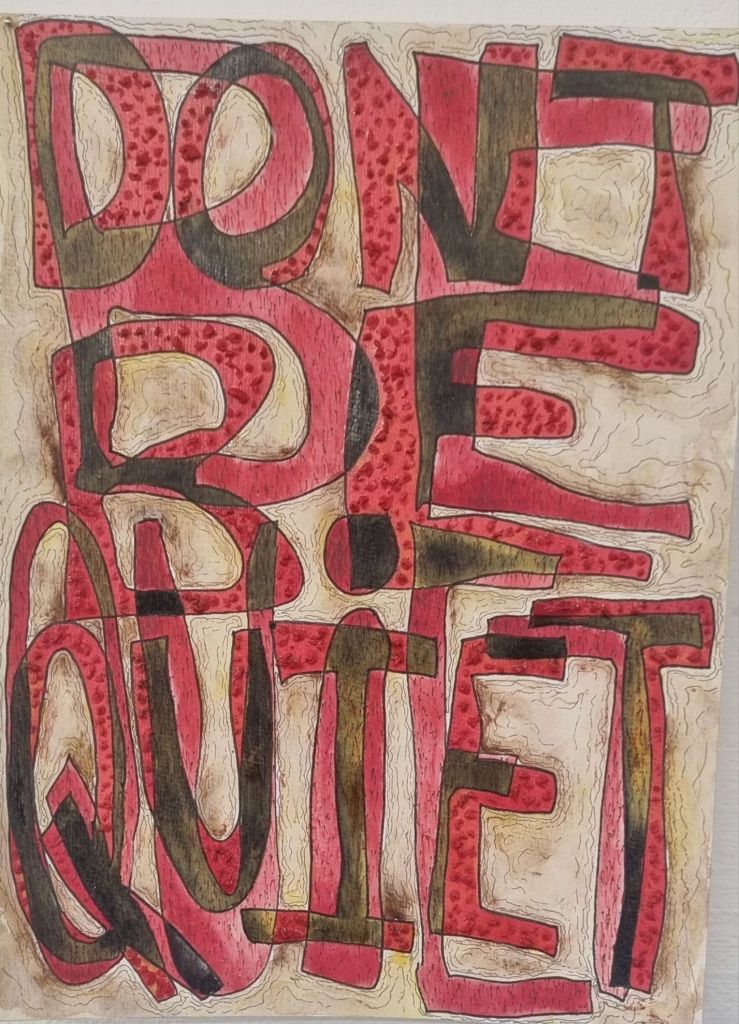
Be Quiet.Don't Be Quiet. 
Taken from a doco on the work and life of artist Ai Weiwei
Be Quiet. Don’t Be Quiet. A response from a doco on Ai Weiwei

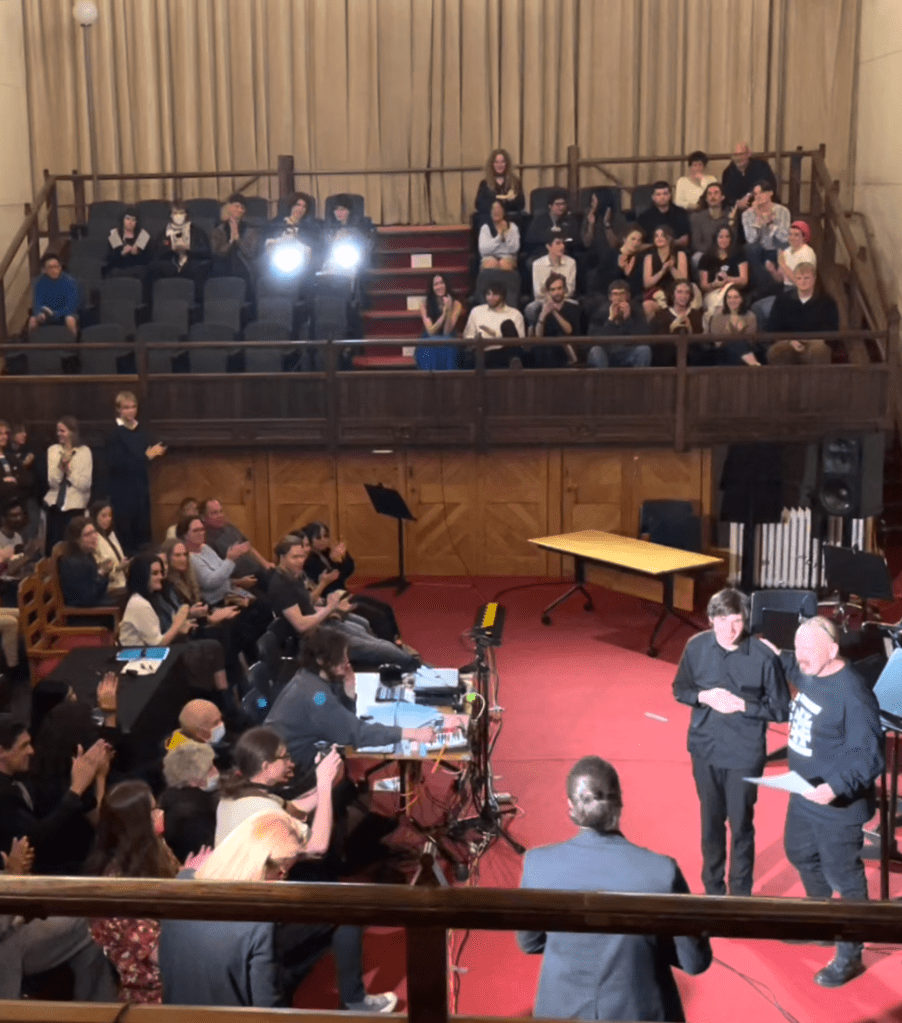
Week three starts on a Saturday. I have been asked to be one of three ‘adjudicators’ for the annual Lilburn Trust NZSM Composers Competition. An adjudicator is a fancy word for judge. I’m to provide insight in determining the pieces of music to receive the annual awards! There are 14 compositions in total, from an array of various university music departments, from classical composition to electronics using AI, from jazz to somber to pop.  The selections have been pre-selected from students at differing stages  of their study.

We are given the scores to the music to read during the performance. I am unable to do this. It’s a skill I’ve never learned, but I am able to listen attentively. The things I rate are: 

  • the aliveness of a performance
  • the interactions between performers
  • the things the performance does to me – what does it evoke?
  • those things that take me by surprise
  • those things that don’t
  • the before’s and after’s of the performance
  • the self-responsibility and consideration of stage management-or lack-there-of
    and
  • does the performance match the text/hype of the program 

I realise my years of gigging and touring have taught me a great lot of skills that may not be so obvious from the academic tradition. Things that I realise are not so considered here.  And I am sure there will be many things I am missing precisely because I have one set of experiential skills instead of an other, more formal, set. The other judges all look at the quality of the script, how the performance adheres to the composition, and how the composition follows certain musical conventions that I am 100% ignorant of.

After hearing the 14, we three have a rapid and robust deliberation deciding on where the awards will go.  Happily, a diverse range of performances are selected, acknowledging technical ability, compositional quality, consideration of stage and space, performance bravery, and adventurousness of the composer. But all the performers and composers are deserving of acknowledging and commendation. My final encouragement would be to keep pushing the boat out!!

Best Performer award to Nathan Parker

There is additional newness for me this week. I have a rehearsal space available now every Tuesday, at Toi Pōneke. These are now my main recording days. They also come with a specific focus on collaboration. I invite Chrissie’s project DSLB in, I am safe in her tolerance as I may need to troubleshoot unexpected technical hiccups.  The main challenge is to ensure that the right technical equipment is on hand to enable the best recording … it seems to be sufficient. To support this, I have access to some nice microphones from the NZSM. It all works perfectly and after a full day of intense playing, we collect two and a half hours of recorded material. 

Near the end of the day, we are both become aware of the fatigue from exertion and concentration. I encourage ‘one more piece’. A lot of sound-ground has been covered. The instruments have been put through the routine of the first familiar and then unfamiliar explorations into sound territories. We both feel a bit spent. But we do it, one more lap around the racetrack. Finishing up, and listening back, what we have hauled in is a lush, atmospheric, angular piece of wonderfulness. it’s going to be exciting to share this work soon.

One of the proposed outcomes of this residency is the making of a V.M.A album. I’ve already done a fair bit of loose, improvised, and searching noodling playing to settle in.  This week a framework has started to appear, a framework from which I can hang ideas for the next 9 weeks and beyond.

Almost all of the albums I have been part of in the past have been made during tight times squeezed in and around the rest of ongoing-life. Having slow time to mull on ideas, to consider structure and dynamics, and to explore with dedicated intention is a new and unfamiliar space; luxurious and wonderful.

This time also presents a confronting opportunity. It says  ‘here is the time, what do you want to say?’. Brevity and seriousness can flatten playfulness and curiosity. Playfulness and curiosity can distract from the serious act of completion. Somewhere in between there is a middle ground, a place that teeters, a foot-in-both-camps space, and a pivot point that never settles into complacent stillness. It is a sweet spot of creative precariousness and I feel confident that for a time on Tuesday, we were visiting that place.

May this shifting ground hold me up.

SOUNDBITES:

  1. The melody is guiding my eyes. I become aware, during the performance, that with each change in the music, so too my gaze alters. I’m look upward as the saxophone goes into the higher register. The higher the note, the higher the view. My vision takes in the floor as the lower notes are blown. It’s as if my eyes alone are dancing. The observation of observing my eyes from the inside.
  2. We wake before the shake. It’s a gut sound, a frequency outside, the house, and our hearing. It is registered in the third-ear of the diaphragm. Guitars bounce on the walls, and the resonance of strings wakes as Richter waves roll through the house. We’re waiting for the next one, with deep and attentive listening in impending silence.
  3. A cafe house-stereo is playing a grandiose metronome. The three on my right are talking, and I’m inadvertently listening in. I think the words are familiar, but doubt suggests that it’s not my tongue they are speaking in. A dialectical similarity, maybe? Maybe from somewhere else? Is it my hearing loss at fault? Or the terrible acoustics?[but excellent for privacy] Maybe it just their enunciation? Maybe it’s none of my business.
  4. As the crow flies, we are as close as 9100kms apart, but you ask, ‘Can you hear the busy street?’ You say next to the alleyway of your home is one of the cities main transport arteries. Also, you say, beneath the path in front of your home, is one of the old cities canals. ‘Can we hear it?’ I can hear my belly rumble for dinner, while, perhaps, yours is sleeping just after lunch. This time next year, we will be Here. Then we shall hear.
  5. The flue of the fireplace is becoming a home for a bird. Claws, like a record players’ stylus, resonating on the circular stainless steel. Each morning, during coffee, we hear its movement. When we move, it stops. Perhaps the chimney acts as a two-way telephone, like old tin cans and string. Or an early-warning stethoscope into our room, alerting the blackbird of downstairs-action. It’s a precarious position to bring kin into the world. We will now be avoiding fires while DJ Blackbird scratches around up top.
The Chimney minus bird