The Physics of the Swing

“How do you stop the paper twisting?”, he asks.

It’s something I’ve been thinking about for a while as I prepare some pictures for an exhibition. I want them to float off the wall, hanging from each other at 40mm distance, and have a breath-like flutter. Flutter is not the right word, I’m after a rigidity of movement, something like an articulation. If the paper is too paperly and the connections are lightweight, then the overall assemblage twists. I want to be able to dictate the physics of the swing.

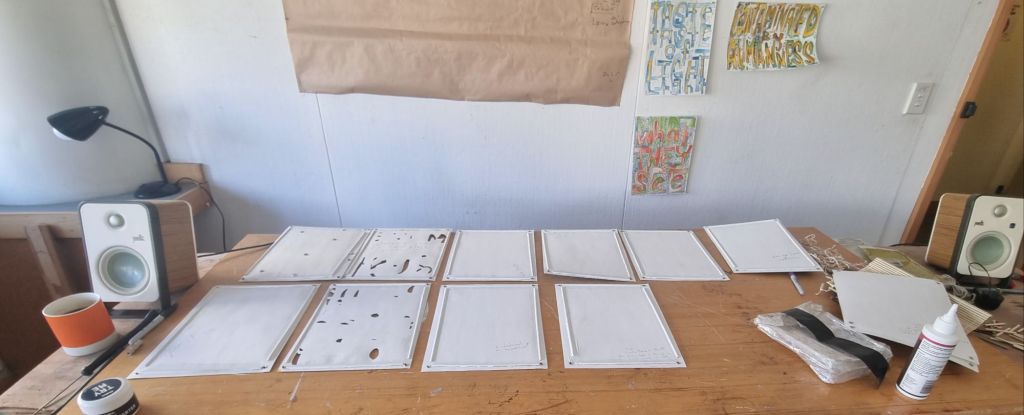
The architecture of the paper needs to be bolstered. On the back of the sheets, disassembled bamboo mats become the near- invisible framing. For the pictures to hang from each other, I make something like a big staple from sturdier wire, which has less intrinsic movement. These are then spray painted with a bright orange to light the mood of its weightiness. It achieves what I’m looking for.

Tuesday. I can not make it work. I’ve spent the last 90 minutes trudging this equipment downstairs, setting it up to record, and now nothing. Has it been damaged it in the move? Why is that always the first thought? It was working fine before but now only silence. For 10 minutes, all the lights have been flashing like a trashy disco, but not a peep of sound. Check cables, sensors, connections, and power supplies. I look for the obviously simple reasons before catastrophising options arrive. 

However, the answer to this issue is simpler. It appears that the fungi are withholding their signals. Sleepy fungi. I spray a bit of water onto the mushrooms. The moisture improves the transfer of signal-to-sensor. I reconnect the sensors to the damp flesh and sound bursts into life, with life, from life. 

I’ve made this mistake before.

In the beginning, before this project was a project, I had no idea what a modular synthesizer was. When my first modules arrived, I could not make them work. I leaned on the wisdom of Issac, the only person I knew locally who was informed about such arcane things. He generously lent me gear and knowledge.

Perhaps it was during the second ‘lesson’.

Isaac came over home one evening. Huddling over the equipment, watching closely as he looked skillful in his extraction bleeps and bloops of sound. We were completely focused on the machinery. At some point, though, without obvious reason, sound stopped. I watched on as Issac problem-solved – checking cables, connections, etc. He appeared mystified, I was beyond lost and unable to help. Some inkling prompted him to poke the plant. Then, as if re-energised, sound returned. Should I anthropomorphize the moment, I would think it was the plant playing tricks on us, going, “Oi!! … I’m here as well, get your head out of your geek, and pay attention!!” Such rude foliage. But it’s got a point.

This was a small act of relearning, of where ‘else’ to place attention and consideration. That it needs to be in more places than one. How often do I need to be reminded that invisible things have influence? The world is haunted by unseen things and their own connections. We are at the mercy of the obscure and opaque.

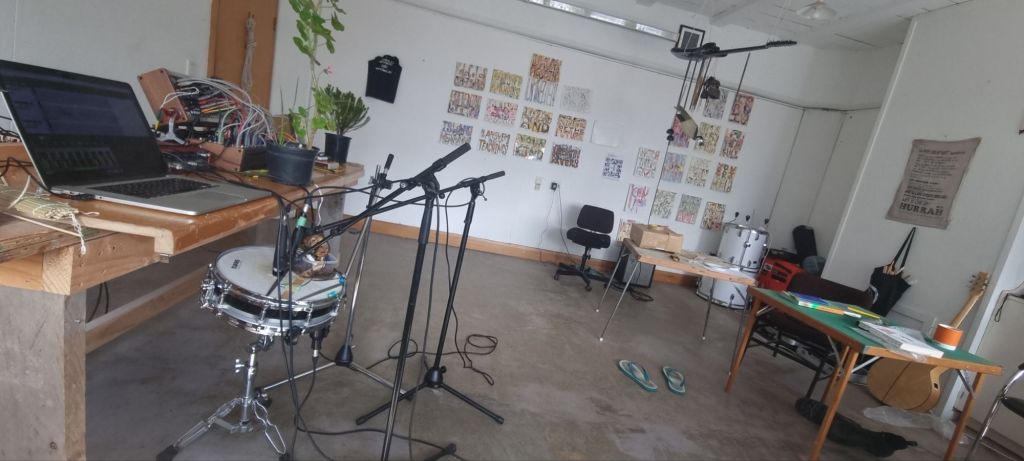
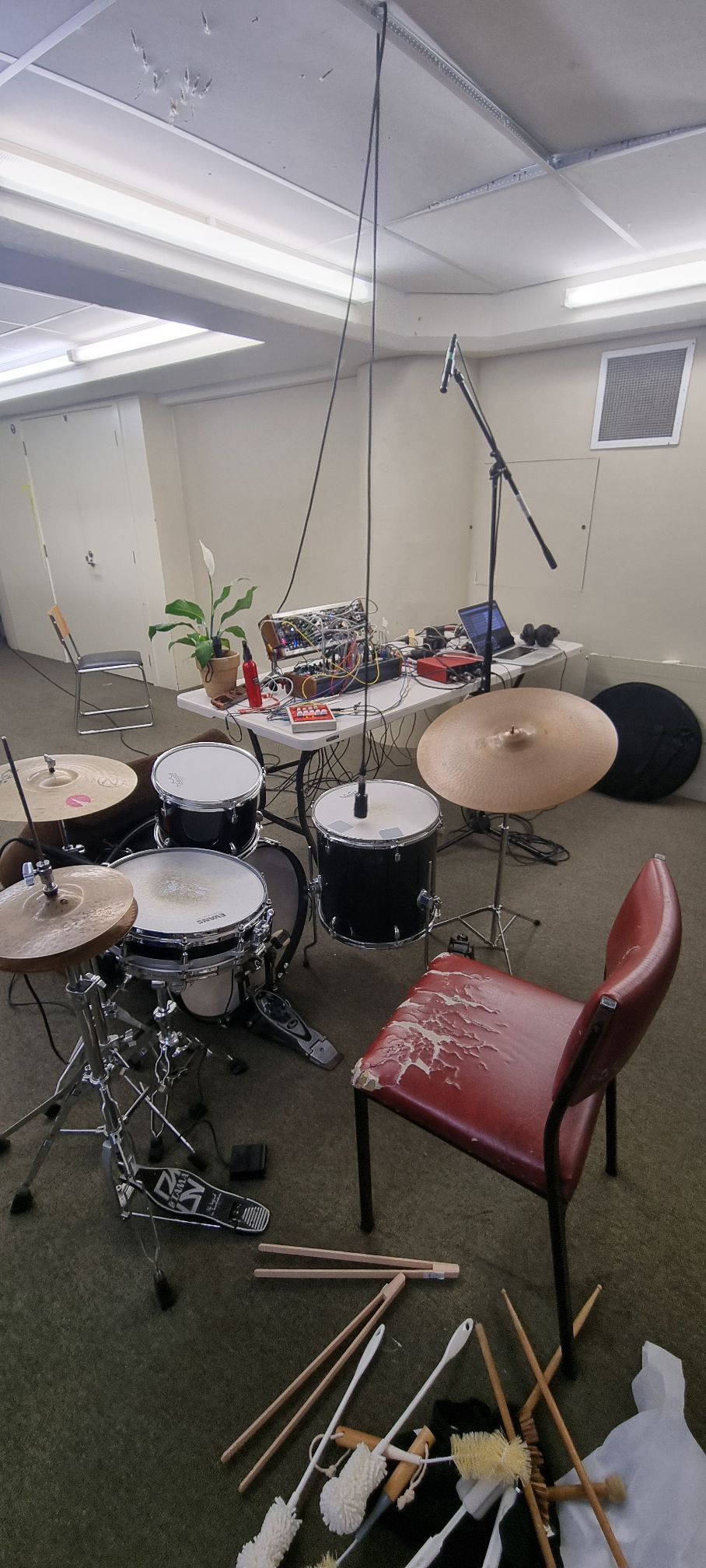
Back to Tuesday. With the sound issues resolved, I set about re-recording a piece from last week. I didn’t have enough microphone stands, so I dangled cables from the aluminum framing holding up the suspended ceiling. I suspended two microphones, one over the rack tom and the other over the floor tom. If I clumsily bump the mic, it will start to swing over the drum. The movement of the mic collected the sounds emanating from the skin as it approached, traveled across, and departed from the drum as it swung through its arc.

I realise I can use this clumsy action with good effect. I reset the mics over the drums and let them swing.  I press record and capture the movement in action. Timing, linked with tempo, are cornerstones in the act of metronomic drumming.  But in this instance, the timing is determined by the physics of the swing. As momentum diminishes from the swings’ natural reduction in distance, there is an audible increase in frequency of the beats.  I record several takes this way, using different mics and drums, building up a set of tracks that feels like it has some sort of regularity. I know it doesn’t.

[Later the Youtube algorithm shows me a piece of music by musician Steve Reich. He had used microphones in the same way but over guitar amps, playing with the feedback. I think I like my version more.]


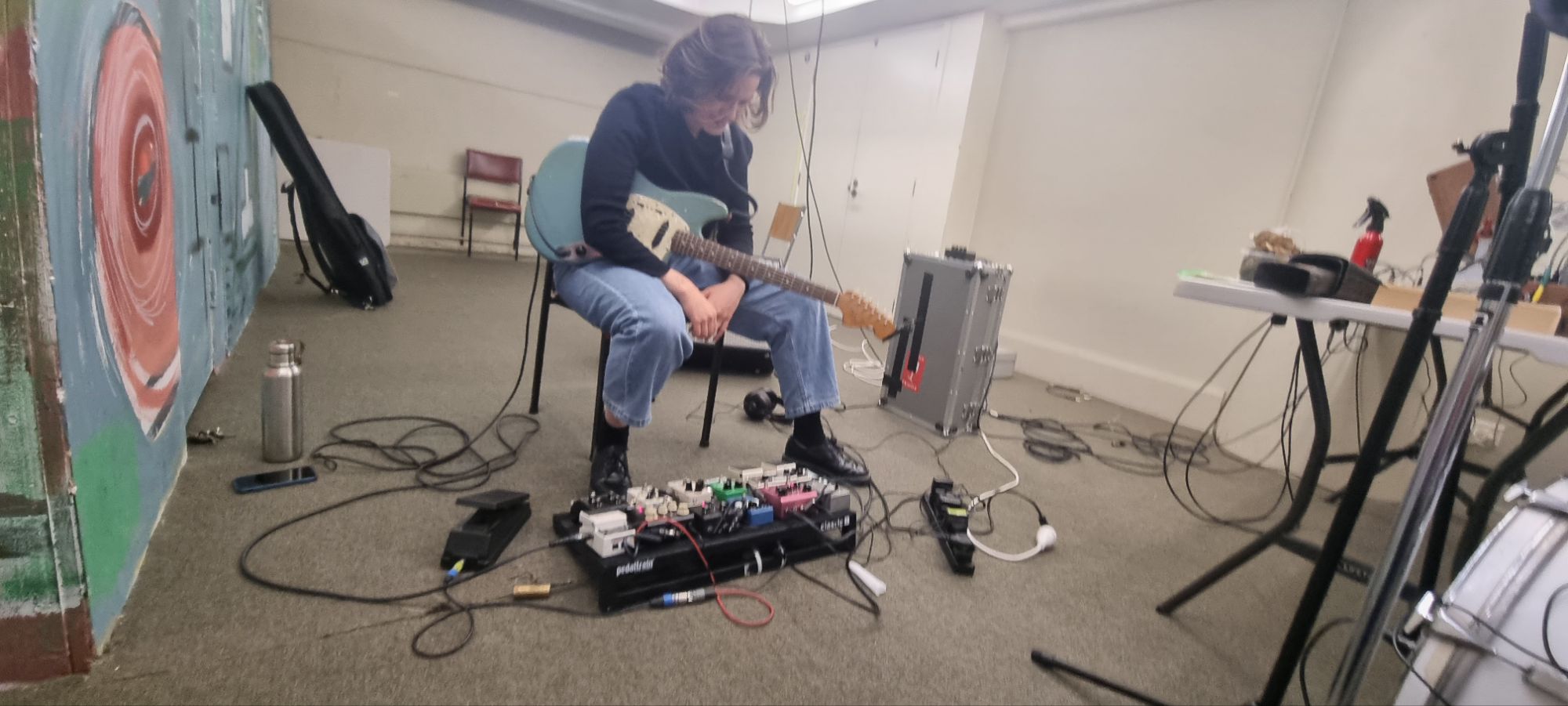
In the afternoon I’m joined by visual and sound artist and guitarist Gemma Thompson. Gemma is also a regular inhabitant of Toi Pōneke. We have only recently met. We have chatted a couple of times in the kitchen, and have never heard of each others’ music, other than a short clip she played to me from her phone of a recent concert. It is an interesting way to meet someone through sound rather than words. There is a confidence required to be able to let go in the company of a stranger, the urge to self-censor, and self-limit can hobble opportunities like these. It’s a good practice to work against these things.

I host an open studio on Wednesday evening. It’s an open invitation to present the current work-in-progress. And I get to demonstrate how the machine/plants work together. I am both surprised and heartened at the number of people who come through. There seems to be genuine interest in the project,  and many are willing to take part in the chance to interact with sound making. 

One demonstration that gathers attention is where I place one sensor onto the plant/fungi and the other onto a persons’ finger. No sound is made until the circuit is closed by the person with the sensor connecting with the plant. We expand this by bringing in extra people, as long as they hold hands with the person connected to the sensor and the person at the end of the line touch the plant/fungi. It’s possible to hear audible changes in the sound from this bigger loop. Sometimes, it seems to take a little longer for sound to register, and the rapidity of the signal changing seems slower. But there seems to be something awe-inspiring for people when they have the chance to become part of an organic loop, part of a connection that makes this sound. It is almost as if the connection is more important than the aesthetic.

The week wraps up with a lichen-influenced mechanism playing metal chopsticks on a snare drum. It was a useful distraction as the swing states gave Trump his victory. So much had been written already with an air of certainty about what will come.  I’m no soothsayer, I’m making no predictions. I trust the fact that Trump is not breaking the rules of physics. Negative does not exist in a vacuum. For there to be a negative-in-charge, somewhere there exists a positive.  I’ve no idea what it is. It seems invisible. But if I must remind myself of one thing, it is that the invisible also has influence, and most things deemed certain never are.

SOUNDBITTEN:

  1. One door over, a Kango hammer bites into concrete. A metal tooth drumming on the solidity of the wall, intermittent in attack, dusty in effect. It has a jangle in it’s voice, bells chime as the engine powers up. Another machine over another fence chews into spring grass. It’s a two-stroke throatiness, undulating in pitch, as it works against the resistance of rapid weeds.
  2. A bird sings twice. First from the bough high up in the Eucalyptus, air astringent with fragrance. The second as the echo returns from the bricked house opposite. The quickest reverb. Sharp like a smell, piercing to the ear like molecules to the nose. Reminds me of a text that says the smell of fresh cut grass is, in the language of the garden lawn, screaming.
  3. The show was over 20 years ago. I’d been to plenty that had left my ears ringing in the past, it usually stops after two or three days. Not this time. Loud laptops, pure digital tone, my drums in the crosshairs of the P.A. I hear it now. I’ve got strategies to cope with the constant background sound. Stress is a volume knob, a red flag, a siren’s call to attend to some inner need if the ringing starts screaming.
  4. There were only partitions between the bed bays in the long corridor that slept 80. Mine is next to the Dorm master’s door. No privacy. No quiet space. Lights out. I would hide the walkman undercovers, listen to the Sex Pistols on headphones. Lights on. Dorm master had me on display to all, getting six of the best for my sonic indiscretion. It won’t stop me.
  5. I make mixtape for road trips in the car, all the favorite songs in one place. Pack the kids and go south for summer. Along the coast, the song Motorhead comes on. At the same time, kid 2 throws up. We stop, clean up, and carry on. Down the road Motorhead returns. And like an allergic reaction, kid 2 throws up again. Stop, clean up, put the tape away, and carry on.

The Floor Holds

Somewhere in my post-viral fuzziness, I lose all my keys to all the doors I need to open. Later, I make so many trips up and down the stairs because I forget one thing after another. I am not fastidious enough when plugging cables into boxes and discover later that I have recorded one channel of audio and one channel of silence. I tell myself to be careful with the marker while doing measurements around the pictures, a purple line glaringly appears unwelcome in a margin. I download some footage I captured to make a video, I manage to lose it all in the process, and only realised after I had deleted from my photo. Argh!

That’s how a week starts. Small and inconsequential irks when held in comparison to the big issues of the day.  In a doubtful moment, I ask, “What is this for?” “What does my art add in the scheme of things?” In a world of fear, anxiety, murder and massacre art can seem like a folly, a luxury, a something that’s “nice-to-have” as one politician recently spewed.

It makes me ask of myself:

  • What ways should I think about what Im doing?
  • Am I making escapism? 
  • Am I making something that helps me/we/us step outside of the pressures of the practical issues of today? 
  • Is my thinking captured or critical? 
  • Am I making something in context or am I decontexturalizing? 
  • Am I making a brand? 
  • Am I making something meaningful or grandiose? 
  • What do I think now that that gatekeeping position has shifted?
  • What in my work addresses the bread and butter issues of the day?

Big naval gazing questions. In fact sometimes the only response to questions such as these is a big ‘Fuck it and Fuck Off’. They have a time and a place. But if it’s inertia they create then it’s not welcome. A reflective pause is different from the dead air of being inert.

The last post contained a photo of the Bread and Puppets manifesto. I hadn’t really thought too hard about why I added it other than I think the words are good. Today, I think differently. It states ‘Art soothes pain, Art fights against War & Stupidity, Art is like good bread, Art is like green trees’.

Art is like Green Trees. It makes something that makes it easier to breathe. 

It amazes me how easily something so ephemeral can remind us that we CAN imagine something different, sweeter, better, and fully welcoming. Everything constructed we see starts in the imagination. If it can be thought of, then it can be done. The algorithm of feeds, the corralling of ‘If-it-bleeds-it-leads’ news reporting, the shouting of opinionated anybodys online sucking up airspace, and the limitations of the corporate storytellers shut down the notion that the world remains full of options, opportunities and alternatives. Here we say, “Fuck it and Fuck off!”

Dunedin, 1988

I think of my own experience. Music has always made sense to me, captured and captivated me. It ‘spoke’ to me before I could speak for myself or even figure myself out. It gave me a hand up when I needed help. If you knew the young adolescent me you would have known I was trouble, or trouble was on its was to find me. But music gave me an option. In fact, I think music gave me my first real confidence. When my own mental world was at it’s bleakest, most slippery, I could always find some purchase in some musical expression to grasp. 

And I would never meet the makers of these sounds. Or in some random rare and precious moment I might. But on the whole they would never, ever, know the tiny but deeply meaningful impact they installed in this small life. And the way we obsess about things like bands, books, and such, I’m feeling confident that it happens all over the place, all the time. Small individual acts of making things better. That’s a gift to give. So massive thanks, love, applause and appreciation to all those, everywhere, who give without expectation of return.

If you’re a maker, keep making! 

Soundbites:

  1. Clocks! I hear clocks. The kind with hands and mechanisms making noise. Big ones. Ticking away in seconds. They sound close, overhead, omnipresent, inside my head. Your poor house has no clocks like these. There’s a timekeeper on the oven only. I am being haunted by time, hallucinating time, imaging time as if it were there. It’s just the solvent talking.
  2. Listen back to recording, time wobbles. A snare hit’s untidy. Out of Time. I demand the snare’s attention! To human time. Timed time. My Time. But here’s the But. What did I hear that threw my strike? Distracted tight time? Mmpatient time? Glide time. I listen to something in its Own time. Can I be brave and accept organic time? Messy time? Not My-time.
  3. Sounds like the ocean. The wet is beer and sweat. I am driftwood on a wave in a moshpit. Together it’s both dangerous and safe. I look for the band. I’ve lost the song. I cannot tell where we are or what comes next. Beats flails after beats. The bass is a weighted blanket. The guitar is the Cheshire Cat’s grin. The music holds me. It is ferocious and full of smiles.
  4. She listens small. There’s something inside it. A fragment of action, a shout from friction. If she can find the start, that doesn’t exist, and the end, that doesn’t exist, she will have made something that does exist. And repeat. Turn fractal into pattern, turn figment into rhythm. Something that was not there. But she could hear it, she just needed to find it. Here it is.
  5. I fell in love with Foley through Star Wars. I saw a demonstration of how the sounds of stormtrooper blasters was made. Somewhere in a desert, large pylons were anchored with cables, securing them to the earth. Hit the wound steal, cymbals made of metal strings. Zap! The ordinary everydayness of things became the sounds of the future.
Modular synth, Peace Lily and drum kit set up for recording.
V.M.A recording set up with swinging mic.

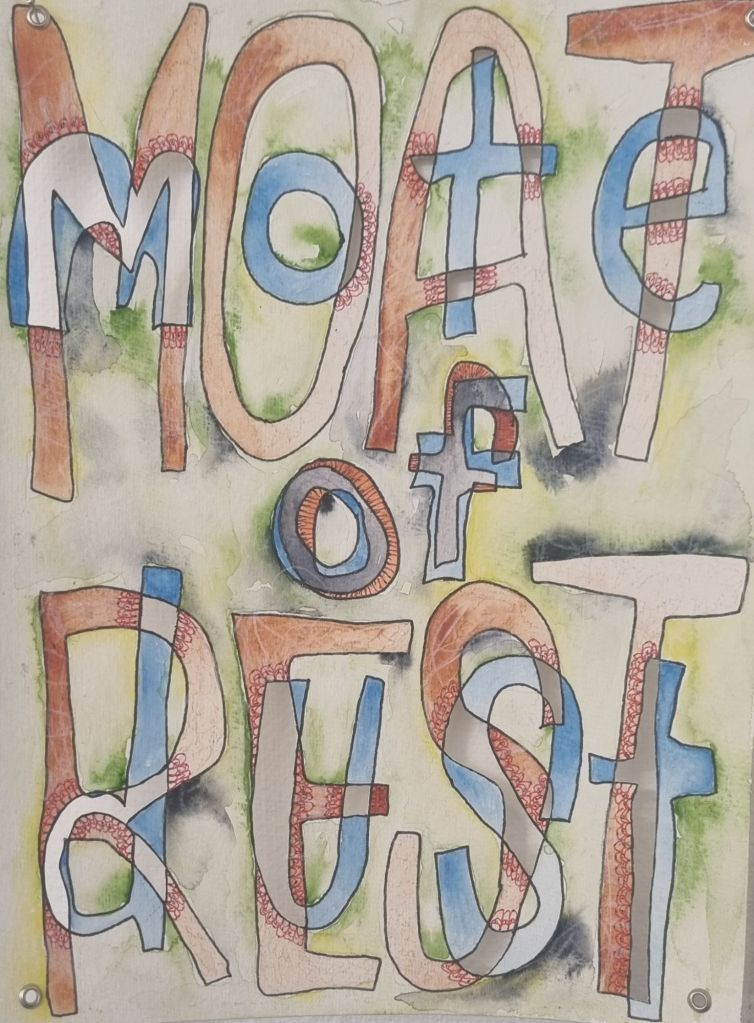
Moat of Rest

Quietly, we go into the week. a lot of sound waves were generated last week, in studio and at shows. Some calm is welcome. There are some practical tasks to complete.

I have been invited to contribute a set of posters for an exhibition, opening in December. The gallery is called Te Atamira, a purpose-built ‘community arts and cultural space’ in Queenstown. I spend Monday figuring out the logistics of hanging when I am unable to assist with the physical installation. I want the posters to have some movement as they hang out from the wall. Hanging/floating parallel to the wall, I want the space between the paper and the surface to contract and expand, but not twist.

Adding structural integrity to the paper

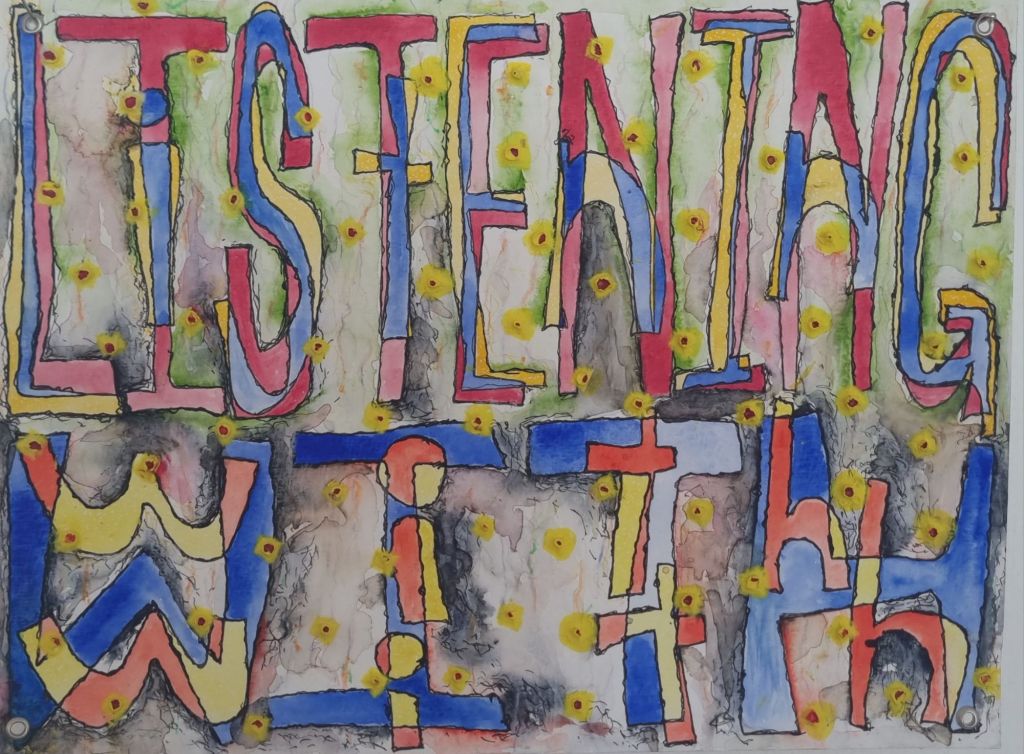
The drawing project developed as an accidental pastime during the DCR residency, November 2023. It was never intended to become a thing. I had just planned to take some paper and paints to doodle in the downtime. I haven’t had the inclination to write big songs like we sung in sterile, committing 3-4-5 words to a piece of paper seemed satisfying enough.

It was a pastime without expectation. I enjoyed scratching out the blockiness of the letters. Abstracted shapes presented themselves when I wrote the second text over the first, I’ve always had a thing for negative space.  I like the vagueness and flexibility of context and interpretation when punctuation is removed. And the chance to just play with colour brought it’s own pleasure.

Many of the phrases came from text that I was reading, descriptors that had extra possibilities tucked inside when lived out of the original context, multiple meanings presenting from a very economic sentence.

This will be the third time I have been able to display publicly this year, not bad for an accident.

And then I became inhabited. The last week or so has been more social than usual. Maybe someone from a bus ride, a cafe, or an audience was feely poorly, perhaps, or maybe not, was harboring a virus that has made me home. Nothing too bad, not CoVID, according to the RAT, but it’s bad enough for me to isolate at home for a few days.

It’s made some space to catch up on the accumulated recordings so far. Re-listening is a time-intensive task that requires a distant objectivity, not always easy to maintain. If listening back is too close to the recording session, then the excitement of the experience can get in the way of discernment. Things that were called mistakes at the time of recording may still sound like errors. With some distance, though, those ‘errors’ may blur into something more inspired, an accident of greater interest. Errors may be hypercritical reflections from a fragile ego. Inspired accidents may be discovered when the ego is belted down firmly in the backseat. These unexpected musical deviations can often be the thing that captures and maintains interest over multiple listens.

Also, ideas start to swirl in relation to the exhibition to be installed in June 2025 at Toi Pōneke. First ideas are not final ideas, but I’m often in a much more comfortable space once I have something to edit. 

DSLB v.m.a setup

Patience for admin has never been a strong streak. When the motivation is brewing, all i want to do is just get on with the doing. However, this unplanned pause from the studio has actually been pretty helpful. For example, I was listening to the collaborated recordings with Chrissie and her DSLB project today. To be honest, I was uncertain about them directly after, I didn’t think my playing was as interesting as it could have been. But on listening today, with a good few weeks in between, I hear new patterns, textures, bursts of interest, and surprise. I have a few more sessions planned to add to this collaboration project. It’s off to a great start.

However,  all that said, I’m over the calm, I’m ready to get back the studio.

Soundbites

  1. Trees roil like kelp in a sea of wind. Birds swim in currents. I wonder, do fish hear the bull-kelp roar? It’s night’s middle, listen to the norwester, crest first, then bear down. Whipping all tall growth that stands above scrub. Every leaf and branch a wood/wind reed. Everything that rattles will. I feel pressure change from an ocean of air inside ears.
  2. Chest Sounds: wheeze, stridor, crackles, rhonchi. rasp, pleural rub. Auscultation – play the skin of drum, hear the resonance and density from percussion. An ear to a wall, listen for the In’s, the out’s, the rate and delay, for wet sounds, other sounds, no sound. Pay attention when Cheyne-Stokes sings, the song of the lungs soon end.
  3. Susurration is a burble in rainfall. It shimmer in choir as puddles, rivers, Oceans return. The chatter of uncountable billions when surface tension meets matter. The blurred accents of drops on wood, earth, tin, skin, wing, and kin. Wet squall murmurate, shift, accommodate the fluid response to gust, current, and eddy. Sleep well inside weathers lullaby.
  4. Guns at the front door of the farmhouse, none in the new home in town. I make a replica of wood. Find a single bullet in the garage. “That’ll look cool”! Make it fit, hit with hammer.                      !Silence!              Mum calling, runs to me, eyes up, I hear Nothing. Absolute Quiet. Did hearing return? Yes. In time to be berated, rightly so, as she digs pellets from skin with a pin.
  5. The night wind has hands, it lifts liberated cans, and throws down the road. Notes are released, tuned into the tin dents from kicks and wheels. Hear patterns: settled, gusts, roll… duk duk duk..duk….duk! Long, flat streets are best. On main drags, like Dee or Don, you could hear extended canned music. If lucky, it echoes. If extra lucky, power poles wire add their voice in unison.

Open Studio: Toi Pōneke

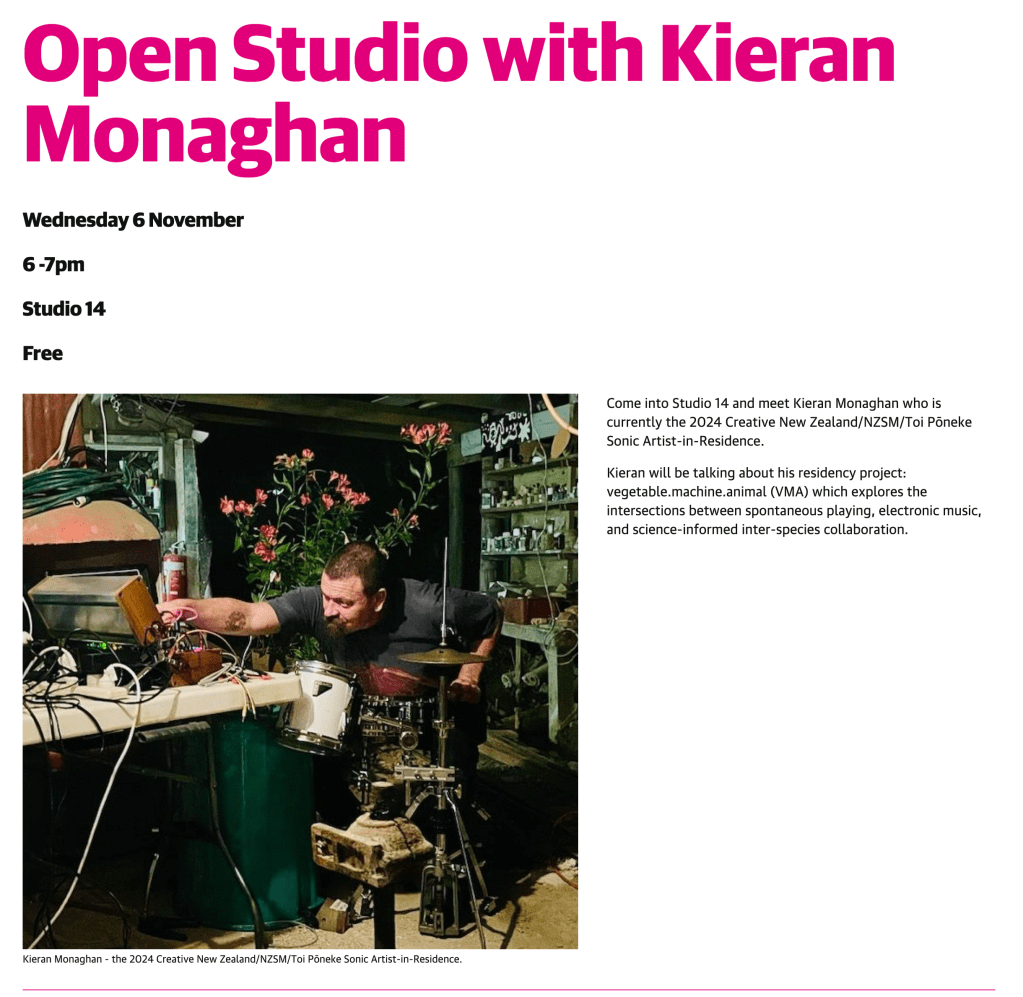
Screenshot of the Toi Pōneke website. Top text: Open Studio with Kieran Monaghan, Wednesday 6 November, 6-7pm, Studio 14, Free.
On the left is a photo of Kieran reaching over his drumkit to make adjustments on the modular synth on the table in front of him. His action bends him towards the left. There is a large flowering plant behind him. The location is in an open, but covered, space at night at the Driving Creek Railway in Coromandel. 
Text on the left of the image says:
Come into Studio 14 and meet Kieran Monaghan who is currently the 2024 Creative New Zealand/NZSM/Toi Pōneke Sonic Artist-in-Residence.

Kieran will be talking about his residency project: vegetable.machine.animal (VMA) which explores the intersections between spontaneous playing, electronic music, and science-informed inter-species collaboration.

Kia ora all. This is an open invite to come and visit me in Studio 14 on Wednesday 6 November, between 6 – 7pm, to check out what Im up to.

I will be happy to offer sound demonstrations of the project at work , discuss questions you might have, be confounded at the same time if I don’t have answers, offer you some kai to nibble. Will be 100% family friendly. Studio 14 is located on the second floor, lift access is available.

FACEBOOK EVENT
Toi Pōneke original LINK

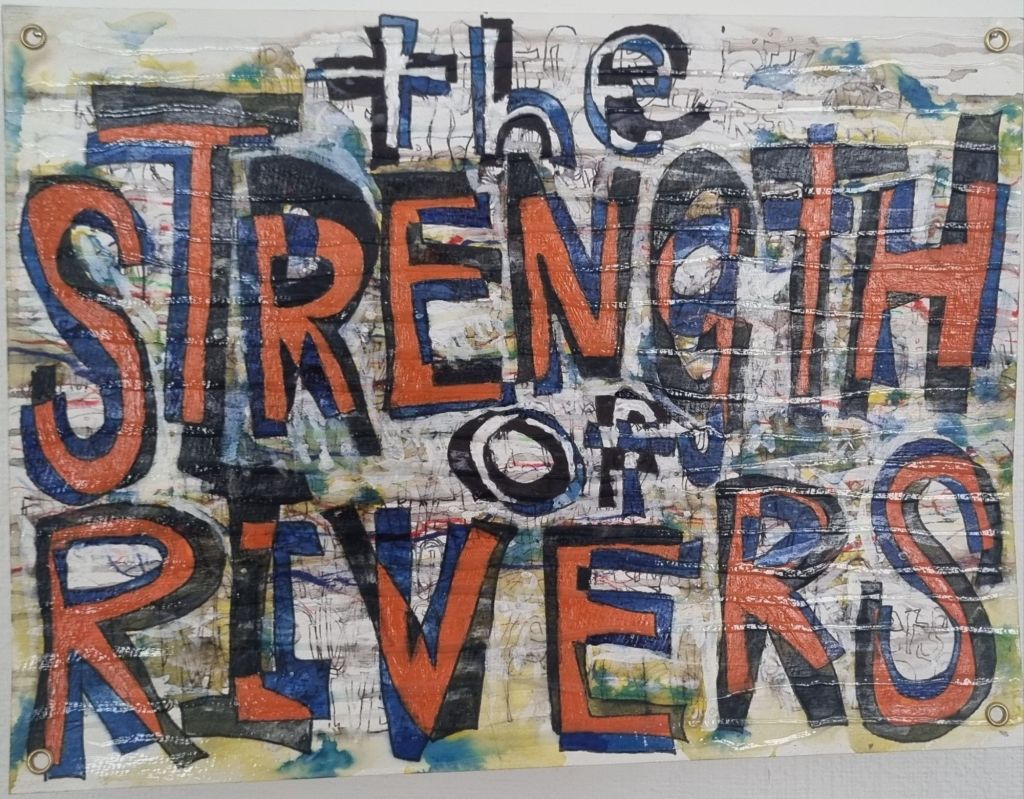
The Strength of Rivers

A picture by Kieran. It says:
the Strength of Rivers.
The words Strength and Rivers are uppercase, in black, orange and blue.
The words the and of, are lower case in blue, black and white.
The background is scratchy, drawn on, and covered-over streaks of ink, splashes of yellow and blue watercolour.
the Strength of Rivers

Life in the little room, on the edge of a city, edge of an island, edge of the Pacific, and on the edge of the big world, has been good this week. Settling-time is past, and my stride is underway. Pieces of music seem to find themselves somewhere near completion. My energies and disposition have found their rhythm in this residency. I treat it like work. I spend the full day working till home time. I have a meal break in the middle of the day for lunch with the staff, when able, like all good unionists.

In the studio paintings are strewn on the table in various stages of dress, notebooks open for spontaneous scratching, piles gather in disheveled messes from previous efforts of image or sound making, sentinels of stands hold cymbals and microphones, others lean against the walls, books on the table open and inviting, there is a rotting Taupata log from home with dried-up fungi, and the Peace Lily is still making its way to flower.

One book of interest this week is the Collected Poems of John Berger. A good friend introduced me to Berger several years ago. He gave me ‘Hold Everything Dear’, a small book containing some of Berger’s essays on his connection with Palestine, among other topics.  The book arrived as a beacon in a personal dark time. And what a rope-ladder Berger has been for me since. By now I have read much of his work. Berger’s ability to strike a light in the bleakest of stories was a story I needed, and still need, to hear.

And in the grass of this rain
flowers
which grew with the strength of rivers
       –o the pockets of the ferryman
        packed with the letters
        silences and promised. numbers
        of those who left!
which grew with the strength of rivers 
into estuaries.

An excerpt from the poem Twentieth Century Storm is one such example from Berger. Like all good poetry, the more I read it, the more I read into it. A reminder that whatever ‘today’ may throw our way, the ‘tomorrow’ is waiting and open. The estuary is not a ‘Me’ moment. It is an ‘Ours’ event.

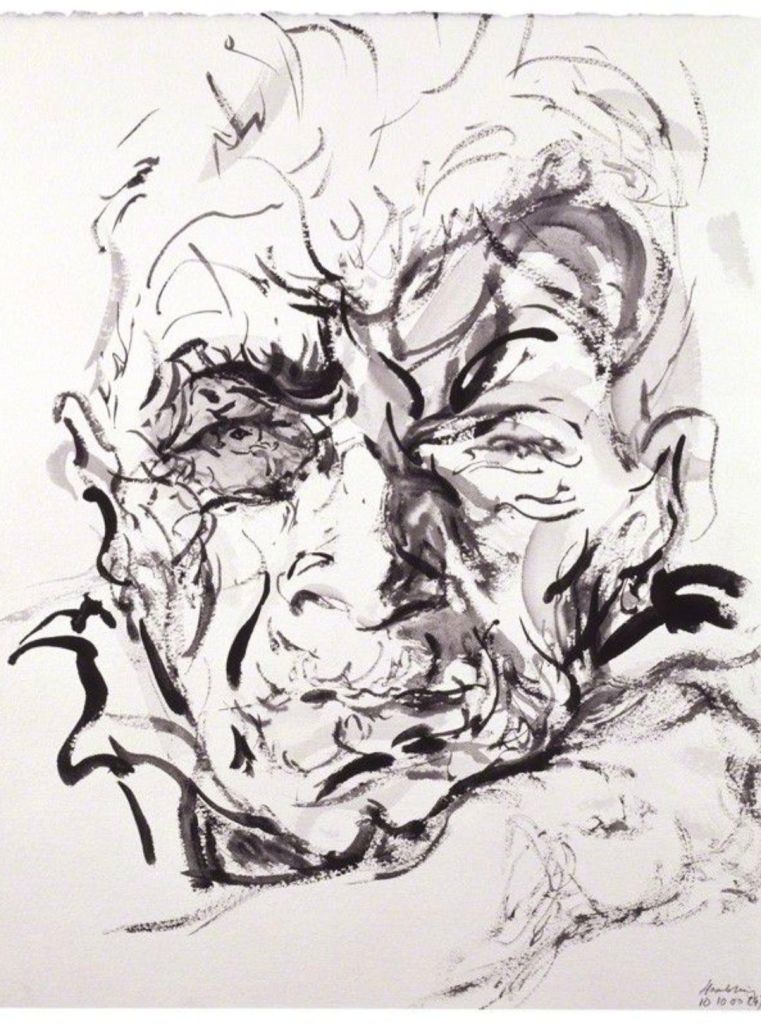
An ink drawing of John Berger, drawn by Maggi Hambling. The lines are very loose, barely scratched onto the paper, there are only a few heavy black lines. But in the lightness of this drawing Bergers intensity stares out at the viewer.
Portrait of John Berger, drawn by Maggi Hambling

Between Me and Ours

A question has bounced around my head since winning this residency. I have been appreciative of the enthusiasm and support given by friends on gaining this privilege. Yet there’s been several times when people have stated, well-meaningly and with the warmest intent, that it is something I “deserve”, that it seems right to have it bestowed upon me in light of what has gone before. 

I really struggle with this idea, of ‘deserving’. I cannot help but think that the opposite of this is that there must be a battalion of ‘others’ that do not deserve it. I know this to be grossly inaccurate. I can rattle off a long list of extraordinary creative people from all walks who would make great use of such opportunities, benefiting both themselves and the communities they work within. I also think it accentuates the cruel myth that those who work hard get their due rewards. Next time you’re in a hospital, ask a cleaner about all the rewards they have gathered for their hard work. Privilege is not evidence of hard work.

False humility is also unattractive. I would be lying to say I am not making the most of this privilege/opportunity. All I can say is that what I think We All Do Deserve is safety from each other, from despots in power playing politics, from ideologies which lift up only themselves while targeting ‘others’, a place to live, a meal to eat, a person to love, a chance to play. We deserve the chance to be curious and explore, the opportunity to be wrong and learn, to dream and escape, to be trusted and responsible. You can add your own suggestion to my incomplete list.

It’s not strange to feel that the Political networks of the current day are doing their best to push one into states of disappear. But the political actors are not a ‘We’, it’s most often a He, acting like Dams would on a river, to obstruct, block, and bottleneck. So where ever you put your energy, whatever your cause for better might be, think of yourself and your crew, your people, your mob and your kin as something in flow towards, to be part of something that grows “… with the strength of rivers into estuaries.”

(Here is something uplifting, an incredible story of water, persistence, and restoration).

I finish the week with two vegetable.machine.animal shows. 

The first is the celebratory afterparty of Wellington Zinefest. An impressively wonderful event with multiple spaces considered and made available so people can access the party in whatever way they find comfortable and welcoming. I play in the main foyer of Trade’s Hall.

The entrance to this beautiful space became infamous in 1981. A suitcase packed with explosives was left at the entrance. It seems likely the intended targets were some of the Union organizations within. However it was the cleaner Ernie Abbott who picked up the suitcase and died in the explosion. The perpetrators were never found.

The second was a fundraiser for the Neil Roberts Memorial Day. Neil Roberts was a punk anarchist who died when the explosives he was carrying detonated at the entrance of the Wanganui Computer as the target, on 18 November 1982.  Located in the city of Whanganui, the computer was the NZ government’s first database of accessible information on citizens, used by police and other surveillance services. His act is seen as a protest against the government’s growing surveillance mechanisms. 

The fundraising show was held at a newish Wellington venue, Underworld, which seems to be comfortable with bands of a noisier and heavier disposition. It was an evening of assertive music in multiple styles, and me and the houseplant.

Picture of kieran on drums, taken from his left side. The venue is the foyer of the Wellington Trades Hall. There is beautiful light on stage, he is leaning back, looking up, maybe eyes closed, as both hands seem to be heading to the snare drum together.
Trades Hall, photo Chrissie Butler

SOUNDBITES

1. The cat on the pillow talks, ‘Feed Me’. I drag the window behind me open and hope she jumps out , just like she does every other morning [or is she pushed?]. The dawn chorus calls into our room, the trees are close, sound-laden with feathered fruits. The doppler of another sound moves slowly through this song. It is a six am flight to somewhere awake.

2. I’m listening to ‘No Title As Of 13 February 2024, 28340 Dead’, the newest album by Godspeed You! Black Emperor. The band lock this piece of their art as a statement on the carnage against the Palestinian civilian population. It confounds me that this music can seem both futile and essential. Music holding hopes and sorrows together, a bit like Berger’s words. 

3. My ears are still asleep. THAT sound upstages somnolence. I am immediately aware of the risk of being breakfast. ThE steady buzz cuts through the blur of early morning. I pull my anxious head undercover. Steady? Mosquito’s can be many things, but steady is not one of them. I hear the buzz again, I listen, realising it’s the whine of the machine grinding coffee beans.

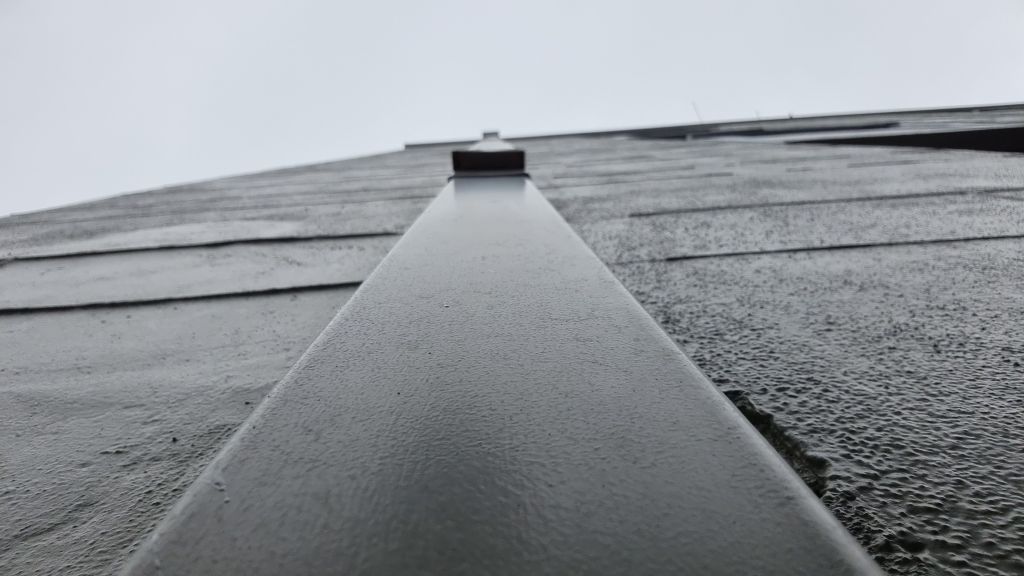
4. I’m holding my phone to the downspout. As if I know where the pipes ears are, and I’m helping it take a call. The rain has only stopped falling outside. Inside, drops descend from the gutter two stories up to percuss at this elbow junction on the way to the drain. This wet military tattoo, the rhythm of rain, is what stopped me in my tracks.

The phone is resting on the pipe of the guttering that goes to the drain. The view is looking up towards the roof, the sky is grey and the rain has just stopped.
Looking up the Downpipe

5. Pull wire till straight. I underestimate the breaking point and fall one step backwards as the pliers and metal separate with sound. Repeat three times, calibrating the effort downwards. I notice a sine wave trapped in shape. I guess the resonance is transferred down the wire, the wave becomes visible when the vibration stops at the jaws of the vice.

Picture of vice with wire in the jaws. The wire is being pull tight, but it snaps in my hands, sending a wave down the length of wire producing a sine wave pattern .

The Drawing Archive – a new skirted side-project

Screen shot of new website showing an image of Bill Wood and the details of the right hand menu bar.
Screenshot of Chrissie’s website, The Drawing Archive

NEW this week!!! We have launched a skirted side-project. The Drawing Archive is the new online home for Chrissie’s sketches in the dark at gigs, images from her work in inclusive design and snaps from her daily-ish 6-minute diary habit.

The Drawing Archive is also a home for a collation of drawing exercises by Chrissie’s fav image maker, Lynda Barry and odd muses on drawingness.

If you’re interested in receiving an image (like the one below) in your inbox, visit The Drawing Archive, subscribe and the gifts will arrive. Enjoy 🙂

Half-page Batman days, residency at Driving Creek Railway, Coromandel November 2023

Neil Robert’s Day – Pōneke Fundraiser

FROM FACEBOOK:

Nau mai! Haere mai!

Neil Robert’s Day is just around the corner, and it’s pretty big this year. We’re putting on two fundraiser shows – this one here in Pōneke and one in Whanganui.
Come see FOUR sweeeet bands and one alright DJ!
Doors at 9pm
Displeasure
Retaliator
Side Eye
vegetable.machine.animal
DJ Suave

NO stink cunts policy will be strictly enforced. 

Neil Roberts was a punk anarchist who died in an act of explosive defiance, with the Wanganui Computer as the target, on 18 November 1982.  Located in the city of Whanganui, the computer was the NZ government’s first digital database of accessible information on citizens, used by police and other surveillance services. His act is seen as a protest against the government’s growing surveillance mechanisms.

Film maker Russel Campbell has written about the events of the act and on some documentation that took place afterward.

May The Shifting Ground Hold Me Up

Be Quiet.Don't Be Quiet. 
Taken from a doco on the work and life of artist Ai Weiwei
Be Quiet. Don’t Be Quiet. A response from a doco on Ai Weiwei

Week three starts on a Saturday. I have been asked to be one of three ‘adjudicators’ for the annual Lilburn Trust NZSM Composers Competition. An adjudicator is a fancy word for judge. I’m to provide insight in determining the pieces of music to receive the annual awards! There are 14 compositions in total, from an array of various university music departments, from classical composition to electronics using AI, from jazz to somber to pop.  The selections have been pre-selected from students at differing stages  of their study.

We are given the scores to the music to read during the performance. I am unable to do this. It’s a skill I’ve never learned, but I am able to listen attentively. The things I rate are: 

  • the aliveness of a performance
  • the interactions between performers
  • the things the performance does to me – what does it evoke?
  • those things that take me by surprise
  • those things that don’t
  • the before’s and after’s of the performance
  • the self-responsibility and consideration of stage management-or lack-there-of
    and
  • does the performance match the text/hype of the program 

I realise my years of gigging and touring have taught me a great lot of skills that may not be so obvious from the academic tradition. Things that I realise are not so considered here.  And I am sure there will be many things I am missing precisely because I have one set of experiential skills instead of an other, more formal, set. The other judges all look at the quality of the script, how the performance adheres to the composition, and how the composition follows certain musical conventions that I am 100% ignorant of.

After hearing the 14, we three have a rapid and robust deliberation deciding on where the awards will go.  Happily, a diverse range of performances are selected, acknowledging technical ability, compositional quality, consideration of stage and space, performance bravery, and adventurousness of the composer. But all the performers and composers are deserving of acknowledging and commendation. My final encouragement would be to keep pushing the boat out!!

Best Performer award to Nathan Parker

There is additional newness for me this week. I have a rehearsal space available now every Tuesday, at Toi Pōneke. These are now my main recording days. They also come with a specific focus on collaboration. I invite Chrissie’s project DSLB in, I am safe in her tolerance as I may need to troubleshoot unexpected technical hiccups.  The main challenge is to ensure that the right technical equipment is on hand to enable the best recording … it seems to be sufficient. To support this, I have access to some nice microphones from the NZSM. It all works perfectly and after a full day of intense playing, we collect two and a half hours of recorded material. 

Near the end of the day, we are both become aware of the fatigue from exertion and concentration. I encourage ‘one more piece’. A lot of sound-ground has been covered. The instruments have been put through the routine of the first familiar and then unfamiliar explorations into sound territories. We both feel a bit spent. But we do it, one more lap around the racetrack. Finishing up, and listening back, what we have hauled in is a lush, atmospheric, angular piece of wonderfulness. it’s going to be exciting to share this work soon.

One of the proposed outcomes of this residency is the making of a V.M.A album. I’ve already done a fair bit of loose, improvised, and searching noodling playing to settle in.  This week a framework has started to appear, a framework from which I can hang ideas for the next 9 weeks and beyond.

Almost all of the albums I have been part of in the past have been made during tight times squeezed in and around the rest of ongoing-life. Having slow time to mull on ideas, to consider structure and dynamics, and to explore with dedicated intention is a new and unfamiliar space; luxurious and wonderful.

This time also presents a confronting opportunity. It says  ‘here is the time, what do you want to say?’. Brevity and seriousness can flatten playfulness and curiosity. Playfulness and curiosity can distract from the serious act of completion. Somewhere in between there is a middle ground, a place that teeters, a foot-in-both-camps space, and a pivot point that never settles into complacent stillness. It is a sweet spot of creative precariousness and I feel confident that for a time on Tuesday, we were visiting that place.

May this shifting ground hold me up.

SOUNDBITES:

  1. The melody is guiding my eyes. I become aware, during the performance, that with each change in the music, so too my gaze alters. I’m look upward as the saxophone goes into the higher register. The higher the note, the higher the view. My vision takes in the floor as the lower notes are blown. It’s as if my eyes alone are dancing. The observation of observing my eyes from the inside.
  2. We wake before the shake. It’s a gut sound, a frequency outside, the house, and our hearing. It is registered in the third-ear of the diaphragm. Guitars bounce on the walls, and the resonance of strings wakes as Richter waves roll through the house. We’re waiting for the next one, with deep and attentive listening in impending silence.
  3. A cafe house-stereo is playing a grandiose metronome. The three on my right are talking, and I’m inadvertently listening in. I think the words are familiar, but doubt suggests that it’s not my tongue they are speaking in. A dialectical similarity, maybe? Maybe from somewhere else? Is it my hearing loss at fault? Or the terrible acoustics?[but excellent for privacy] Maybe it just their enunciation? Maybe it’s none of my business.
  4. As the crow flies, we are as close as 9100kms apart, but you ask, ‘Can you hear the busy street?’ You say next to the alleyway of your home is one of the cities main transport arteries. Also, you say, beneath the path in front of your home, is one of the old cities canals. ‘Can we hear it?’ I can hear my belly rumble for dinner, while, perhaps, yours is sleeping just after lunch. This time next year, we will be Here. Then we shall hear.
  5. The flue of the fireplace is becoming a home for a bird. Claws, like a record players’ stylus, resonating on the circular stainless steel. Each morning, during coffee, we hear its movement. When we move, it stops. Perhaps the chimney acts as a two-way telephone, like old tin cans and string. Or an early-warning stethoscope into our room, alerting the blackbird of downstairs-action. It’s a precarious position to bring kin into the world. We will now be avoiding fires while DJ Blackbird scratches around up top.
The Chimney minus bird

Contaminated by Humanness

Picture painted by Kieran,  contains the words Contaminated By Humanness. An idea from the book The Light Eaters by Zoë Schlanger.

There are sensors connected to a plant at one end. At the other of the sensors is a plug inserted into a box that is a mess of cables and flashing lights. Speakers play sounds corresponding to interactions with the plant. Someone else is listening. I’m waving my arms around, fishing for words, trying to reel in some shape of comprehension.

I cannot think of a single instance, while demonstrating this project, that I experienced indifference. Typically, people’s fascination towards this budding idea that there is a perceivable, inter-actable, response from a species who hasn’t even been afforded the notion of agency, let alone complex life, in any form. 

It’s exciting when people become intrigued. They want to ask questions. I can almost see cognition kicking in, lights going on. I do not mean this in a way that could be construed as patronising, quite the opposite, a curious and inquisitive human is a wonderful thing.

The sound comes from the speakers. They ask, “Is this what the plant sounds like?”. No must be the answer. Anything else would be a lie. 

It’s an understandable question, when stepping towards the unimaginable. The imagination projects onto this non-human entity a humanness: “Maybe in some near-sci-fi way we will be able to ‘communicate’ with plants? Maybe it will be like a First Contact moment from an alien-encounter story?” I explain that what we are hearing is the result of the plants voltage only, it’s internal electricity, a biological signal which is measured between two sensor points. BUT, I emphasise, this is no less remarkable. We can interact and hear how the change of electrical signal changes the sounds coming from the machine. These are examples of signs of life, small recognitions that this entity, this plant, is detecting changes in the environment. And in response, changes in biosignals become audible. Caution is needed here, intention and meaning can not be interpreted from this moment anymore than a clinician is able to ascertain something about your personality from an ECG. It is impossible.

Online, I’ve seen examples of people making music with plants, presenting something that looks like a spiritual connection, a musical synergy. Most of the time, I think it’s an illusionary moment that is fraught with moral garbage. I would argue that such fantasy is unnecessary. We can be amazed at the astounding complexity of life without the bullshit.

Image of the cover of the book The Light Eaters by Zoë Schlanger.

Zoë Schlanger’s book ‘The Light Eaters’ (2024) is an exploration of the recent science on plant intelligence, plant communication and plant memory. Ideas that had once been decried and ridiculed are now undergoing a rethink in light of new research and repeatable experiments. “Contaminated by Humanness” is an idea from Schlanger’s book. This idea of Humanness is a polite way to announce Anthropocentrism. Anthropos is Greek for Human. Anthropocentrism is the placing of the human experience and perspective central to all. For example, for things to be understood, hold value and meaning, they must be translatable into a position relevant to the Human. Failing to ‘See’ other positions, other Others, as of value, meaning, and importance has brought ‘Humans’ of modernity to the worst versions of ourselves. Schlanger’s suggests that there are many more perspectives of the world that may remain truly unimaginable, yet remain alongside us, permanently in co-existence.

In this project I describe the sound-making devices of the synth as akin to Google Translate. It enables us to perceive, attempt to comprehend, and engage with the signal of the lifeiness of non-human others. In this awareness-making moment perhaps perspective might shift. What’s been seen cannot be unseen, so too what has been heard can not be unheard. I think it’s important to not corral these sounds into a classical framework of what music is. I want the unexpected musicality to hold its own space. And then we can decide to simply participate without overlaying some limited conceptual idea such as music definitions. We can start by learning to have bigger ears.

Writing this makes me think of an early, and very formative, event. I can pinpoint the moment my ears expanded.

Sometime in the late 80’s I hitchhiked to Christchurch. One day I was walking in the square in the city centre. I had just brought a cassette called 2X4, a collection of live recordings from a German industrial group, Einstürzende Neubauten. I had read about them in fanzines but had never heard them. Invercargill was a long way from Berlin. Until today.

My ancient copy of 2x4 by the German industrial band Einstûrzende Neubauten. I thought it no longer played due to too much beer spoiled on it, but tonight, the spools rolled fine... still as noisy as ever

Walking through the Square, Cathedral to the Left, the pub Warners ahead, my ears were confounded and lost by these raw, unfamiliar sounds on my cassette Walkman. What I heard gave me NO reference to help me understand the sound. Percussive machinery, confronting angular rhythms, and Bargelds’ high-pitched vocalisations felt indigestible. Even though it was both fascinating and disconcerting I had to stop listening for a moment, just to catch my breath. 

Removing the headphones the perplexity remained as I felt like I was STILL listening to the band.

All around the Square was the sound of construction sites, building projects in various forms of ascent. Skeletal towers full of labourers beating frames into shape. Concrete-mixers, angle grinders, hammers, saws, power tools and brute force all at work. I heard it all.

I also heard, I realised, what I needed in order to listen to the cassette. The builders had no pretense on being musicians, but the musicians used the tools of construction and destruction to create songs and entertainment. Tools containing specific utility, identity, became challenging in the hands of another. Not so much bending it out of shape, but into a newer shape. A shape that encompassed both this world of construction and also that world of creative exploration. The building world became contaminated by a musicness.

Many of these building never survived the earthquakes 30 years later. But I still hear ‘music’ where it isn’t.

Review: Onyx Music Review of DSLB

Skirted Records is a Pōneke (Wellington) based, Aotearoa (New Zealand) label, and they have released the EP “Pass-On-Ings” by a project called DSLB, which is the experimental electronic spawn of Chrissie Butler, who is also one half of Mr Sterile Assembly.

So, we start on “1” with its gradual build-up of horn noise, with minute wavering within their held notes, so if one listens carefully, plus a growing drone in the background. Those held notes are intense and seemingly take on a life of their own. The warbling and rattling nature of “2” makes you think that this is a machine. What sort of machine? Who knows, but the rhythmic noises it makes are very pleasing, and sounds it makes are like the motor had lost its casing, as it is left to run.

In “3,” for the first minute, the sound is so low, you are not sure if anything is playing at all, but gradually you perceive the gentle beeping, as the music blooms, delicate and reverberating. Slowly emerging strains of melody are extruded, like a sea shanty in syrup, and maybe it was suddenly consumed by the waters, for all goes quiet. Track “4” is the loudest, though for me, it might also be the most poignant, as if there is a loneliness within the horn like sounds, calling out to the world without any reply, other than the random rhythms.

There is a fragility to the EP, with the music a mixture of instruments and electronic programming. The softest of sounds holds as much attention as the loudest, with each note and drone weaving a soundscape. DSLB is opening up new worlds with Pass-On-Ings.


ORIGINAL LINK