Where we discuss the dilemma of formats for music, why formats are nice, AI Slop, and why it’s good that AI will never be able to lick an envelope

I love making music, but then what do I do with it?
There is a repetitious frequency among me, my friends, and other small-time music makers. It’s the cyclic dilemma of what to do with a collection of sounds that feels deserving of the title, Album.
What format to make? Tape? CD? Vinyl in a million colours? T-shirts? Or a shit-tonne of other paraphernalia to add congestion to the world? And how common is it to hear of homes that have no equipment to play any physical format on other than a bluetooth speaker? Very common.
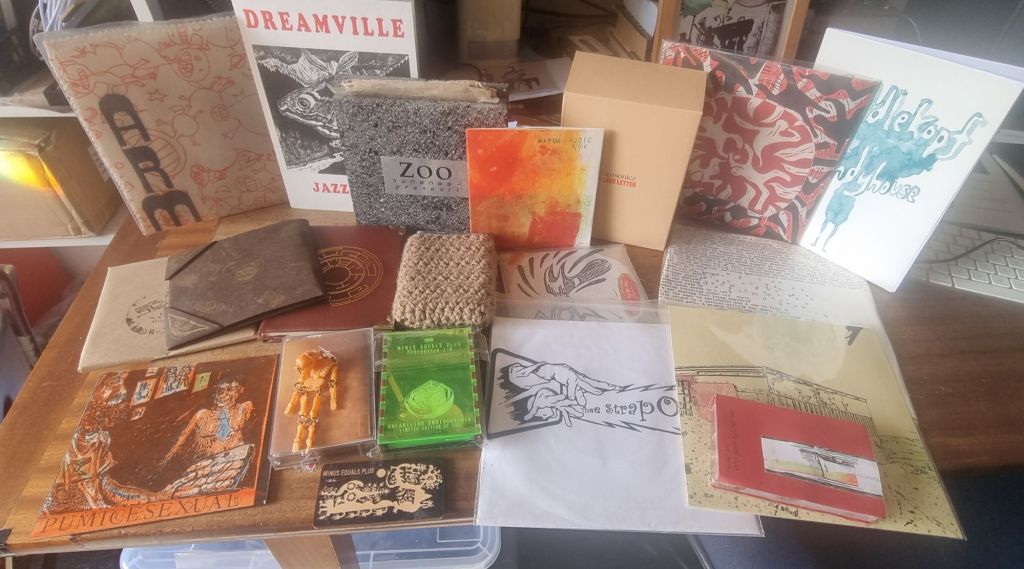
Once that’s been navigated and an idea has been committed to physically, you end up with something called Product. The question is “Then what”? Into shops, though some may not take the format you’ve made, and chasing up sales can still be extraordinarily cumbersome and archaic? Or online selling in the expandingly gargantuan sphere of the web? Online can be great, and it’s a wonderful surprise to have people in Alaska buy your stuff, but the postal costs to almost everywhere in the world from Aotearoa are truly crippling! Then how about touring to promote the recording? It’s still probably the best way to sell albums and merchandise, but not if you factor in flights to anywhere in the world, and the limitations of carrying bulky items (if touring on a tight budget) with all the other essentials of a touring band, such as equipment and clothes. And once in a new location there is the predilection that different regions have different tastes for different formats – some want cassettes, elsewhere t-shirts, others ask for vinyl, others laugh at CDs – who has a CD player? It is impossible to satisfy all tastes and fashions.
Another distribution outlet is online. There are streaming services for the absolute convenience of the listener and next to zero for the musician. Or the artist-focused platforms like Bandcamp and Bandwagon, which are trying to ensure more funds going to the makers of music.
Vinyl holds pole position, the gold-standard evidence that somehow you have ‘made it’ as a successful musician. It is, of course, a myth. It was a fantastic dream when I was young, to aim for an album on vinyl. But it seems like a problematic proposition that seems difficult to justify for the sake of ego. New records these days can cost upwards of $100 in some cases. The average price these days seems to be $50. But if what you’re buying is a lot cheaper than that, you need to know that someone else is weathering the cost, striving to break even, let alone make a little extra to put towards the next project.
Then, there is the often under-discussed conversation about the environmental impacts of a large non-recyclable format made from fossil fuels. Great for culture, crap for climate.
But all that said, I still like things. I love the expression of confidence and commitment people display when whatever is used to protect the format becomes a work of art in itself. I adore a beautifully conceived and created artifact. Great design can contribute additional information beyond the recorded sound.

Recently, I’ve been playing with the idea that the making of a material item, as opposed to only online, is like throwing an idea into the future. If, in the lifespan of this item, it finds its way into general circulation, it becomes immediately unknowable who may stumble across it at some future time. It’s a microscopic idea, but it feels like a meaningful consideration to think in the forward-tense. It’s a tiny contemplation, but I have been the appreciative beneficiary of such small discoveries and so perhaps others might, years from now, also enjoy the efforts of my labour.
One other less considered idea is how these nearly obsolete formats sit alongside technology like Artificial Intelligence (AI)? These days it’s a challenge to differentiate between AI and human-made text/images. AI audio programs are sophisticated enough to fool the listener. A tune can be generated by providing instruction on genre, feel, vocal choice, lyric, and letting AI do the rest. These tools will only get more sophisticated. As the processing capability becomes exponentially more powerful, so too does the increase in the deluge of content such as AI Slop “…badly managed or improperly deployed AI systems, that deliver, unwanted, poor quality, inaccurate, and simply ‘spammy’ content”. This is now the junk of our everyday lives.

But no matter how advanced AI may become, it will never be able to lick an envelope. Maybe this is an area where physical formats are useful, islands of the handmade against the algorithm of the AI. The committing of sound to physical form requires more steps beyond that instant generator of music. Instant music that can be immediately uploaded to streaming services, swamping the stream with a perpetual deluge. Committing sound to form demands that the ephemeral must interact with the material. It makes a physical and revisitable part of the world. And anyways, it’s hard to flood the world with handmade.
I have no clear idea of what is the best course of action. Actually, I think there is no clear answer. But I remain committed to the idea of making artefacts in the hope that there are others who enjoy our paraphernalia. I enjoy the process of folding, cutting, and gluing. I love the act of making. AI algorithms are brilliant in the application of science, weather forecasting, and other such domains, but not in areas such as culture and information. Perhaps the act of making a ‘thing’ becomes a small defiance against the invisible coding and bias built into these systems.
Soundbitten:
- Who heard the tree fall? The bend, strain, snap, and the crack of it. Unlikely anyone during the midnight howl. Nests ejected from limbs, the dismembered wings of leaves, trees twisting from the earth to the eaves. Ferocious, roaring, the gale shouts at every single dislodgeable and launchable thing. With its ear to the ground, the limb finds no silence.
- Cocooned. Prepare for later, a T.V dinner for eye eyes. But there’s no victory lap after the hunt. An assailant attacks the predator. Movement is frantic around the bounty. I am deaf to the duel. Spiders ‘hear’ with their legs. A foot on each web strand, deciphering vibrations into meaning, eight lines of communication at a time. Battle breaks the web, and lunch is lost.
- Fresh batteries in walkman, listen and play. This was how I learned to play the drums. I thought what I heard had all been played at once. All that technical prowess delivered in real time by extraordinary musicians. Who knew about multi-tracking, layering up, and moving equipment around. On that one particular track, Stewart Copland played only the hi-hats, not the kit!
- Hallucinogens render me incompetent to play songs despite the urging of band mates. All tethers to reality lost. But shows must go on. I grab bits of metal and other sharp objects collected to make industrial sounds. Projectiles produce great sounds crash-landing, heads duck in very real danger. John sits on me for my safety, from myself, and from others.
- The cancer’s back, it’s a weird relief she says, she no longer has to wait its return. Now tho, it’s a mission to finish the album, her one document. Songs she’d written, words she’d wrote. The last time we met, there was not much of her left. The exhaustion near total, almost unable to do the last track, energy for one take only, and no space for mistake. I still hear to her sing.

 skirted Records