Tag Archives: Gemma Thompson

Cheers Ears!

Where we reflect back on the 12 weeks of residency, review whats been done, offer thanks, and review objectives, and round it off with some plum porn

All Hands Make Light – One word removed to change the phrase completely
Taken from the band of the same name

I reside, now, post-residency.
Is the past tense of Residency, Residensed???

What an opportunity it has been, to have twelve weeks funded, supported, and committed, to the exploration and development of this project. A dedicated time to explore ideas, sounds, and thoughts, to make new connections and networks, to further hone technical skills in recording processes, editing and mixing, image-making, and presentation. To play fast and slow, to play solo, to collaborate, to demonstrate, and discuss this flight of fancy of mine.

When I applied for this residency I provided some goals and examples of evidence of work, that I would develop during this time. Gathering recordings was one of these outputs. And since late September, when the position started, these recordings grew into a substantial two-fold project.

Firstly, I made numerous solo recordings, exploring various ideas like suspended guitar, plant-driven percussive mechanisms, and the good old-fashioned banging away on my trusty drum kit. It has been great to have extended time to experiment. I’m yet to start editing, but I hold an excited anticipation of what will be discovered.

Secondly I held weekly recording sessions for collaborations. This was an opportunity to invite some very inspired performers (Chrissie Butler, Gemma Thompson, Bill Wood, Andy Wright, Tim Morrell, Sophia Frudd, Baxter Grey, Ruby Solly, David Long, Andrew Faleatua, Issac Smith, Kedron Parker and Nico Buhne) who I felt would enjoy playing plant and fungal electronic sounds. Each session was dramatically different from the next and collaborators worked with a wide range of instrumentation including electric guitar, drums, percussion of all sorts, trumpet, cello, electronics, taonga puoro, violin, fagufagu, drums, electric piano, and voice. I also got to collaborate with Mo Zareei who worked with live-mixed bio-signals from VMA, in his own studio setting. I feel lucky to have had the time to interact and play with these extraordinarily talented musicians and sound makers and I look forward to listening back to these session in early 2025.

Another continuous aspect of the residency has been image-making. This visual component helps me anchor learnings from readings in a way I can easily reference. They help me to hold multiple ideas and points of view in eyesight simultaneously. I will include the images in the exhibition at Toi Pōneke in June. Twelve of the images have just taken a little excursion to Queenstown, where they have been included in the Use Your Words exhibition at Te Atamira Gallery, which is pretty cool.
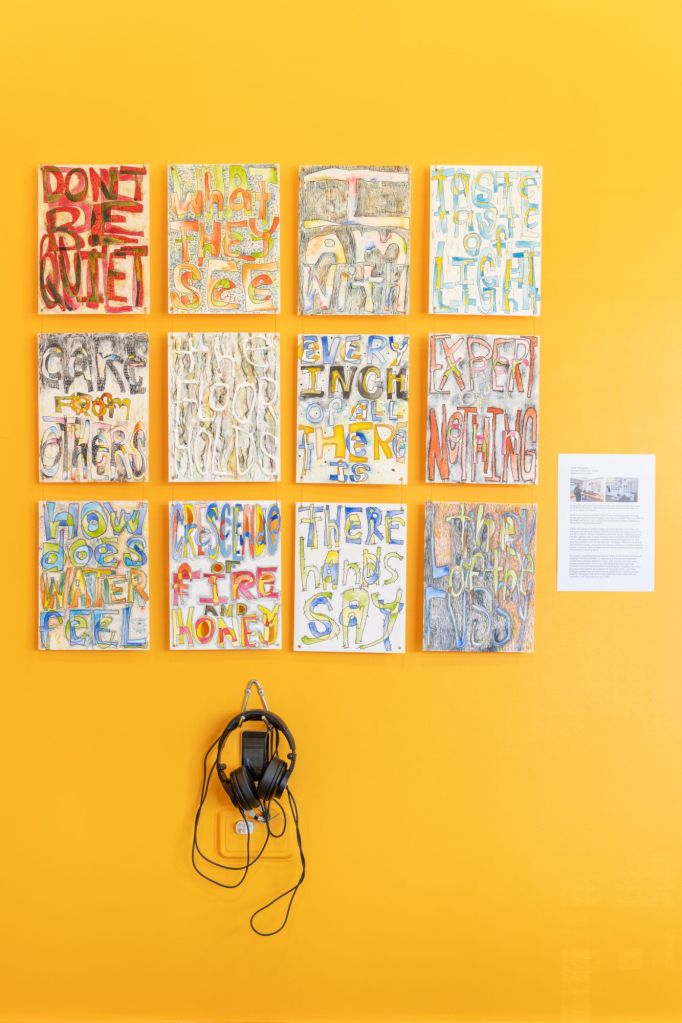
A set of images now on display at the Use Your Words exhibition at Te Atamira in Queenstown. 
Photographer: David Oakley

The last component of this residency and a commitment from the outset has been documenting this residency. I proposed to write online weekly to express thoughts and ideas that were of interest at the time. Although I have blogged in this way many times in the past, one joyful evolution was the inclusion of soundbites, which have concluded each post in a section called Soundbitten. These soundbites started as a whim in the second week and grew quickly into 55 miniature stories that circulate around a key sound source or reference. Over the weeks, I became more conscious of needing to listen to notice the sound stories in the present, alongside trawling memory for meaningful sound memories from the past. The compilation of writings has now been complied with the page ARCHIVE: 2024 Creative New Zealand/NZSM/Toi Pōneke Sonic Artist-in-Residence. The text is currently being arranged into a limited edition print version, available on the opening night of the exhibition in June 2025. I hope it has been something that you have enjoyed.

So here I am newly residenced and it is interesting to reflect on what I expected to do and what I actually did. I suggested I would explore the idea of “a sonic practice for the Anthropocene”. I wanted to explore and develop a sonic practice that: 

 places the ‘human’ not at the centre, but as an active ‘collaborator’ in a trio of non-human/tech/human. 

 insists the voice of the ‘Other’ is amplified and essential to the voice of the ‘Whole’. 

On reflection, I think I have achieved what I set out to do, but the journey is continuous. Decentering the ‘human’ from the centre of the performance and investigating the ideas of a horizontal, interactive, and interspecies framework has been a shared experience. Collaborators frequently stated that it was both novel, and musically exciting, to listen to and respond to ‘other’ in the room. And from my perspective, though I was facilitating these meetings, I did not feel that the spotlight was mine.

As this project continues to develop, I realise the more I become reliant, dependent, on the ‘Other’.  There is no way to make this happen without ‘them’. It’s less about ME and more about THIS. Publicly, we are becoming inseparable.

In these crisis times, many would argue that we were never separate, and that reestablishing a re-connectivity to the natural world is essential for any version of future viability. It is not my intention to sound grandiose, but I hope this project is a contribution towards that future-focused mindset. A future that welcomes both diversity and uniqueness, makes space where the needs of the individual are respected but do not trump, dominate, or compromise the needs of the myriad cohabiting communities.

Soundbitten:

  1. These days, I only ever see you at the supermarket. In other times, it was at gigs. I’d just brought an ice cream for moko, you were bus-waiting with hubby. Always, we hug. You tell me “ I’ve been reading your writing”. Recount back to me the stories I wrote. Those little bits of sound, experiences that could have been yours. I listen back. Bitten, it’s life after the bite.
  2. Margaret Sparrow, song bird, vasectomy queen. I’m on a slab, voluntarily. Shaved, prepared, anesthetized with local. It’s simple; revel, snip, seal. Twice. She works, cautery device in hand, singing with her sidekick, to work songs of Gilbert and Sullivan emanating from a tape deck on the shelf, “I am the very model of a modern…”… Hello mr sterile!
  3. These hills were quiet when we arrived. Denuded of green by farming and fire. Then it was gorse, blackberry, weed. Once upon a time, here would hear the heat, the sound of ‘progress’, the colonialist act of razing. But if abandoned, the wilds return. Hushed at first. Now, the dawn valley’s boisterous with chatter, choir, clarion call, chimed bell, clacked gong.
  4. From a distance, a whisper this way comes. Hush turns to hiss. Like the persistent sound of approaching train, but not. It falls, dancing. One thing meets another thing, times multiple. The raindrops play the leaves like drums, the percussion of wet onto leaf litter. Then the downpour hits the roof, a curtain, a wall, a wave of water, tap-dancing.
  5. How does the plum sound? Do branches hear pollinators in blossom? Do flowers sigh in post-coital germination? The bees gleeful buzz when dusted in pollen? Who hears petals fall? Or the nutrients, fluids, directed to the swelling buddings? Does the Sun sing lewd songs to make the fruit blush? It’s unknown, but I know how the light tastes. Hear my delight as juices burst free.

Thank you to the following:
●To the collaborators who came along, shared their skills, talents, and willingness to play with this project
●The staff of the New Zealand School of Music who supported my explorations and requests
●All the staff at WCC Tōi Pōneke Arts Centre for making me feel welcome and sharing lunch time banter
●CreativeNZ for the funding
●To all those people who stopped by and shared their curiosity
●To the other art workers in residence at Tōi Pōneke
●Thank you to you for reading this far!
●And the most massivist! Thanks! always, always, always to Chrissie for everything!!

The Physics of the Swing

“How do you stop the paper twisting?”, he asks.

It’s something I’ve been thinking about for a while as I prepare some pictures for an exhibition. I want them to float off the wall, hanging from each other at 40mm distance, and have a breath-like flutter. Flutter is not the right word, I’m after a rigidity of movement, something like an articulation. If the paper is too paperly and the connections are lightweight, then the overall assemblage twists. I want to be able to dictate the physics of the swing.

The architecture of the paper needs to be bolstered. On the back of the sheets, disassembled bamboo mats become the near- invisible framing. For the pictures to hang from each other, I make something like a big staple from sturdier wire, which has less intrinsic movement. These are then spray painted with a bright orange to light the mood of its weightiness. It achieves what I’m looking for.

Tuesday. I can not make it work. I’ve spent the last 90 minutes trudging this equipment downstairs, setting it up to record, and now nothing. Has it been damaged it in the move? Why is that always the first thought? It was working fine before but now only silence. For 10 minutes, all the lights have been flashing like a trashy disco, but not a peep of sound. Check cables, sensors, connections, and power supplies. I look for the obviously simple reasons before catastrophising options arrive. 

However, the answer to this issue is simpler. It appears that the fungi are withholding their signals. Sleepy fungi. I spray a bit of water onto the mushrooms. The moisture improves the transfer of signal-to-sensor. I reconnect the sensors to the damp flesh and sound bursts into life, with life, from life. 

I’ve made this mistake before.

In the beginning, before this project was a project, I had no idea what a modular synthesizer was. When my first modules arrived, I could not make them work. I leaned on the wisdom of Issac, the only person I knew locally who was informed about such arcane things. He generously lent me gear and knowledge.

Perhaps it was during the second ‘lesson’.

Isaac came over home one evening. Huddling over the equipment, watching closely as he looked skillful in his extraction bleeps and bloops of sound. We were completely focused on the machinery. At some point, though, without obvious reason, sound stopped. I watched on as Issac problem-solved – checking cables, connections, etc. He appeared mystified, I was beyond lost and unable to help. Some inkling prompted him to poke the plant. Then, as if re-energised, sound returned. Should I anthropomorphize the moment, I would think it was the plant playing tricks on us, going, “Oi!! … I’m here as well, get your head out of your geek, and pay attention!!” Such rude foliage. But it’s got a point.

This was a small act of relearning, of where ‘else’ to place attention and consideration. That it needs to be in more places than one. How often do I need to be reminded that invisible things have influence? The world is haunted by unseen things and their own connections. We are at the mercy of the obscure and opaque.

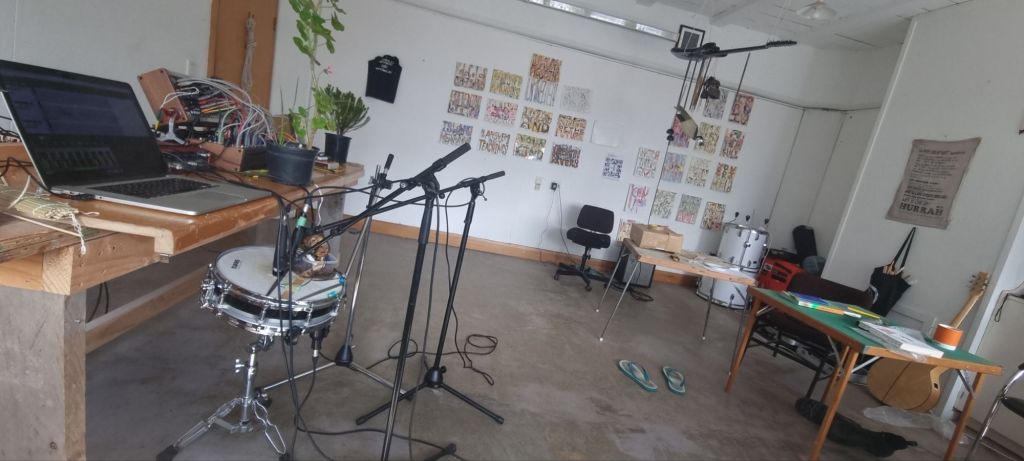
Back to Tuesday. With the sound issues resolved, I set about re-recording a piece from last week. I didn’t have enough microphone stands, so I dangled cables from the aluminum framing holding up the suspended ceiling. I suspended two microphones, one over the rack tom and the other over the floor tom. If I clumsily bump the mic, it will start to swing over the drum. The movement of the mic collected the sounds emanating from the skin as it approached, traveled across, and departed from the drum as it swung through its arc.

I realise I can use this clumsy action with good effect. I reset the mics over the drums and let them swing.  I press record and capture the movement in action. Timing, linked with tempo, are cornerstones in the act of metronomic drumming.  But in this instance, the timing is determined by the physics of the swing. As momentum diminishes from the swings’ natural reduction in distance, there is an audible increase in frequency of the beats.  I record several takes this way, using different mics and drums, building up a set of tracks that feels like it has some sort of regularity. I know it doesn’t.

[Later the Youtube algorithm shows me a piece of music by musician Steve Reich. He had used microphones in the same way but over guitar amps, playing with the feedback. I think I like my version more.]


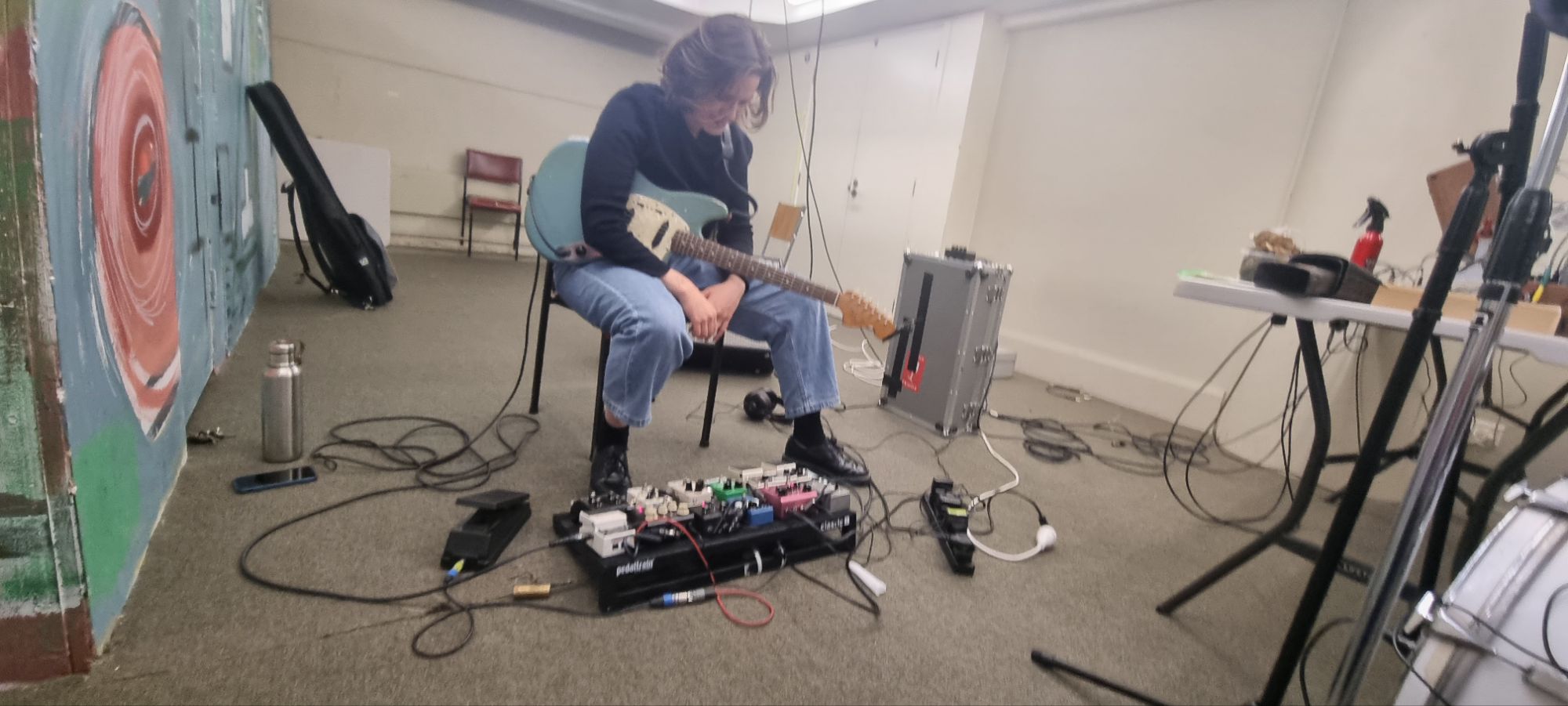
In the afternoon I’m joined by visual and sound artist and guitarist Gemma Thompson. Gemma is also a regular inhabitant of Toi Pōneke. We have only recently met. We have chatted a couple of times in the kitchen, and have never heard of each others’ music, other than a short clip she played to me from her phone of a recent concert. It is an interesting way to meet someone through sound rather than words. There is a confidence required to be able to let go in the company of a stranger, the urge to self-censor, and self-limit can hobble opportunities like these. It’s a good practice to work against these things.

I host an open studio on Wednesday evening. It’s an open invitation to present the current work-in-progress. And I get to demonstrate how the machine/plants work together. I am both surprised and heartened at the number of people who come through. There seems to be genuine interest in the project,  and many are willing to take part in the chance to interact with sound making. 

One demonstration that gathers attention is where I place one sensor onto the plant/fungi and the other onto a persons’ finger. No sound is made until the circuit is closed by the person with the sensor connecting with the plant. We expand this by bringing in extra people, as long as they hold hands with the person connected to the sensor and the person at the end of the line touch the plant/fungi. It’s possible to hear audible changes in the sound from this bigger loop. Sometimes, it seems to take a little longer for sound to register, and the rapidity of the signal changing seems slower. But there seems to be something awe-inspiring for people when they have the chance to become part of an organic loop, part of a connection that makes this sound. It is almost as if the connection is more important than the aesthetic.

The week wraps up with a lichen-influenced mechanism playing metal chopsticks on a snare drum. It was a useful distraction as the swing states gave Trump his victory. So much had been written already with an air of certainty about what will come.  I’m no soothsayer, I’m making no predictions. I trust the fact that Trump is not breaking the rules of physics. Negative does not exist in a vacuum. For there to be a negative-in-charge, somewhere there exists a positive.  I’ve no idea what it is. It seems invisible. But if I must remind myself of one thing, it is that the invisible also has influence, and most things deemed certain never are.

SOUNDBITTEN:

  1. One door over, a Kango hammer bites into concrete. A metal tooth drumming on the solidity of the wall, intermittent in attack, dusty in effect. It has a jangle in it’s voice, bells chime as the engine powers up. Another machine over another fence chews into spring grass. It’s a two-stroke throatiness, undulating in pitch, as it works against the resistance of rapid weeds.
  2. A bird sings twice. First from the bough high up in the Eucalyptus, air astringent with fragrance. The second as the echo returns from the bricked house opposite. The quickest reverb. Sharp like a smell, piercing to the ear like molecules to the nose. Reminds me of a text that says the smell of fresh cut grass is, in the language of the garden lawn, screaming.
  3. The show was over 20 years ago. I’d been to plenty that had left my ears ringing in the past, it usually stops after two or three days. Not this time. Loud laptops, pure digital tone, my drums in the crosshairs of the P.A. I hear it now. I’ve got strategies to cope with the constant background sound. Stress is a volume knob, a red flag, a siren’s call to attend to some inner need if the ringing starts screaming.
  4. There were only partitions between the bed bays in the long corridor that slept 80. Mine is next to the Dorm master’s door. No privacy. No quiet space. Lights out. I would hide the walkman undercovers, listen to the Sex Pistols on headphones. Lights on. Dorm master had me on display to all, getting six of the best for my sonic indiscretion. It won’t stop me.
  5. I make mixtape for road trips in the car, all the favorite songs in one place. Pack the kids and go south for summer. Along the coast, the song Motorhead comes on. At the same time, kid 2 throws up. We stop, clean up, and carry on. Down the road Motorhead returns. And like an allergic reaction, kid 2 throws up again. Stop, clean up, put the tape away, and carry on.