
“How do you stop the paper twisting?”, he asks.
It’s something I’ve been thinking about for a while as I prepare some pictures for an exhibition. I want them to float off the wall, hanging from each other at 40mm distance, and have a breath-like flutter. Flutter is not the right word, I’m after a rigidity of movement, something like an articulation. If the paper is too paperly and the connections are lightweight, then the overall assemblage twists. I want to be able to dictate the physics of the swing.
The architecture of the paper needs to be bolstered. On the back of the sheets, disassembled bamboo mats become the near- invisible framing. For the pictures to hang from each other, I make something like a big staple from sturdier wire, which has less intrinsic movement. These are then spray painted with a bright orange to light the mood of its weightiness. It achieves what I’m looking for.

Tuesday. I can not make it work. I’ve spent the last 90 minutes trudging this equipment downstairs, setting it up to record, and now nothing. Has it been damaged it in the move? Why is that always the first thought? It was working fine before but now only silence. For 10 minutes, all the lights have been flashing like a trashy disco, but not a peep of sound. Check cables, sensors, connections, and power supplies. I look for the obviously simple reasons before catastrophising options arrive.
However, the answer to this issue is simpler. It appears that the fungi are withholding their signals. Sleepy fungi. I spray a bit of water onto the mushrooms. The moisture improves the transfer of signal-to-sensor. I reconnect the sensors to the damp flesh and sound bursts into life, with life, from life.
I’ve made this mistake before.
In the beginning, before this project was a project, I had no idea what a modular synthesizer was. When my first modules arrived, I could not make them work. I leaned on the wisdom of Issac, the only person I knew locally who was informed about such arcane things. He generously lent me gear and knowledge.
Perhaps it was during the second ‘lesson’.
Isaac came over home one evening. Huddling over the equipment, watching closely as he looked skillful in his extraction bleeps and bloops of sound. We were completely focused on the machinery. At some point, though, without obvious reason, sound stopped. I watched on as Issac problem-solved – checking cables, connections, etc. He appeared mystified, I was beyond lost and unable to help. Some inkling prompted him to poke the plant. Then, as if re-energised, sound returned. Should I anthropomorphize the moment, I would think it was the plant playing tricks on us, going, “Oi!! … I’m here as well, get your head out of your geek, and pay attention!!” Such rude foliage. But it’s got a point.
This was a small act of relearning, of where ‘else’ to place attention and consideration. That it needs to be in more places than one. How often do I need to be reminded that invisible things have influence? The world is haunted by unseen things and their own connections. We are at the mercy of the obscure and opaque.
–
Back to Tuesday. With the sound issues resolved, I set about re-recording a piece from last week. I didn’t have enough microphone stands, so I dangled cables from the aluminum framing holding up the suspended ceiling. I suspended two microphones, one over the rack tom and the other over the floor tom. If I clumsily bump the mic, it will start to swing over the drum. The movement of the mic collected the sounds emanating from the skin as it approached, traveled across, and departed from the drum as it swung through its arc.
I realise I can use this clumsy action with good effect. I reset the mics over the drums and let them swing. I press record and capture the movement in action. Timing, linked with tempo, are cornerstones in the act of metronomic drumming. But in this instance, the timing is determined by the physics of the swing. As momentum diminishes from the swings’ natural reduction in distance, there is an audible increase in frequency of the beats. I record several takes this way, using different mics and drums, building up a set of tracks that feels like it has some sort of regularity. I know it doesn’t.
[Later the Youtube algorithm shows me a piece of music by musician Steve Reich. He had used microphones in the same way but over guitar amps, playing with the feedback. I think I like my version more.]
In the afternoon I’m joined by visual and sound artist and guitarist Gemma Thompson. Gemma is also a regular inhabitant of Toi Pōneke. We have only recently met. We have chatted a couple of times in the kitchen, and have never heard of each others’ music, other than a short clip she played to me from her phone of a recent concert. It is an interesting way to meet someone through sound rather than words. There is a confidence required to be able to let go in the company of a stranger, the urge to self-censor, and self-limit can hobble opportunities like these. It’s a good practice to work against these things.
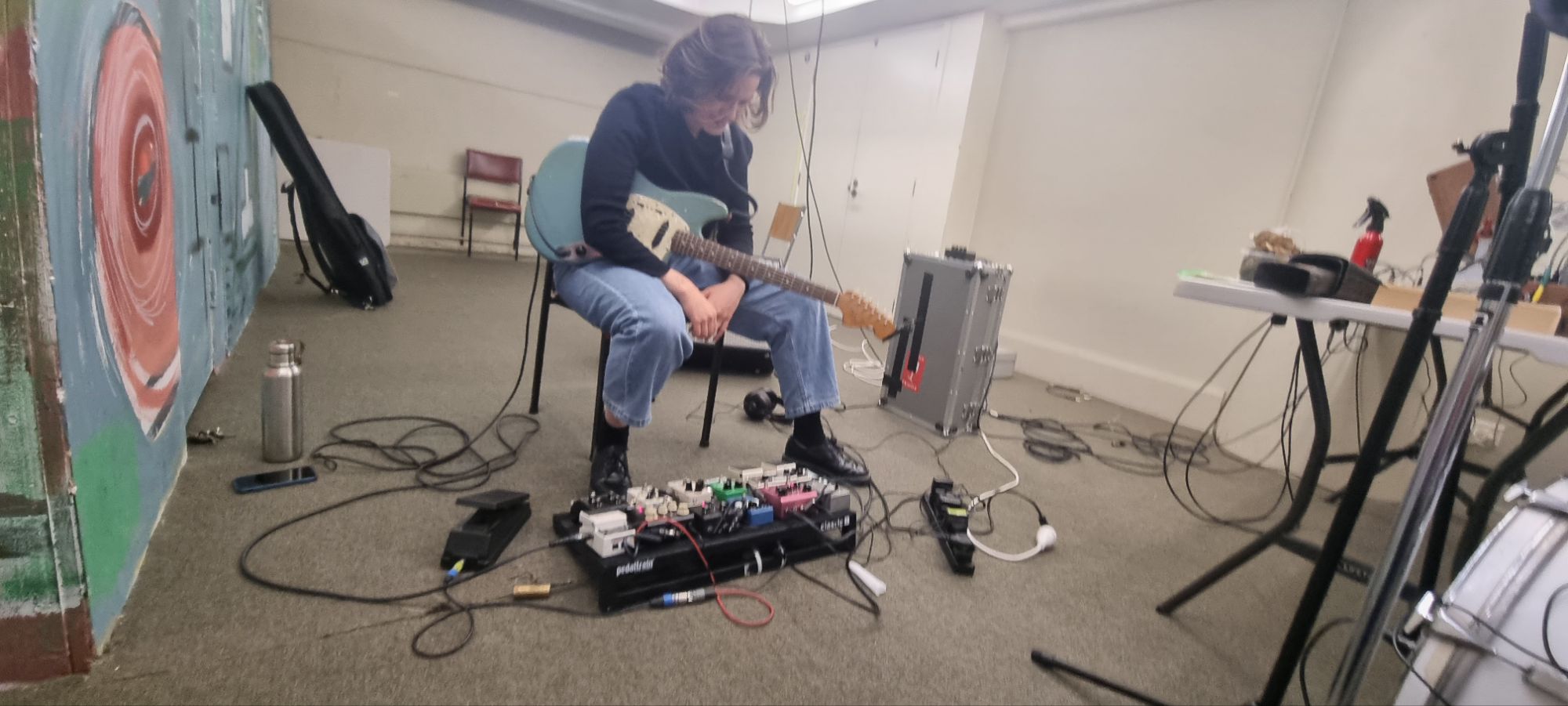
I host an open studio on Wednesday evening. It’s an open invitation to present the current work-in-progress. And I get to demonstrate how the machine/plants work together. I am both surprised and heartened at the number of people who come through. There seems to be genuine interest in the project, and many are willing to take part in the chance to interact with sound making.
One demonstration that gathers attention is where I place one sensor onto the plant/fungi and the other onto a persons’ finger. No sound is made until the circuit is closed by the person with the sensor connecting with the plant. We expand this by bringing in extra people, as long as they hold hands with the person connected to the sensor and the person at the end of the line touch the plant/fungi. It’s possible to hear audible changes in the sound from this bigger loop. Sometimes, it seems to take a little longer for sound to register, and the rapidity of the signal changing seems slower. But there seems to be something awe-inspiring for people when they have the chance to become part of an organic loop, part of a connection that makes this sound. It is almost as if the connection is more important than the aesthetic.
The week wraps up with a lichen-influenced mechanism playing metal chopsticks on a snare drum. It was a useful distraction as the swing states gave Trump his victory. So much had been written already with an air of certainty about what will come. I’m no soothsayer, I’m making no predictions. I trust the fact that Trump is not breaking the rules of physics. Negative does not exist in a vacuum. For there to be a negative-in-charge, somewhere there exists a positive. I’ve no idea what it is. It seems invisible. But if I must remind myself of one thing, it is that the invisible also has influence, and most things deemed certain never are.
SOUNDBITTEN:
- One door over, a Kango hammer bites into concrete. A metal tooth drumming on the solidity of the wall, intermittent in attack, dusty in effect. It has a jangle in it’s voice, bells chime as the engine powers up. Another machine over another fence chews into spring grass. It’s a two-stroke throatiness, undulating in pitch, as it works against the resistance of rapid weeds.
- A bird sings twice. First from the bough high up in the Eucalyptus, air astringent with fragrance. The second as the echo returns from the bricked house opposite. The quickest reverb. Sharp like a smell, piercing to the ear like molecules to the nose. Reminds me of a text that says the smell of fresh cut grass is, in the language of the garden lawn, screaming.
- The show was over 20 years ago. I’d been to plenty that had left my ears ringing in the past, it usually stops after two or three days. Not this time. Loud laptops, pure digital tone, my drums in the crosshairs of the P.A. I hear it now. I’ve got strategies to cope with the constant background sound. Stress is a volume knob, a red flag, a siren’s call to attend to some inner need if the ringing starts screaming.
- There were only partitions between the bed bays in the long corridor that slept 80. Mine is next to the Dorm master’s door. No privacy. No quiet space. Lights out. I would hide the walkman undercovers, listen to the Sex Pistols on headphones. Lights on. Dorm master had me on display to all, getting six of the best for my sonic indiscretion. It won’t stop me.
- I make mixtape for road trips in the car, all the favorite songs in one place. Pack the kids and go south for summer. Along the coast, the song Motorhead comes on. At the same time, kid 2 throws up. We stop, clean up, and carry on. Down the road Motorhead returns. And like an allergic reaction, kid 2 throws up again. Stop, clean up, put the tape away, and carry on.

 skirted Records