Where we discuss mixed-up time, documenting, school, and other such things on the way to words.
I arrive at the penultimate point in the residency. In my head, there is one more week. Truth be told, though, I’m wrong. The contractual end date is the 15th. Incorrectly, I think it ends just before xmas. Fortuitously, Toi Pōneke offers me ongoing use of the space until the 3rd of February. I am saved from my error becoming awkwardly public. That said, the psychology of this time must end as contracted, as the next phase of work needs to begin. This entails the distilling, editing, mixing, and compiling of audio and other works for the June 2025 exhibition.
Audio recordings are only one documentation of this time. These words are another. It’s a purposeful decision to also record this time, this way, as a textural account of a sound experience. The motivation for this is based on personal frustrations. My frustration is that writing seems to be something I am only capable of doing while on tour, in another country, in a place I may not return to, recounting experiences of encounters with people I may never meet again. It is a conscious act to find the barriers I hold in regards to writing, and breach them.
It surprises me when I think of my academic past, that this pen-to-paper process has become enjoyable. When I was at school, I barely made it to the end of the fifth form (year 11). Prior to exit, there was an escalation of trouble, detention, and conflict. Walking away from school, the idea that I might experience joy from the written word or learning seemed unimaginable.
However, the hunger for learning is resilient. My school experience did not quash it. As it turned out, I was ravenous, and lyrics were the literary form that fed me. I would read, learn by heart, sing along, and take learning from the words people put to music. I would be disappointed if an album did not have lyric sheets inside, along with accompanying art and/or photos. Maybe I thought it showed a lack of care for the listeners’ engagement, or whoever this band was was not serious enough in their intention and practice. Seems adolescent now, but it was really important at the time. And to be honest, I still appreciate and pay attention to that effort when I see it.
Fast forward some years. When I was lyric writing for the band, mr sterile Assembly, there was often a lot of reading involved. A story would be identified that held some contemporary relevance. I would look for key reference material such as text, books, articles, other songs, and footage and then digest. Some songs took years to complete, others less time. This process was really enjoyable, and I grew to appreciate the additional learning around a topic. Unsurprisingly, that process still remains relevant to the way I approach making work now.
The current project of vegetable.machine.animal continues to follow this process. There is no lyrical content at this point in time, but who knows how that will develop. However despite the no-focus on lyrics, I continue to read broadly in relation to the ideas behind this project. What fascinates me is the think-shifting writing that is being published in both hard and popular sciences and the arts. There are many incredible discoveries being reported in these texts, awe inspiring ideas that make the world bigger, and provide evidence to dismantle some of the worst aspects of the Enlightenment Individual. That model of individuality that places certain humans higher than others, that elevates Humans out of nature, and that redefines almost everything as Resources available to take, consume, and exploit.
Some of the amazing examples of current findings:
- Coral reefs have sonic soundscapes. Experiments are underway on coral reef repair after bleaching from warming waters and increasing acidity. Underwater speakers play the sounds of a healthy reef beside the damaged ones. The ‘healthy’ sounds invite familiar varieties of life to return and repopulate the habitat.
- 50 communication signals have been identified via Mycelial networks – mushrooms talk?
- Some plants can ‘hear’ themselves being eaten, adapt to be less tasty, and warn nearby kin of incoming bugs.
- Trees can recognise their seedling kin, and favor them by providing additional nutrients via mycelial networks.
- Species like Venus Fly-traps have proven that there is a capacity for something similar to memory.
- Orca has different audible dialects of clicks, whistles, and pulsed calls between pods and clans. Some sounds/signals have been identified as continuous across decades, while other sounds evolve. The young learn from these patterns from the older.
- Somewhere in deep time, our evolutionary ancestors were a water dwelling species. As such, we evolved without the nervous receptors to detect the feel of water that surrounded us. We still do not have these receptors. All we can feel is the fluctuating temperature and the fluid motion. We can’t feel the real wet.
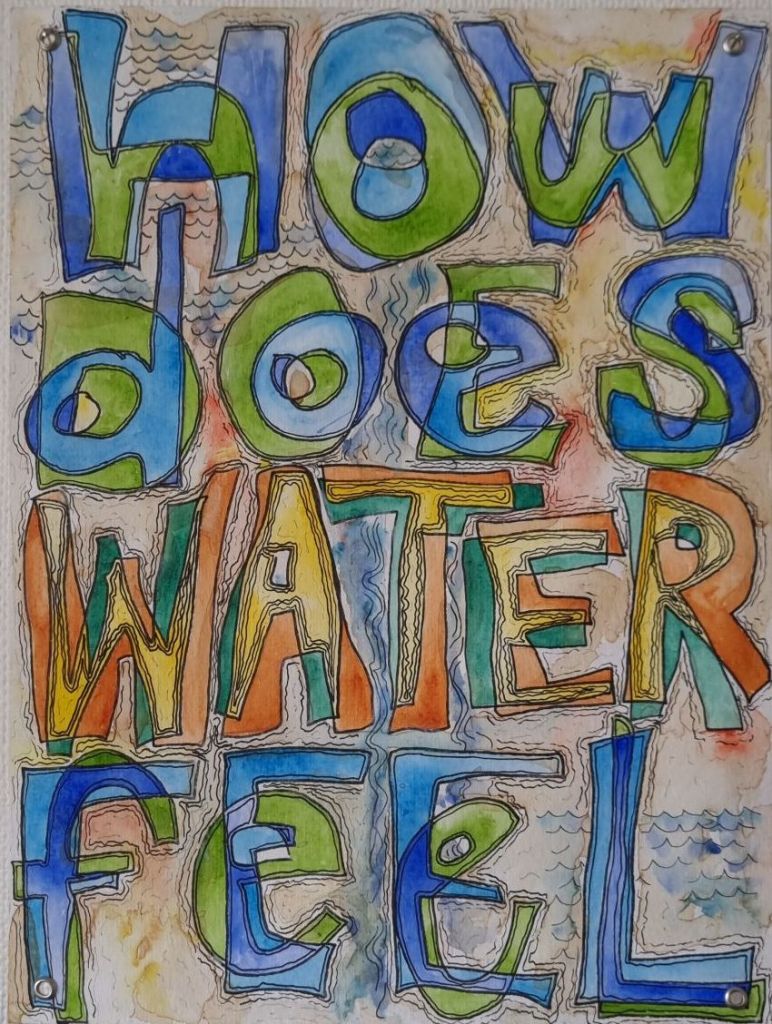
Words take on a life of their own. And all those words I’ve been reading have infiltrated my sonic explorations. Tiny ambiguous phrases began to be collected. On a single day in November 2023, I had a single thought to pass the time while I was between recordings. This resulted in a single doodle, I added some colour , and that doodle just has not stopped.
I enjoy art practices built on multi-disciplinary approaches, representations of ideas that can not be contained into a single medium. My word posters have become integral parts of the sound work. The sound work is integral to the posters, different information delivered from differing mediums, but all from the same reasons.
What amuses me also is that this is the third time image-making has become a focused activity. The first show I had was in the Invercargill museum in 1991 with all the angst of adolescence on display. The second time, somewhere in the mid 90’s in Wellington, and those images were dark. 30 years later, me and mark-marking reconnect. Less desperate, more joyous, and nothing but an exuberant whimsy.

Reading List:
Entangled Life – Merlin Sheldrake | The Light Eaters – Zoe Schlager | ECOES Sonic Arts Press | Islands of Abandonment – Cal Flyn | Staying with the Trouble – Donna Haraway | Dark Ecology – Timothy Morton | An Immense World – Ed Yong | Death by Landscape – Elvia Wilk | Ways of Being – James Bridle | The Overstory – Richard Powers | The Sounds of Life – Karen Bakker | The Mushroom at the End of the World – Anna Tsing | Gaia and Philosophy – Lynn Margulis and Dorion Sagan | Future Stories – David Christian | Let’s Become Fungal! Mycelium Teaching and the Arts – Yasmine Ostendorf-Ridriguez | Eryk Salvaggio – Electric Mushrooms and the Circuitry that Loves Them
Soundbitten:
- It’s not blood in ears, so I sit here in silence, try to locate the fluid flow. Water sounds like water. It can also sound expensive. Yesterday, we heard the pop of the cylinder element, and now showers are cold. But this is not that. It’s the bruit of fluid in motion, the leaking valve of the outside tap, to the artery of garden hose. The Hydro-Phlebotomist makes a house call.
- Can you hear me sleep? I know I can not. But sometimes the noise I make wakes us. Conversations with my unhinged side, the dream-Me, a metaphoric I. I hear you sleep, read the depths by the sound of the breath. There is that first unconscious pursed-lipped exhalation, more out than in. It’s fragile, easily disturbed. Deep down, it’s much more quiet.
- Driller Killer on the back patch of a cut-off denim, covered in studs. Skin receives Vit D through holes at knees. Wear the emblems of Crust, signs of D-Beat, evidence of Grindcore. At home in a pub, front row, a tumble of mosh pit. Here in daylight, on the front row at graduation, with flowers in hand, lipsyncing as the house band plays summer grooves.
- Earmuffs blur the whining sander, coarse grit abrasive to the crud of ages. Pitch fluctuates, friction vs gnarled terrain. Scars in lumber from the bite of steel, piercing, render tree to plank. Before wood-fall, the sound of axe, saw, chainsaw, the graze of teeth of industry. And before Before, the upward creak of timber mobility, the birdsong, the raindrop, the seedpod.
- Dali’s boring, but Hugo Ball rules. 1916, Europe, Karawane says it all! ‘Jolifanto bambla ô falli bambla, grossiga m’pfa habla horem… & …ü üü ü…’. 106 years later, Snakes in a Fijian café, reciting the poem into a handheld sound collector, and the curious ears of the overhearers, attach, and send. I nest the file with the other .wavs. We are Hugo’s future. We sing Ba-Umf!

 skirted Records