During the NZSM/Toi Pōneke arts residency, 2024, I was introduced to SOUNZ– the Centre for New Zealand Music. To be honest, I knew about SOUNZ in the peripheral cul-de-sacs of my brain but I thought it was mostly for classical music. And it is, but it is also much more.
It says about itself that it “…champions and promotes the sounds and music of Aotearoa, New Zealand.” It contains a huge collection of music score and such, but I was totally unaware that it has a substantial audio/visual component.
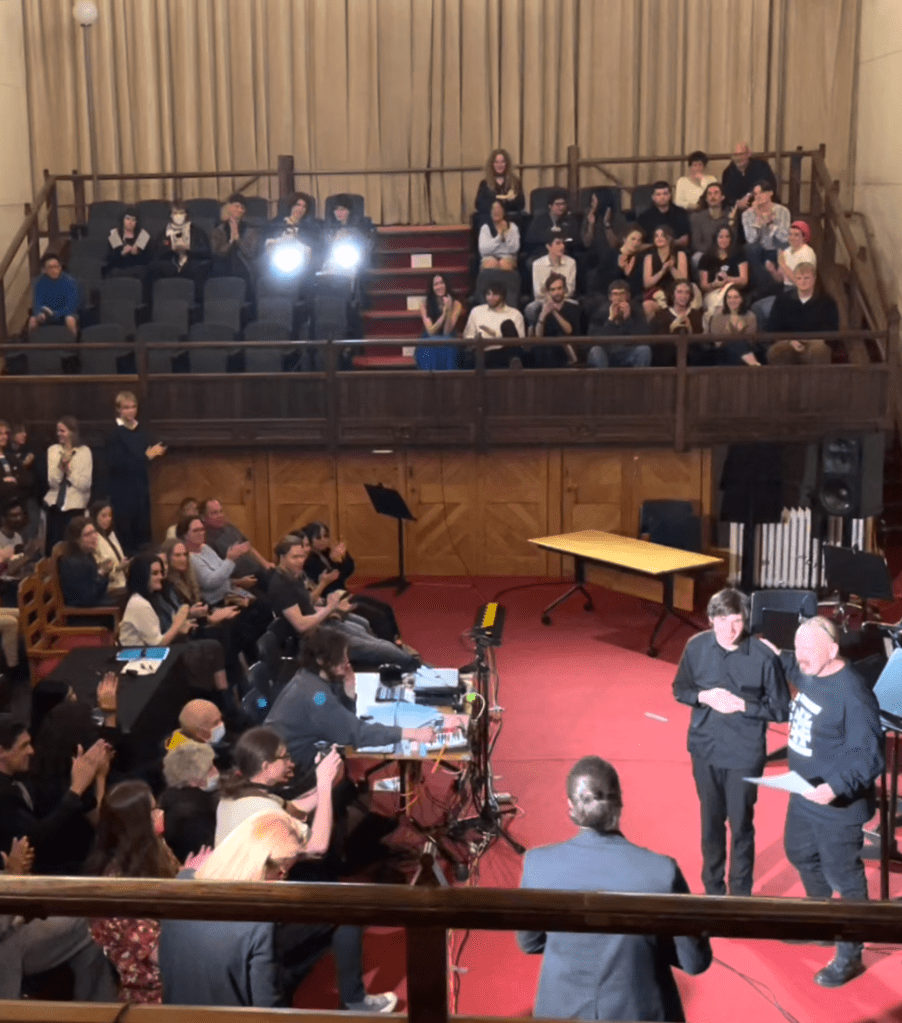
SOUNZ offered to come and video a number of performance associated with the vegetable.machine.animal Guest album launch, as well as a couple of the performances attached to the accompanying exhibition being held at Toi Pōneke. For free! With multiple cameras! and they would do the grunt of editing etc! Quite an amazing offer. My tasks were to perform well, and be responsible for recording the audio – this is quite likely a barrier for many but less insurmountable these days as digital recording devices get smaller, easier to use, and more available.
The video work was completed by Chris Wilson, a production team of team of one. Amazingly easy to work with, and very considerate in the way he set multiple cameras around the stage in ways that did not seem invasive or impinge on the ability to perform. A terrific experience.
I wish again to offer many thanks to the other musicians who took part in these performances: Kedron Parker, Gemma, S. Thompson, David Long, Chrissie Butler, Timothy Morel, Sophia Frudd, Andrew Faleatua (unfortunately not filmed but an audio recording was collected) and Ruby Solly. They are all incredible music makers in their own rights and are worthy of your aural attention.
Home again after four weeks on the road. Unpacked, reassembled, and now time for minor maintenance, repairs, and reflection.
It was a first to embark on such an extensive local tour. One that spanned both islands and explored venues from house gigs, chapels, record stores, bars, galleries, and community spaces. There were a bunch of new towns and venues, and a few familiar favourites. This tour also felt like a grand opportunity to get an update on what’s physically happening in other centres, build new, and reconnect with older, networks, and to experience a bunch of active musicians and bands around the motu. 13 shows were booked, two fell through but picked up a improv show in Lyttelton, and a Live-to-Air on Radio One in Ōtepoti/Dunedin, so, luckily, 13 remained. The log offered zero complaints.
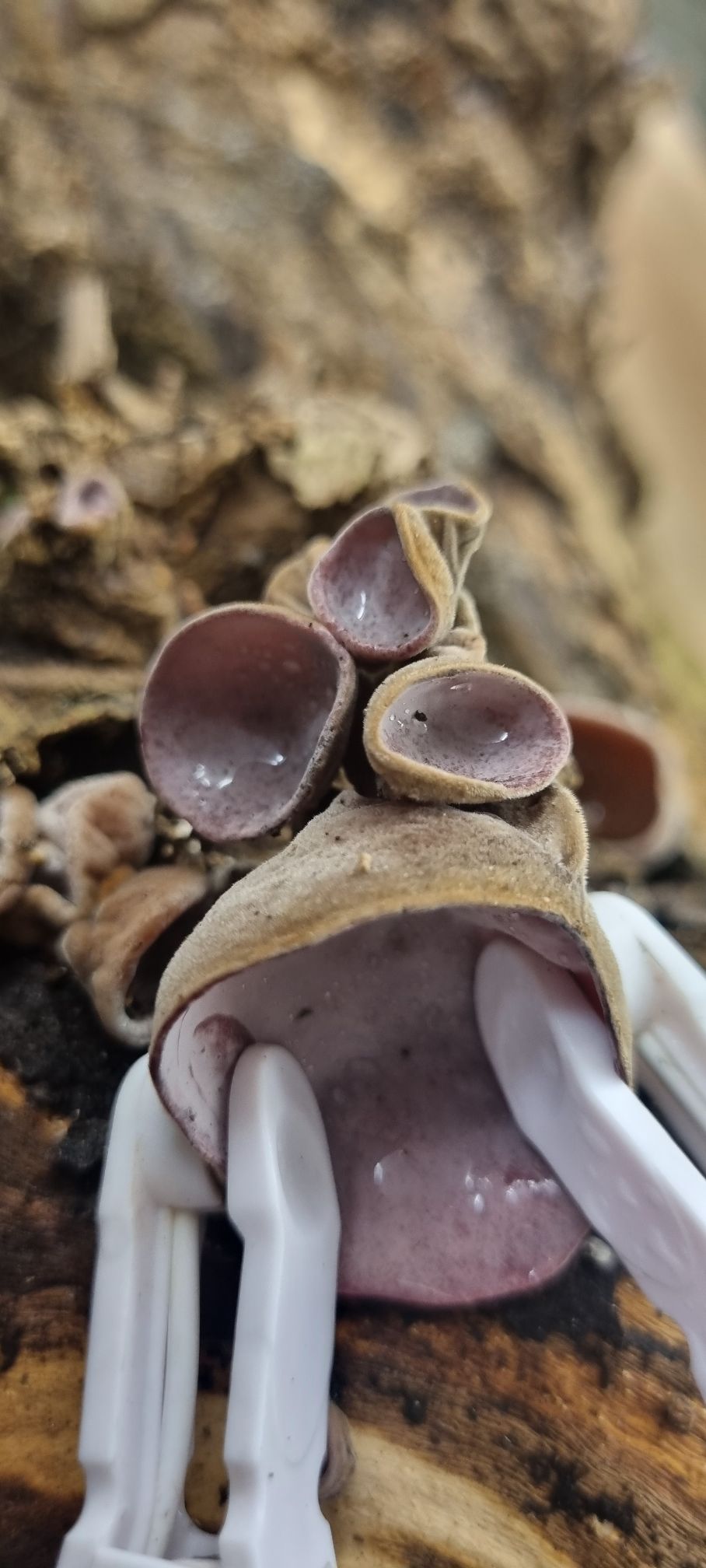
Now in this post-tour-state, I am left with my optimism uplifted. There are strong pockets of community interest and activity who seemed to be interested in experiencing fungi-impregnated and log-powered music. Loads of fascinating conversations happen after the shows. I certainly had a brilliant time and feel confident that the many-varying audiences enjoyed the spectacle as well.
Many thanks to: Sam and Glory [especially for the log!], Tonamu and the Kirikiriroa/Hamilton crew, Jeff and AF, Mark and the rest in Heretaunga/Hastings [unfortunately didn’t get to play but seems like a great network and hope to go there soon], Campbell, Sarah, Snails, Porridge Watson, Ben and Hanna, Zac at Common Ground, Matt/George et al in Te Waiharakeke/Blenheim, Matthew Plunkett, Ruben Derrick, Te Atamira, Fi and the crew of Radio One, Mads & Liam of Hōhā, The Crown crew, Jordan/Matt of Murgatroyd and Threes and Sevens Records – Waihōpai/Invercargill. Also, to Radio Control, Ben at IN sessioNZ, Mark Amery at RNZ, and Radio One, for the radio interviews. Extra special thanks to Fergus Nm for the image for the poster. And to all the bands, bedding, and bonding, it was very much appreciated, let’s do it again sometime soon.
Where we reflect back on the 12 weeks of residency, review whats been done, offer thanks, and review objectives, and round it off with some plum porn
All Hands Make Light – One word removed to change the phrase completely Taken from the band of the same name
I reside, now, post-residency. Is the past tense of Residency, Residensed???
What an opportunity it has been, to have twelve weeks funded, supported, and committed, to the exploration and development of this project. A dedicated time to explore ideas, sounds, and thoughts, to make new connections and networks, to further hone technical skills in recording processes, editing and mixing, image-making, and presentation. To play fast and slow, to play solo, to collaborate, to demonstrate, and discuss this flight of fancy of mine.
When I applied for this residency I provided some goals and examples of evidence of work, that I would develop during this time. Gathering recordings was one of these outputs. And since late September, when the position started, these recordings grew into a substantial two-fold project.
Firstly, I made numerous solo recordings, exploring various ideas like suspended guitar, plant-driven percussive mechanisms, and the good old-fashioned banging away on my trusty drum kit. It has been great to have extended time to experiment. I’m yet to start editing, but I hold an excited anticipation of what will be discovered.
Secondly I held weekly recording sessions for collaborations. This was an opportunity to invite some very inspired performers (Chrissie Butler, Gemma Thompson,Bill Wood, Andy Wright, Tim Morrell, Sophia Frudd, Baxter Grey, Ruby Solly, David Long, Andrew Faleatua, Issac Smith, Kedron Parker and Nico Buhne) who I felt would enjoy playing plant and fungal electronic sounds. Each session was dramatically different from the next and collaborators worked with a wide range of instrumentation including electric guitar, drums, percussion of all sorts, trumpet, cello, electronics, taonga puoro, violin, fagufagu, drums, electric piano, and voice. I also got to collaborate with Mo Zareei who worked with live-mixed bio-signals from VMA, in his own studio setting. I feel lucky to have had the time to interact and play with these extraordinarily talented musicians and sound makers and I look forward to listening back to these session in early 2025.
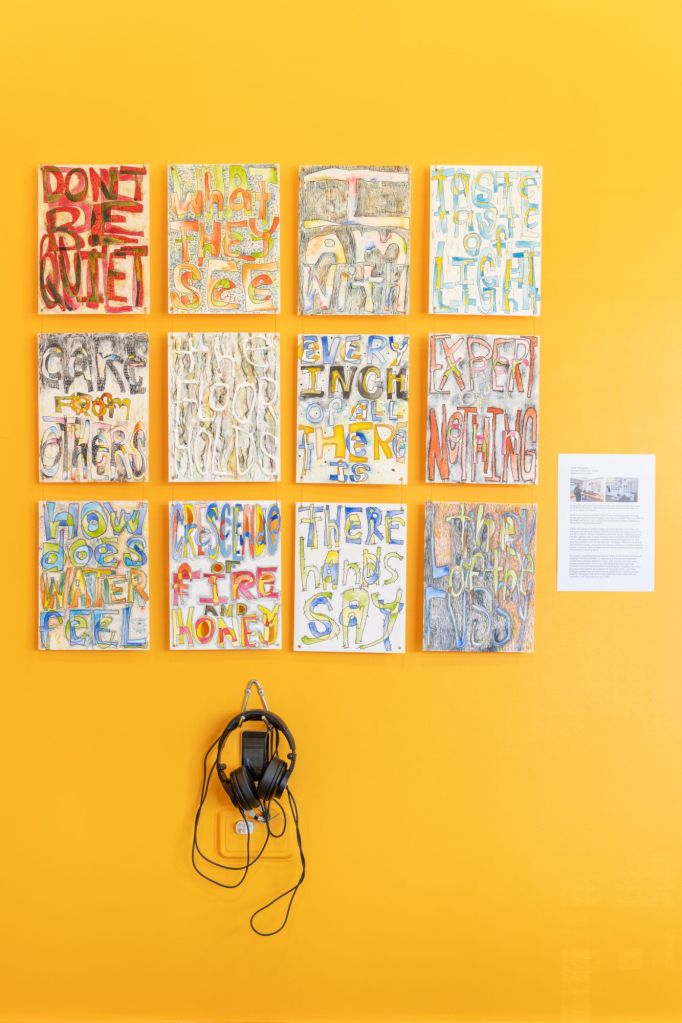
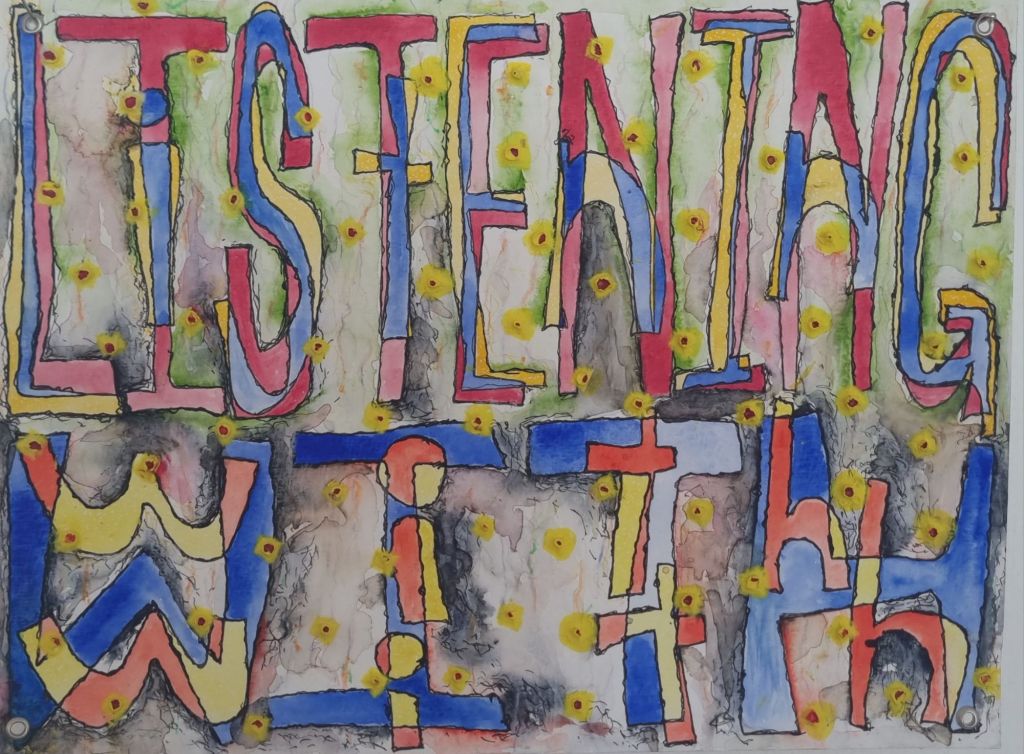
Another continuous aspect of the residency has been image-making. This visual component helps me anchor learnings from readings in a way I can easily reference. They help me to hold multiple ideas and points of view in eyesight simultaneously. I will include the images in the exhibition at Toi Pōneke in June. Twelve of the images have just taken a little excursion to Queenstown, where they have been included in the Use Your Words exhibition at Te Atamira Gallery, which is pretty cool.
A set of images now on display at the Use Your Words exhibition at Te Atamira in Queenstown. Photographer: David Oakley
The last component of this residency and a commitment from the outset has been documenting this residency. I proposed to write online weekly to express thoughts and ideas that were of interest at the time. Although I have blogged in this way many times in the past, one joyful evolution was the inclusion of soundbites, which have concluded each post in a section called Soundbitten. These soundbites started as a whim in the second week and grew quickly into 55 miniature stories that circulate around a key sound source or reference. Over the weeks, I became more conscious of needing to listen to notice the sound stories in the present, alongside trawling memory for meaningful sound memories from the past. The compilation of writings has now been complied with the page ARCHIVE: 2024 Creative New Zealand/NZSM/Toi Pōneke Sonic Artist-in-Residence. The text is currently being arranged into a limited edition print version, available on the opening night of the exhibition in June 2025. I hope it has been something that you have enjoyed.
So here I am newly residenced and it is interesting to reflect on what I expected to do and what I actually did. I suggested I would explore the idea of “a sonic practice for the Anthropocene”. I wanted to explore and develop a sonic practice that:
● places the ‘human’ not at the centre, but as an active ‘collaborator’ in a trio of non-human/tech/human.
● insists the voice of the ‘Other’ is amplified and essential to the voice of the ‘Whole’.
On reflection, I think I have achieved what I set out to do, but the journey is continuous. Decentering the ‘human’ from the centre of the performance and investigating the ideas of a horizontal, interactive, and interspecies framework has been a shared experience. Collaborators frequently stated that it was both novel, and musically exciting, to listen to and respond to ‘other’ in the room. And from my perspective, though I was facilitating these meetings, I did not feel that the spotlight was mine.
As this project continues to develop, I realise the more I become reliant, dependent, on the ‘Other’. There is no way to make this happen without ‘them’. It’s less about ME and more about THIS. Publicly, we are becoming inseparable.
In these crisis times, many would argue that we were never separate, and that reestablishing a re-connectivity to the natural world is essential for any version of future viability. It is not my intention to sound grandiose, but I hope this project is a contribution towards that future-focused mindset. A future that welcomes both diversity and uniqueness, makes space where the needs of the individual are respected but do not trump, dominate, or compromise the needs of the myriad cohabiting communities.
Soundbitten:
These days, I only ever see you at the supermarket. In other times, it was at gigs. I’d just brought an ice cream for moko, you were bus-waiting with hubby. Always, we hug. You tell me “ I’ve been reading your writing”. Recount back to me the stories I wrote. Those little bits of sound, experiences that could have been yours. I listen back. Bitten, it’s life after the bite.
Margaret Sparrow, song bird, vasectomy queen. I’m on a slab, voluntarily. Shaved, prepared, anesthetized with local. It’s simple; revel, snip, seal. Twice. She works, cautery device in hand, singing with her sidekick, to work songs of Gilbert and Sullivan emanating from a tape deck on the shelf, “I am the very model of a modern…”… Hello mr sterile!
These hills were quiet when we arrived. Denuded of green by farming and fire. Then it was gorse, blackberry, weed. Once upon a time, here would hear the heat, the sound of ‘progress’, the colonialist act of razing. But if abandoned, the wilds return. Hushed at first. Now, the dawn valley’s boisterous with chatter, choir, clarion call, chimed bell, clacked gong.
From a distance, a whisper this way comes. Hush turns to hiss. Like the persistent sound of approaching train, but not. It falls, dancing. One thing meets another thing, times multiple. The raindrops play the leaves like drums, the percussion of wet onto leaf litter. Then the downpour hits the roof, a curtain, a wall, a wave of water, tap-dancing.
How does the plum sound? Do branches hear pollinators in blossom? Do flowers sigh in post-coital germination? The bees gleeful buzz when dusted in pollen? Who hears petals fall? Or the nutrients, fluids, directed to the swelling buddings? Does the Sun sing lewd songs to make the fruit blush? It’s unknown, but I know how the light tastes. Hear my delight as juices burst free.
Thank you to the following: ●To the collaborators who came along, shared their skills, talents, and willingness to play with this project ●The staff of the New Zealand School of Music who supported my explorations and requests ●All the staff at WCC Tōi Pōneke Arts Centre for making me feel welcome and sharing lunch time banter ●CreativeNZ for the funding ●To all those people who stopped by and shared their curiosity ●To the other art workers in residence at Tōi Pōneke ●Thank you to you for reading this far! ●And the most massivist! Thanks! always, always, always to Chrissie for everything!!
Where we discuss Nothing, Something, Scenius, The Residents, Crass, Pyramid Club, and SABOT.
How can Something come from Nothing? It’s been a thought doing the rounds in my skull recently. Mostly in the context of how an act of creative hopefulness can turn a blank page into something less than blank or an empty recording session into something containing nuance, hidden surprises, and spectacular noise.
It is, of course, a silly idea. There is no such thing as Nothing for Something to come from. Something always comes from something else, evident, obvious, or otherwise. I did not start from a point that contains no things. I could not write this without a backstory, a previous, a moment leading up-to. There was no blank page. Nothing is an illusion that contradicts itself because an illusion is Something.
Nothing may be less about the actual absence of Something and more the actual evidence of a blindspot we carry with us as move through the world in our simplified way, waiting for a perceptive shift, an inspiration, that teaches us to see anew a thing that previous lived in the invisible.
At one point in the past, when the human eye looked into the smallest places of the World, they were unable to see anything. They thought these spaces were inhabited by nothing. The invention of the microscope changed that forever, and a whole new strata became evident and present, riddled with things. What was once invisible could now not be unseen.
Up here in the land of the human, there are those who are lauded for the ‘creating’ of something from nothing, often called Genius, or Artist. It is an idealistic concept of a rarified creative individual that others can put on a plinth. There are generally financial attachments and investments in such positions. But rarified is not the same as rare. Creativity is not rare at all.
Genius is an overused word. It amplifies the suggested brilliance of the individual.
Scenius is an underused word. It is a word that amplifies the brilliance of community.
Coined by musician Brian Eno scenius “…stands for the intelligence and the intuition of a whole cultural scene. It is the communal form of the concept of the genius.” A scene is an ecosystem where things feed other things. It can nurture and prune, hold spaces for exploration and fine-tuning of concepts. And scenes become incredible when they become intergenerational. A scene is also difficult to commodify and monetize.
For me, The Residents, from San Francisco, are a band who fit this bill. I first remember seeing them on the TV show, Radio with Pictures, on a Sunday night in the early 80’s. It was the video for the unforgettable “Moisture” from the Commercial Album.
The first of the one-minute movies is the song Moisture
This band became infamous for its anonymity, iconic for the eyeball masks they wore. They made music, videos, visual art, concepts, performances and confusion. The line-up anonymously seemed to shift (around an unnamed core), change, adjust as required, and actively avoided centring on a personality. And around this act were a bunch of other bands, not sonically the same but connected into a scene, encouraged by a shared like-mindedness to explore the odder corners of music and art.
Crass LOGO
The anarchist punk collective, Crass is another group that does this for me. They were overtly political in their sound, visuals, performances, and community-making. When I was young, I was in awe of what seemed like their overarching conceptual genius, but now I realise it was the brilliance of the many participants that enabled this effect. A cohesion of a community working together, each to their own strengths, creating something far greater than they could have done individually. This, in turn, inspired others, globally, to create and participate, make music, art, publishing, political activism, and much more beyond the output of Crass.
Pyramid Club LOGO
Another more local example is the Pyramid Club. It is an incredible hub which is “…the home of experimental music and sonic arts in Te Whanganui-a-Tara, Aotearoa. As an artist-run organisation and venue dedicated to experimental practice, Pyramid Club provides a physical and conceptual space for artists whose work falls outside the scope of commercial performance venues.” And it does what it says it does.
Of course, there are people responsible for the administration, but the venue both fosters and flourishes from a vibrant and healthy community. There is such an incredible array of explorations and expressions of music making from across multiple generations. Prior to Pyramid was Freds, and before that was Happy, and before that, The Space. Nearly 30 years of continuous venues for the musical oddballs of this city. This story goes back further to the early 80’s when punk arrived in a very different city. Into this space came another scene, the Primitive Art Group, a free-jazz gathering, who have recently had their story told in the beautiful book, Future Jaw-Clap. Some of the Primitive Art Group can still be seen performing at The Pyramid Club today.
A scene is more than environment, it is ecosystem. Entangled connections going both ways in time. Like a fungal mycelial network, it has sought areas of nutrition and connection. Some connections sustain, others shift and change as people come and go, commitments and demands take precedent, and life changes. But there is enough of a mesh knitting this all together. Growth takes place in multiple areas, and in unpredictable ways.
My introduction into this community started in the late 90’s at The Space in Newtown. It was a venue welcoming to my ideas of festivals, shows, film-nights and other events. I also learned from the exposures to new and unknown things. I am immensely thankful for the opportunities and exposures, the connections, friendships, concerts and opportunities experienced since then. I could not do now what I do without the brilliance of the local scenius, the individuals that make up this communities, playful, quizzical, committed, serious, and persistent.
These ideas all tie nicely into the concept of D.I.Y, Do it Yourself. An acronym that came from a time in punk rock when the only way to release music, organising shows etc was by doing it yourself. It made a lot of sense at the time. But I feel that it’s an idea that needs an update. Many of those original challenges are less of an issue now we have the internet.
Sabot album cover
Then I think of the wonderful band SABOT. Originally from San Francisco, later resettling in Tabor, Czech Republic, where they embarked on a project of scene/community building. We met them on their first tour of Aotearoa, and for us it was another life-changing experience for the better. The album they were promoting on that tour is called D.I.O – Doing it Ourselves. It is a statement of the intent of the We, the Us. This is the update to the loneliness of the ‘Yourself’, a return to the brilliance of together.
None of this is from Nothing. And none of this is for Nothing either. Don’t let anyone tell you otherwise!
Soundbitten:
It’s been a long time. When were we all last in one place? Since before the virus? I stand here, by the sounds of frying, and kitchen sink, preparing a meal for this celebration. For us gathered. And I listen to all your voices. The details are missing but the chorus is sublime. The rise and fall of each other, the laughter, the comfortable silence between. What a song!.
It’s there again! Is an angry wasp in my pillow? Something’s definitely hinting Wake up! I’m too sleepy to be really worried. There’s no pain, I am not roused to action. Space is sated in silence till the next bout of yelling. Wake up! The sleep is deep. No pain means no action. Shhh little bee, go back to sleep, enough of the buzzing, you’ll wake the neighbours!
Hear unison from the second floor opposite. Go outside, get closer. Maybe Mandarin, Cantonese, a dialect? I wouldn’t know the difference. Some percussion holds time. Strings duet with the women of that room, singing songs of other places. Listen long enough, repetition, reprise. It’s free from the window, echoing between buildings, between worlds.
Simple times and simple kids, the rules were clear, it was one or the other. Punk or Metal. Sex Pistols or Judas Priest, One-Way System or Iron Maiden, The Damned or Motorhead. Who set these demands, idiots most likely. Regardless, the Sex Pistols won, like a three-chord distorted religious epiphany. An earth-shifting energy bending these ears forever.
Experiment: Three glass vessel, three pea-shoots. Observe patterns of root growth. No.1: Water flows into one corner. Observe: Roots grow towards the water. No.2: No flowing water. Observe: Searching and branching root distribution. No.3: A speaker playing recorded water sounds. Observe: Root growth towards the sounds. Question: Do they hear?
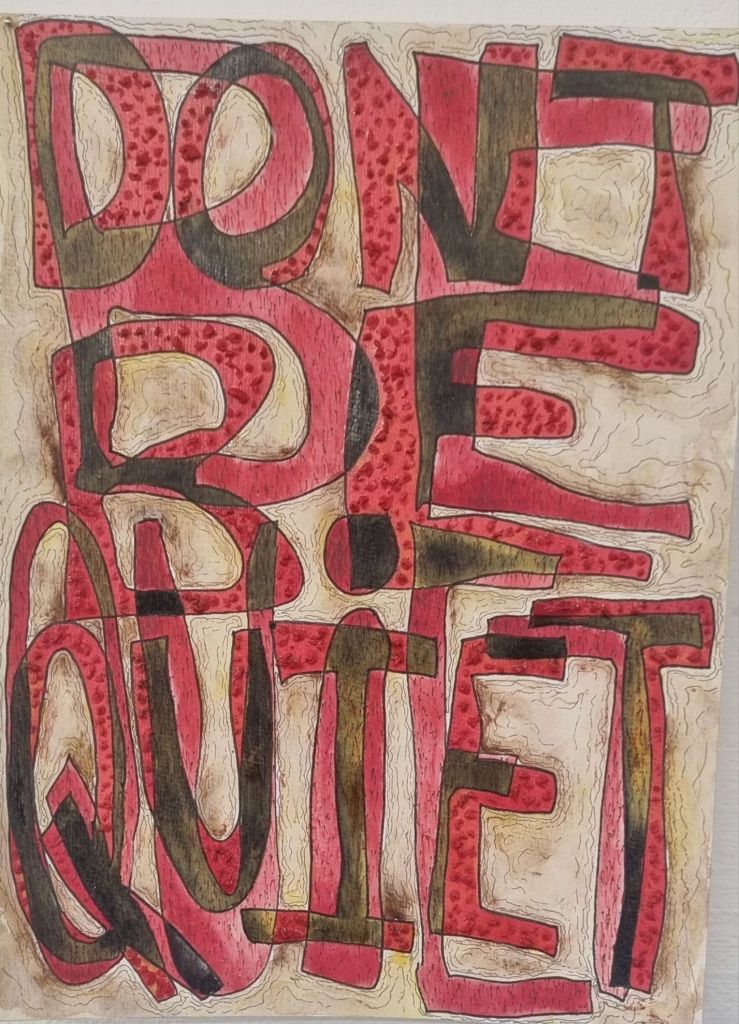
Be Quiet. Don’t Be Quiet. A response from a doco on Ai Weiwei
Week three starts on a Saturday. I have been asked to be one of three ‘adjudicators’ for the annual Lilburn Trust NZSM Composers Competition. An adjudicator is a fancy word for judge. I’m to provide insight in determining the pieces of music to receive the annual awards! There are 14 compositions in total, from an array of various university music departments, from classical composition to electronics using AI, from jazz to somber to pop. The selections have been pre-selected from students at differing stages of their study.
We are given the scores to the music to read during the performance. I am unable to do this. It’s a skill I’ve never learned, but I am able to listen attentively. The things I rate are:
the aliveness of a performance
the interactions between performers
the things the performance does to me – what does it evoke?
those things that take me by surprise
those things that don’t
the before’s and after’s of the performance
the self-responsibility and consideration of stage management-or lack-there-of and
does the performance match the text/hype of the program
I realise my years of gigging and touring have taught me a great lot of skills that may not be so obvious from the academic tradition. Things that I realise are not so considered here. And I am sure there will be many things I am missing precisely because I have one set of experiential skills instead of an other, more formal, set. The other judges all look at the quality of the script, how the performance adheres to the composition, and how the composition follows certain musical conventions that I am 100% ignorant of.
After hearing the 14, we three have a rapid and robust deliberation deciding on where the awards will go. Happily, a diverse range of performances are selected, acknowledging technical ability, compositional quality, consideration of stage and space, performance bravery, and adventurousness of the composer. But all the performers and composers are deserving of acknowledging and commendation. My final encouragement would be to keep pushing the boat out!!
Best Performer award to Nathan Parker
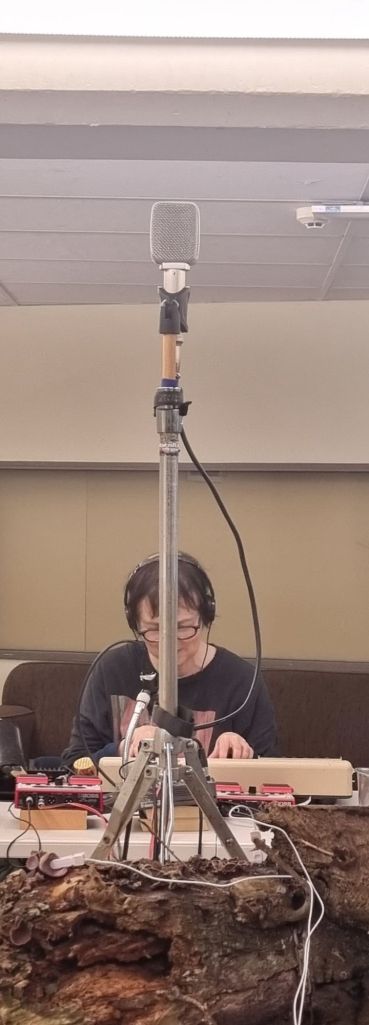
There is additional newness for me this week. I have a rehearsal space available now every Tuesday, at Toi Pōneke. These are now my main recording days. They also come with a specific focus on collaboration. I invite Chrissie’s project DSLB in, I am safe in her tolerance as I may need to troubleshoot unexpected technical hiccups. The main challenge is to ensure that the right technical equipment is on hand to enable the best recording … it seems to be sufficient. To support this, I have access to some nice microphones from the NZSM. It all works perfectly and after a full day of intense playing, we collect two and a half hours of recorded material.
Near the end of the day, we are both become aware of the fatigue from exertion and concentration. I encourage ‘one more piece’. A lot of sound-ground has been covered. The instruments have been put through the routine of the first familiar and then unfamiliar explorations into sound territories. We both feel a bit spent. But we do it, one more lap around the racetrack. Finishing up, and listening back, what we have hauled in is a lush, atmospheric, angular piece of wonderfulness. it’s going to be exciting to share this work soon.
One of the proposed outcomes of this residency is the making of a V.M.A album. I’ve already done a fair bit of loose, improvised, and searching noodling playing to settle in. This week a framework has started to appear, a framework from which I can hang ideas for the next 9 weeks and beyond.
Almost all of the albums I have been part of in the past have been made during tight times squeezed in and around the rest of ongoing-life. Having slow time to mull on ideas, to consider structure and dynamics, and to explore with dedicated intention is a new and unfamiliar space; luxurious and wonderful.
This time also presents a confronting opportunity. It says ‘here is the time, what do you want to say?’. Brevity and seriousness can flatten playfulness and curiosity. Playfulness and curiosity can distract from the serious act of completion. Somewhere in between there is a middle ground, a place that teeters, a foot-in-both-camps space, and a pivot point that never settles into complacent stillness. It is a sweet spot of creative precariousness and I feel confident that for a time on Tuesday, we were visiting that place.
May this shifting ground hold me up.
SOUNDBITES:
The melody is guiding my eyes. I become aware, during the performance, that with each change in the music, so too my gaze alters. I’m look upward as the saxophone goes into the higher register. The higher the note, the higher the view. My vision takes in the floor as the lower notes are blown. It’s as if my eyes alone are dancing. The observation of observing my eyes from the inside.
We wake before the shake. It’s a gut sound, a frequency outside, the house, and our hearing. It is registered in the third-ear of the diaphragm. Guitars bounce on the walls, and the resonance of strings wakes as Richter waves roll through the house. We’re waiting for the next one, with deep and attentive listening in impending silence.
A cafe house-stereo is playing a grandiose metronome. The three on my right are talking, and I’m inadvertently listening in. I think the words are familiar, but doubt suggests that it’s not my tongue they are speaking in. A dialectical similarity, maybe? Maybe from somewhere else? Is it my hearing loss at fault? Or the terrible acoustics?[but excellent for privacy] Maybe it just their enunciation? Maybe it’s none of my business.
As the crow flies, we are as close as 9100kms apart, but you ask, ‘Can you hear the busy street?’ You say next to the alleyway of your home is one of the cities main transport arteries. Also, you say, beneath the path in front of your home, is one of the old cities canals. ‘Can we hear it?’ I can hear my belly rumble for dinner, while, perhaps, yours is sleeping just after lunch. This time next year, we will be Here. Then we shall hear.
The flue of the fireplace is becoming a home for a bird. Claws, like a record players’ stylus, resonating on the circular stainless steel. Each morning, during coffee, we hear its movement. When we move, it stops. Perhaps the chimney acts as a two-way telephone, like old tin cans and string. Or an early-warning stethoscope into our room, alerting the blackbird of downstairs-action. It’s a precarious position to bring kin into the world. We will now be avoiding fires while DJ Blackbird scratches around up top.








 skirted Records