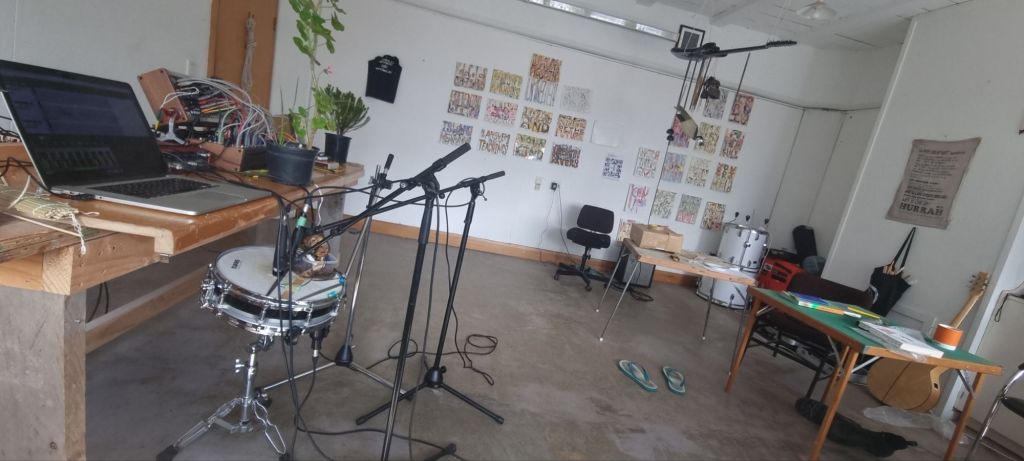
The residency was open in terms of output. No external pressure to “make a thing”, just a chance to nudge some ideas into the light. After a few days of pulling a random array of instruments out of cupboards and off shelves, I settled on working with 6 organs, a prepared piano, a glock, a selection of bowls and sound makers kindly lent by Chris O’Connor and two metal trolleys.
Jeff Henderson, AF director, generously mic’ed everything up, set me up with a recording session on Reaper, we set levels and he left me to it. It is rare that the gig room at AF is unscheduled for such a long period, but the clustering of stat holidays resulted in a gig void, some time off for the AF team and an empty room for me.
It was a new experience recording in a large space for days at a time alone. It took a while to drop into that mental space where the rest of the world fades and your focus narrows to only what you’re making. I value these times out of time so much.
I didn’t really have a plan. I knew I wanted to bring home a collection of tones and drones but beyond that I just played for hours, listened back, culled the dross and kept ideas I felt I could develop. Once I had a first cluster of ideas down from each instrument, I moved everything from AFs computer to my laptop and began overdubbing. This was a more familiar way of working, layering new sounds and ideas up in real time, playing along with myself.
When I’m working like this I often take and make videos. They help me see the sound as well as hear it. Below is an example.
Huge thanks to the Audio Foundation (especially Jeff and Sam) for the invitation and opportunity to spend 8 days researching and developing new work. Thanks for making me welcome and making it easy.
Once upon a time, I worked in health as a nurse. A key principle when working on a ward was to plan for discharge on admission, thinking about the exit during the entering. It helped with treatment planning. I don’t do that work now.
When I started this residency, there was no way I wanted to think about it coming to the end. But 12 weeks is twelve weeks, time passes, and I catch myself thinking about how to wrap it all up, planning to ensure I have captured as many recordings, and as much other material, as possible, especially with a view to the coming year.
When I think about the shape of 2025, the first few months will be busy assembling the recordings into albums. At present, there will be at least two, one of solo works, and a second of exquisite excerpts from the collaborative recordings gathered during this time. Also there will be an exhibition, scheduled for June at Toi Pōneke, and this will be the grand culmination of this residency, the release of the albums, a sound installation, and accompanying media like video and pictures. I’m also in the early stages of blocking a tour of Aotearoa in July, from top to bottom [if you are interested in a show in your town, then please make contact]. And towards the end of the year, both Chrissie and I are going to Tainan, Taiwan, for a residency.
There have been some substantial life changes in recent years. This has, in its own way, moved these opportunities into focus. For the next few years, the primary efforts are to apply maximum effort to see where this project might go. To commit my finite time to see how this work can develop. All the previous projects, tours, and paraphernalia have been gleaned in the spare spaces around a life of full-time work and parenting. I see this, now, as my one chance to push the potential of this project as far as my bravery will take me, and without expectation. The doing is a success.
Someone asked me if I’d like to continue with a hired studio so I could come and go as I please in an ongoing way. I feel the answer for now is, “No thanks”. I like the delineation of time, the finite space, and the limited resources. The idea of time ticking away helps me to focus my attention. I work better if I have a clear idea of my limitations, boundaries, or some provocation to work towards/against. I would be useless if I had access to all the toys all of the time. It’s one of the reasons I like my limited drum kit. It has specific dimensions, tones, and voices, but I am constantly exploring to see how far I can push these set parameters into new areas that will be interesting to me. It’s like the entry point is set and fixed, but I’m constantly searching for new exits.
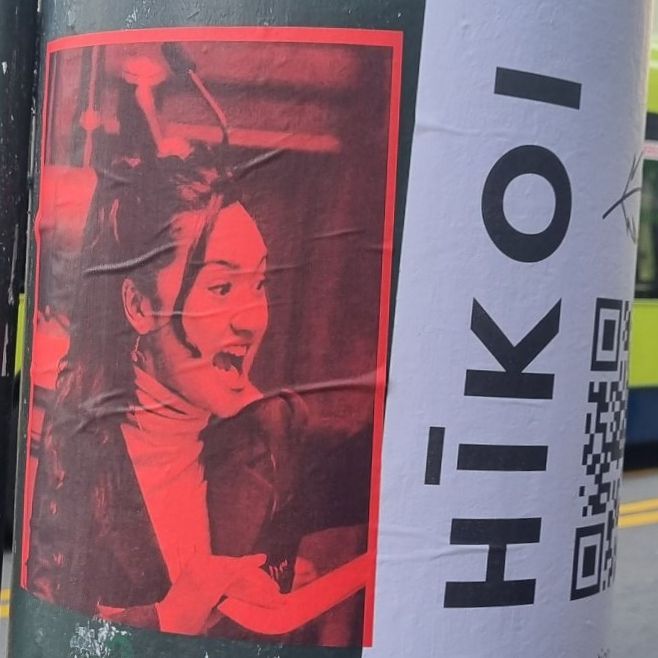
Defience on a powerpole
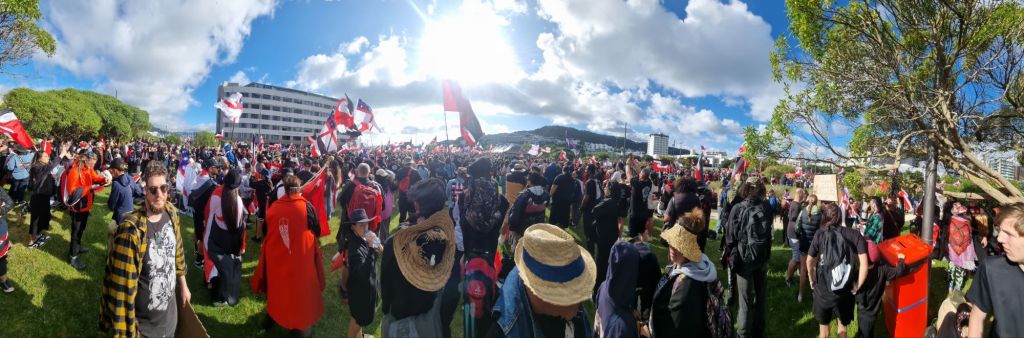
This was the week of the Toitū the Tiriti Hīkoi. Estimates of between 45,000 to 100,000 people gathered in the city to oppose The Treaty Principles Bill, proposed and pushed by the right wing party, ACT. It is a dog whistle for racist politics and behaviour, and an extraordinary waste of money given ACT’s coalition partner said they will not support any further. And some astute analysis has pointed out that this has nothing much to do with equity or equality of race politics, but more to do with the removing of any obstacle for corporations as they eye up resources for exploitation. It was a remarkable gathering to be among, incredibly focused, uplifting, and clear in purpose and message. It is the largest protest in this country’s history. It was not the end of a process but a start. Tiriti forever!
The various assembled instruments of Kedron Parker. Photo: K Parker.
This weeks collaboration partners were musician David Long, sound artist and photographer Kedron Parker, and son Nico Buhne. Each session was incredibly different from the other. David brought cello, acoustic guitar, and effect pedals. Kedron brought hand-made drums, a two-string viola, random percussion, voices, and other sound making nic-nacs. Nico brought a trumpet and tootled beautifully. Both fantastic sessions, which are cooling their heals on a hard drive, as I need some distance between the recording and the mixing. This boundary is essential.
Percussive petals inside drums, inside drums Photo: K Parker
Soundbitten:
It gathers like wind in restless trees or baritone bees. Not hive mind, but like-mind. Individual x thousands. 10,000 sing, unison in union. Over the hush of 12,000 a Kuia calls. 20,000 in tune. 30,000 walk the talk, 40,000 vocal, 50,000 loud. Numbers are drowned out. It sounds like carnival, kids, music, chant, laughter, haka, solidarity, opposition, a position.
12 women’s fingers resonate the mouths of wine glasses. Old men beat a table with canes, slam books, teach pain. The sauna roars with laughter, amplifies the shame. Madonna screams at photographers, fights the paparazzi, wrestles them into stones. The music is the metal of strings and of metal. Jarman’s Garden is full of silence till the sound comes. Lights…
It’s her mother’s flower, her late mother. Although the flower is cut from the root, it contains the energy of life from the cells within, decaying. She lost her, recently, it’s still fresh. Fresh like a flower removed from the stem. But with two sensors on the greenery, essence appears, invisible but audible. And she can interact in any way she sees fit. We hear her.
He speaks words – they hear lies – they hear facts. He talks to camera – they hear inflammatory – they hear solidarity. He says sentences – they hear confusion – they hear inclusion. Like all good performers, he knows his audience. He’s going to make it all great again. They applaud. He shouts at them. They cheer. The music must be loud. He dances.
It’s a box of sound reels but no machine to translate. Those voices lost, there but trapped, obsolete. A suitcase full of cassettes, duplicates, one-offs, moments captured on magnetic magic, parts of parts of the past frozen in time, sometimes in 4/4, sometimes 5/4. Under a container of CDs, burned but cooked, new tech that has already met with entropy.
It’s something I’ve been thinking about for a while as I prepare some pictures for an exhibition. I want them to float off the wall, hanging from each other at 40mm distance, and have a breath-like flutter. Flutter is not the right word, I’m after a rigidity of movement, something like an articulation. If the paper is too paperly and the connections are lightweight, then the overall assemblage twists. I want to be able to dictate the physics of the swing.
The architecture of the paper needs to be bolstered. On the back of the sheets, disassembled bamboo mats become the near- invisible framing. For the pictures to hang from each other, I make something like a big staple from sturdier wire, which has less intrinsic movement. These are then spray painted with a bright orange to light the mood of its weightiness. It achieves what I’m looking for.
Tuesday. I can not make it work. I’ve spent the last 90 minutes trudging this equipment downstairs, setting it up to record, and now nothing. Has it been damaged it in the move? Why is that always the first thought? It was working fine before but now only silence. For 10 minutes, all the lights have been flashing like a trashy disco, but not a peep of sound. Check cables, sensors, connections, and power supplies. I look for the obviously simple reasons before catastrophising options arrive.
However, the answer to this issue is simpler. It appears that the fungi are withholding their signals. Sleepy fungi. I spray a bit of water onto the mushrooms. The moisture improves the transfer of signal-to-sensor. I reconnect the sensors to the damp flesh and sound bursts into life, with life, from life.
I’ve made this mistake before.
In the beginning, before this project was a project, I had no idea what a modular synthesizer was. When my first modules arrived, I could not make them work. I leaned on the wisdom of Issac, the only person I knew locally who was informed about such arcane things. He generously lent me gear and knowledge.
Perhaps it was during the second ‘lesson’.
Isaac came over home one evening. Huddling over the equipment, watching closely as he looked skillful in his extraction bleeps and bloops of sound. We were completely focused on the machinery. At some point, though, without obvious reason, sound stopped. I watched on as Issac problem-solved – checking cables, connections, etc. He appeared mystified, I was beyond lost and unable to help. Some inkling prompted him to poke the plant. Then, as if re-energised, sound returned. Should I anthropomorphize the moment, I would think it was the plant playing tricks on us, going, “Oi!! … I’m here as well, get your head out of your geek, and pay attention!!” Such rude foliage. But it’s got a point.
This was a small act of relearning, of where ‘else’ to place attention and consideration. That it needs to be in more places than one. How often do I need to be reminded that invisible things have influence? The world is haunted by unseen things and their own connections. We are at the mercy of the obscure and opaque.
–
Back to Tuesday. With the sound issues resolved, I set about re-recording a piece from last week. I didn’t have enough microphone stands, so I dangled cables from the aluminum framing holding up the suspended ceiling. I suspended two microphones, one over the rack tom and the other over the floor tom. If I clumsily bump the mic, it will start to swing over the drum. The movement of the mic collected the sounds emanating from the skin as it approached, traveled across, and departed from the drum as it swung through its arc.
I realise I can use this clumsy action with good effect. I reset the mics over the drums and let them swing. I press record and capture the movement in action. Timing, linked with tempo, are cornerstones in the act of metronomic drumming. But in this instance, the timing is determined by the physics of the swing. As momentum diminishes from the swings’ natural reduction in distance, there is an audible increase in frequency of the beats. I record several takes this way, using different mics and drums, building up a set of tracks that feels like it has some sort of regularity. I know it doesn’t.
[Later the Youtube algorithm shows me a piece of music by musician Steve Reich. He had used microphones in the same way but over guitar amps, playing with the feedback. I think I like my version more.]
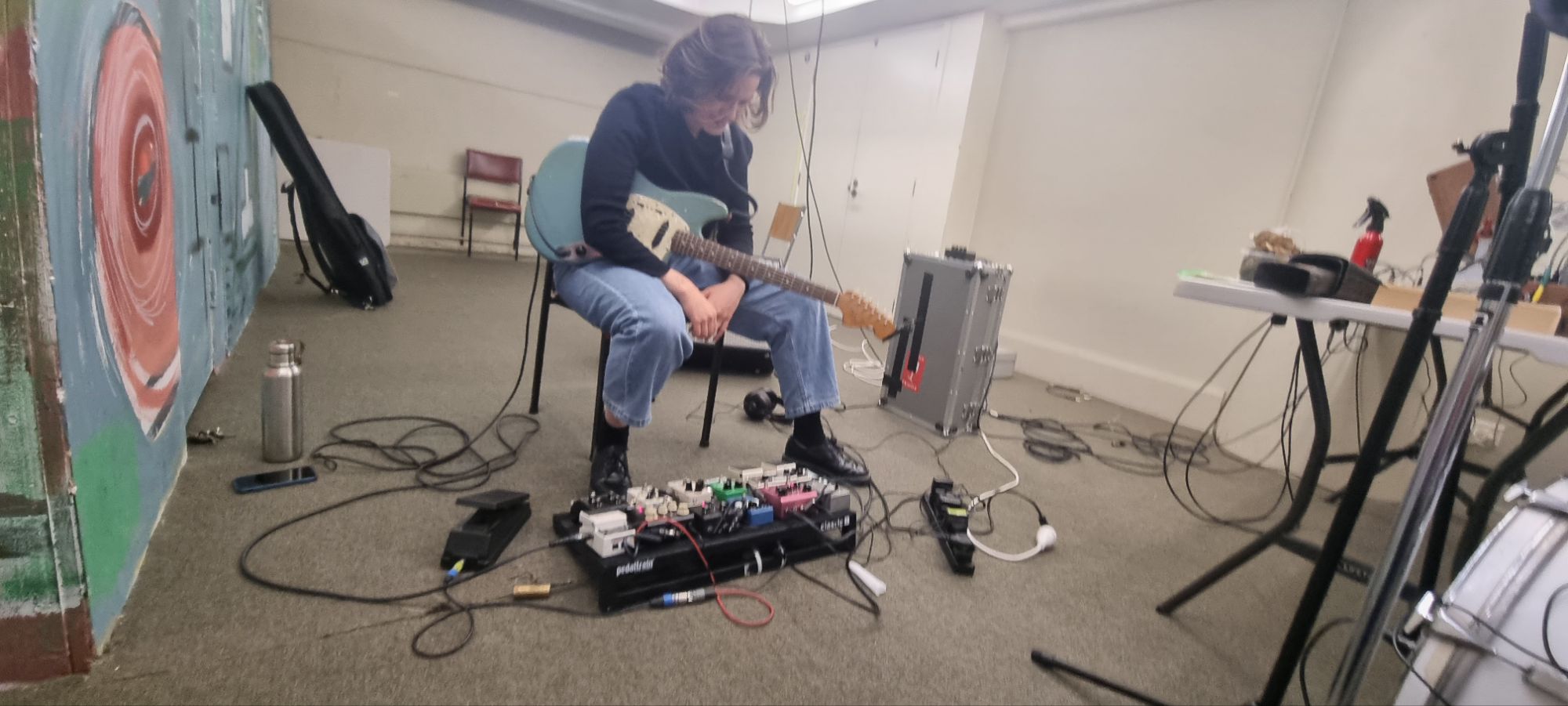
In the afternoon I’m joined by visual and sound artist and guitarist Gemma Thompson. Gemma is also a regular inhabitant of Toi Pōneke. We have only recently met. We have chatted a couple of times in the kitchen, and have never heard of each others’ music, other than a short clip she played to me from her phone of a recent concert. It is an interesting way to meet someone through sound rather than words. There is a confidence required to be able to let go in the company of a stranger, the urge to self-censor, and self-limit can hobble opportunities like these. It’s a good practice to work against these things.
I host an open studio on Wednesday evening. It’s an open invitation to present the current work-in-progress. And I get to demonstrate how the machine/plants work together. I am both surprised and heartened at the number of people who come through. There seems to be genuine interest in the project, and many are willing to take part in the chance to interact with sound making.
One demonstration that gathers attention is where I place one sensor onto the plant/fungi and the other onto a persons’ finger. No sound is made until the circuit is closed by the person with the sensor connecting with the plant. We expand this by bringing in extra people, as long as they hold hands with the person connected to the sensor and the person at the end of the line touch the plant/fungi. It’s possible to hear audible changes in the sound from this bigger loop. Sometimes, it seems to take a little longer for sound to register, and the rapidity of the signal changing seems slower. But there seems to be something awe-inspiring for people when they have the chance to become part of an organic loop, part of a connection that makes this sound. It is almost as if the connection is more important than the aesthetic.
The week wraps up with a lichen-influenced mechanism playing metal chopsticks on a snare drum. It was a useful distraction as the swing states gave Trump his victory. So much had been written already with an air of certainty about what will come. I’m no soothsayer, I’m making no predictions. I trust the fact that Trump is not breaking the rules of physics. Negative does not exist in a vacuum. For there to be a negative-in-charge, somewhere there exists a positive. I’ve no idea what it is. It seems invisible. But if I must remind myself of one thing, it is that the invisible also has influence, and most things deemed certain never are.
SOUNDBITTEN:
One door over, a Kango hammer bites into concrete. A metal tooth drumming on the solidity of the wall, intermittent in attack, dusty in effect. It has a jangle in it’s voice, bells chime as the engine powers up. Another machine over another fence chews into spring grass. It’s a two-stroke throatiness, undulating in pitch, as it works against the resistance of rapid weeds.
A bird sings twice. First from the bough high up in the Eucalyptus, air astringent with fragrance. The second as the echo returns from the bricked house opposite. The quickest reverb. Sharp like a smell, piercing to the ear like molecules to the nose. Reminds me of a text that says the smell of fresh cut grass is, in the language of the garden lawn, screaming.
The show was over 20 years ago. I’d been to plenty that had left my ears ringing in the past, it usually stops after two or three days. Not this time. Loud laptops, pure digital tone, my drums in the crosshairs of the P.A. I hear it now. I’ve got strategies to cope with the constant background sound. Stress is a volume knob, a red flag, a siren’s call to attend to some inner need if the ringing starts screaming.
There were only partitions between the bed bays in the long corridor that slept 80. Mine is next to the Dorm master’s door. No privacy. No quiet space. Lights out. I would hide the walkman undercovers, listen to the Sex Pistols on headphones. Lights on. Dorm master had me on display to all, getting six of the best for my sonic indiscretion. It won’t stop me.
I make mixtape for road trips in the car, all the favorite songs in one place. Pack the kids and go south for summer. Along the coast, the song Motorhead comes on. At the same time, kid 2 throws up. We stop, clean up, and carry on. Down the road Motorhead returns. And like an allergic reaction, kid 2 throws up again. Stop, clean up, put the tape away, and carry on.
Toi Pōneke Arts Centre and Victoria University’s New Zealand School of Music—Te Kōkī (NZSM) are delighted to announce Kieran Monaghan as the 2024 Creative New Zealand/NZSM/Toi Pōneke Sonic Artist-in-Residence.
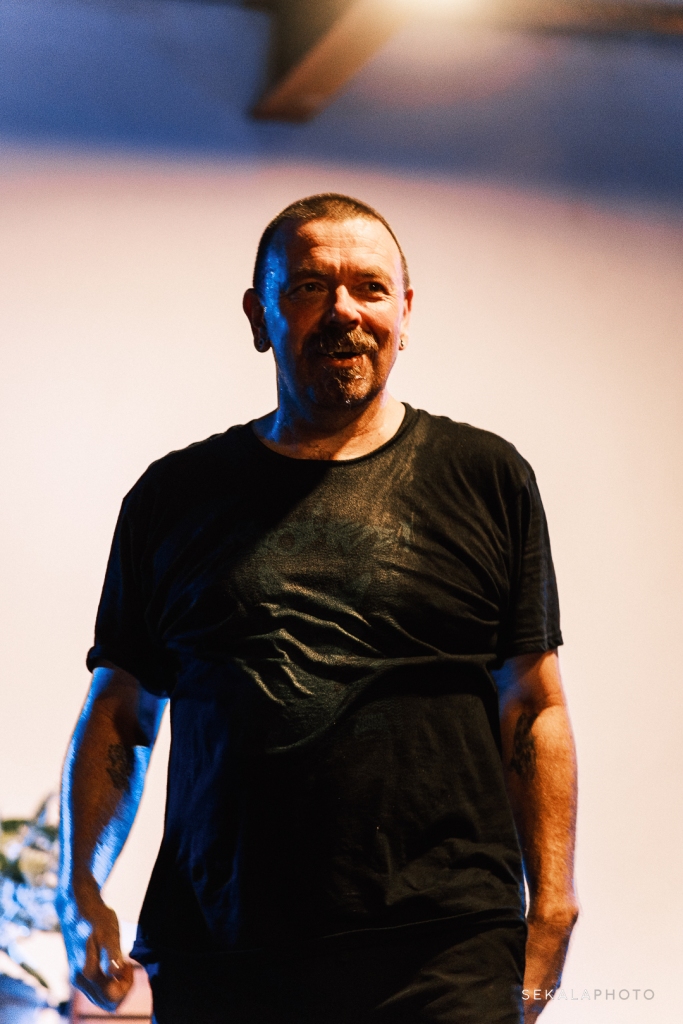
Kieran Monaghan (he/him) is predominantly, and persistently, a drummer and percussionist of found sounds. He calls Te Whanganui-a-Tara/Wellington home. His first crude musical steps were in the late 1980s, playing drums in southern punk rock bands. Heading north in the 1990s opened new musical domains such as theatre with Red Mole, and its little sister Roadworks, and the diverse arrangements of free jazz that tumbled from venues such as The Space. While continuing to play assertive music, alongside developing confidence in improvisational arenas, necessity also dictated that income be made by playing multiple pub circuits in working bands.
His project, vegetable.machine.animal (VMA), is the newest iteration of ongoing musical expression. It explores the intersections between spontaneous playing, electronic music, and science-informed inter-species collaboration.
He co-runs the skirted Records label with domestic and performative partner Chrissie Butler. Together they were the core of the outsider punk group mr sterile Assembly, and Nick Bollinger named them as one of the ten great rhythm sections of New Zealand. Monaghan has toured internationally many times with the Assembly, and more recently with VMA. He has a long catalogue of solo, band, and collaborative recordings. He is a semi-regular DJ on RadioActive.FM. He remains happily hitched, and is a father to three daughters and one mokopuna.
The Creative New Zealand/NZSM/Toi Pōneke Sonic Artist-in-Residence 2024 is a three-month position that runs from 23 September to 15 December 2024. During this time, Kieran will develop a body of innovative and substantial work in the domain of sound art. His work will include a new album, performances and an installation of vegetable.machine.animal. He will become an employee of Victoria University of Wellington for the duration of the residency and may use NZSM facilities and recording equipment over that period. In addition, he will be provided with studio space at Toi Pōneke and his residency will culminate in a 4-week exhibition in June 2025 at Toi Pōneke Gallery.






 skirted Records