Tag Archives: Toi Pōneke Arts Centre

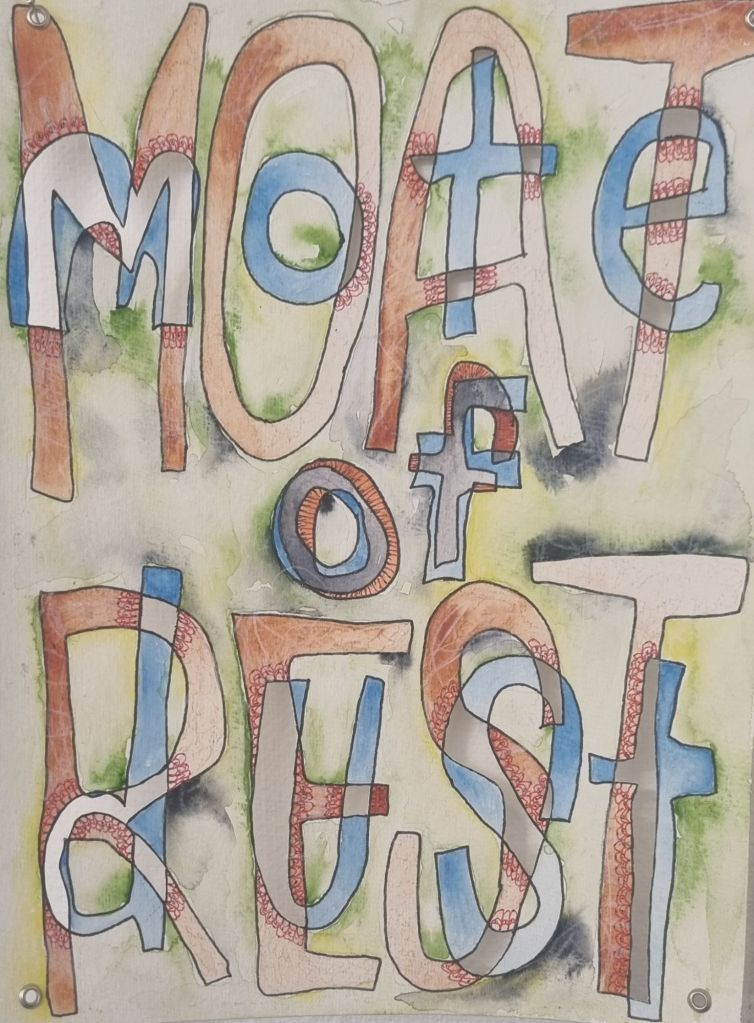
Moat of Rest

Quietly, we go into the week. a lot of sound waves were generated last week, in studio and at shows. Some calm is welcome. There are some practical tasks to complete.

I have been invited to contribute a set of posters for an exhibition, opening in December. The gallery is called Te Atamira, a purpose-built ‘community arts and cultural space’ in Queenstown. I spend Monday figuring out the logistics of hanging when I am unable to assist with the physical installation. I want the posters to have some movement as they hang out from the wall. Hanging/floating parallel to the wall, I want the space between the paper and the surface to contract and expand, but not twist.
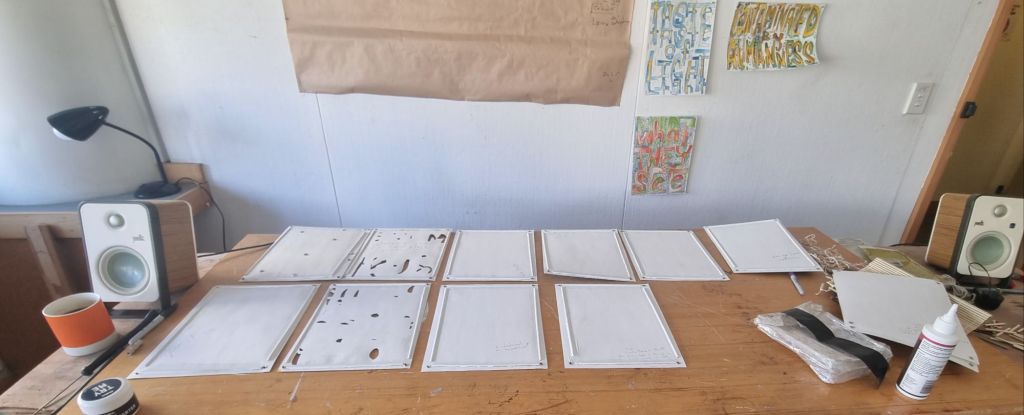
Adding structural integrity to the paper

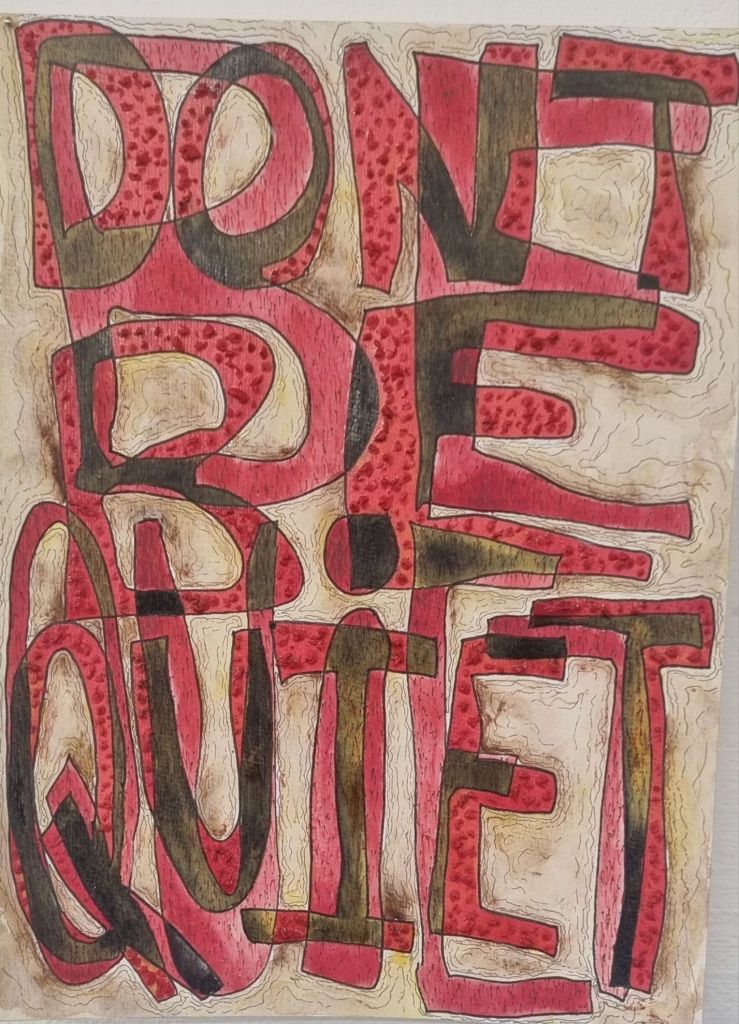
The drawing project developed as an accidental pastime during the DCR residency, November 2023. It was never intended to become a thing. I had just planned to take some paper and paints to doodle in the downtime. I haven’t had the inclination to write big songs like we sung in sterile, committing 3-4-5 words to a piece of paper seemed satisfying enough.

It was a pastime without expectation. I enjoyed scratching out the blockiness of the letters. Abstracted shapes presented themselves when I wrote the second text over the first, I’ve always had a thing for negative space.  I like the vagueness and flexibility of context and interpretation when punctuation is removed. And the chance to just play with colour brought it’s own pleasure.

Many of the phrases came from text that I was reading, descriptors that had extra possibilities tucked inside when lived out of the original context, multiple meanings presenting from a very economic sentence.

This will be the third time I have been able to display publicly this year, not bad for an accident.

And then I became inhabited. The last week or so has been more social than usual. Maybe someone from a bus ride, a cafe, or an audience was feely poorly, perhaps, or maybe not, was harboring a virus that has made me home. Nothing too bad, not CoVID, according to the RAT, but it’s bad enough for me to isolate at home for a few days.

It’s made some space to catch up on the accumulated recordings so far. Re-listening is a time-intensive task that requires a distant objectivity, not always easy to maintain. If listening back is too close to the recording session, then the excitement of the experience can get in the way of discernment. Things that were called mistakes at the time of recording may still sound like errors. With some distance, though, those ‘errors’ may blur into something more inspired, an accident of greater interest. Errors may be hypercritical reflections from a fragile ego. Inspired accidents may be discovered when the ego is belted down firmly in the backseat. These unexpected musical deviations can often be the thing that captures and maintains interest over multiple listens.

Also, ideas start to swirl in relation to the exhibition to be installed in June 2025 at Toi Pōneke. First ideas are not final ideas, but I’m often in a much more comfortable space once I have something to edit. 

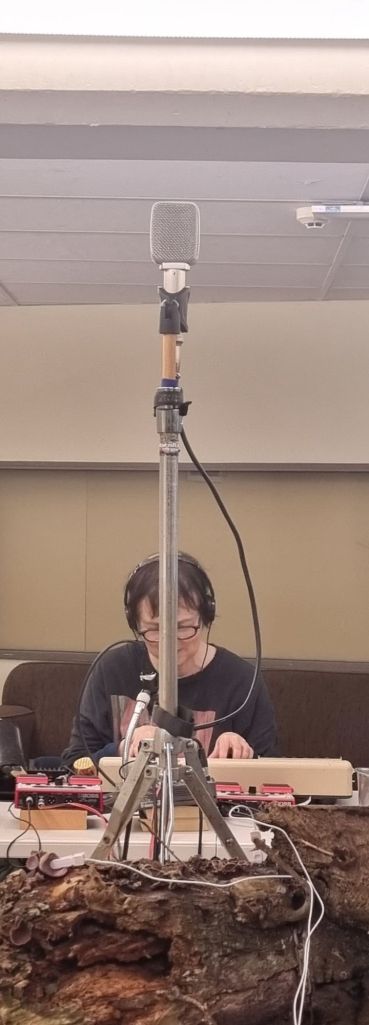
DSLB v.m.a setup

Patience for admin has never been a strong streak. When the motivation is brewing, all i want to do is just get on with the doing. However, this unplanned pause from the studio has actually been pretty helpful. For example, I was listening to the collaborated recordings with Chrissie and her DSLB project today. To be honest, I was uncertain about them directly after, I didn’t think my playing was as interesting as it could have been. But on listening today, with a good few weeks in between, I hear new patterns, textures, bursts of interest, and surprise. I have a few more sessions planned to add to this collaboration project. It’s off to a great start.

However,  all that said, I’m over the calm, I’m ready to get back the studio.

Soundbites

  1. Trees roil like kelp in a sea of wind. Birds swim in currents. I wonder, do fish hear the bull-kelp roar? It’s night’s middle, listen to the norwester, crest first, then bear down. Whipping all tall growth that stands above scrub. Every leaf and branch a wood/wind reed. Everything that rattles will. I feel pressure change from an ocean of air inside ears.
  2. Chest Sounds: wheeze, stridor, crackles, rhonchi. rasp, pleural rub. Auscultation – play the skin of drum, hear the resonance and density from percussion. An ear to a wall, listen for the In’s, the out’s, the rate and delay, for wet sounds, other sounds, no sound. Pay attention when Cheyne-Stokes sings, the song of the lungs soon end.
  3. Susurration is a burble in rainfall. It shimmer in choir as puddles, rivers, Oceans return. The chatter of uncountable billions when surface tension meets matter. The blurred accents of drops on wood, earth, tin, skin, wing, and kin. Wet squall murmurate, shift, accommodate the fluid response to gust, current, and eddy. Sleep well inside weathers lullaby.
  4. Guns at the front door of the farmhouse, none in the new home in town. I make a replica of wood. Find a single bullet in the garage. “That’ll look cool”! Make it fit, hit with hammer.                      !Silence!              Mum calling, runs to me, eyes up, I hear Nothing. Absolute Quiet. Did hearing return? Yes. In time to be berated, rightly so, as she digs pellets from skin with a pin.
  5. The night wind has hands, it lifts liberated cans, and throws down the road. Notes are released, tuned into the tin dents from kicks and wheels. Hear patterns: settled, gusts, roll… duk duk duk..duk….duk! Long, flat streets are best. On main drags, like Dee or Don, you could hear extended canned music. If lucky, it echoes. If extra lucky, power poles wire add their voice in unison.

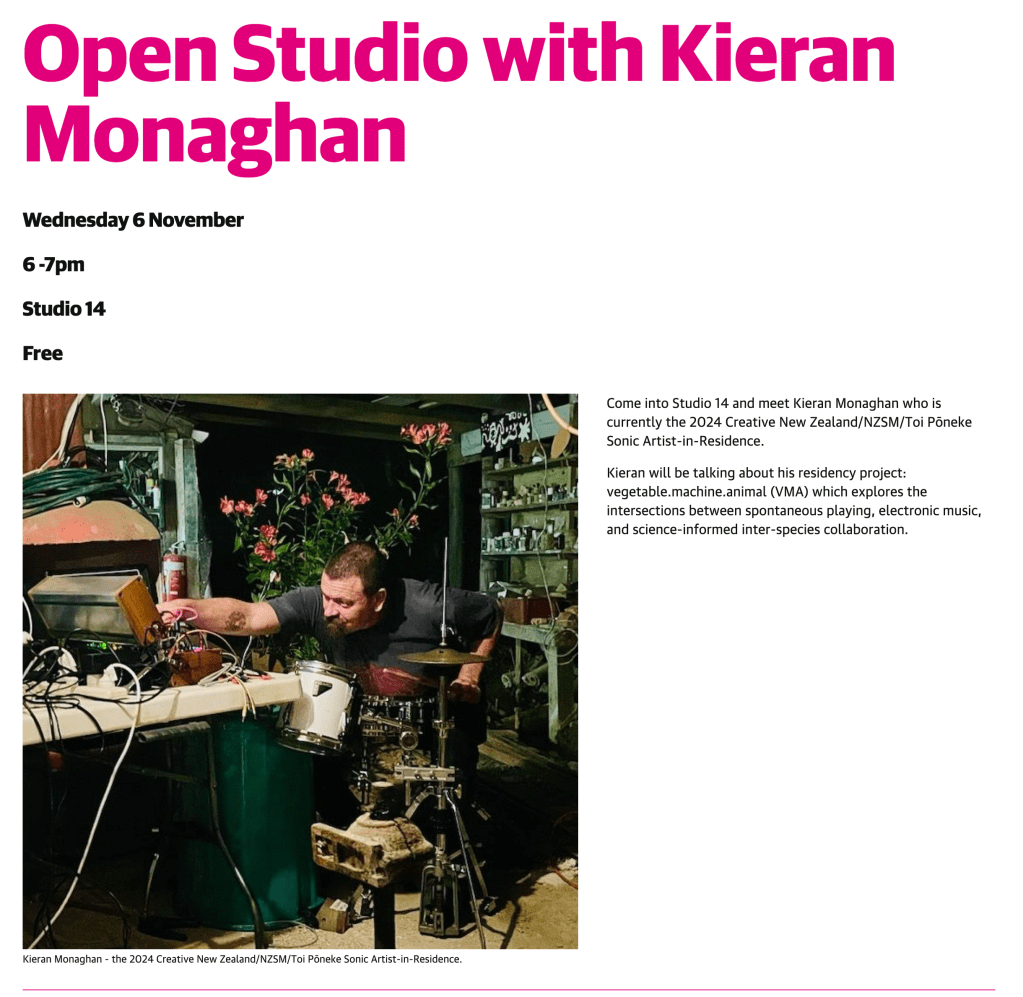
Open Studio: Toi Pōneke

Screenshot of the Toi Pōneke website. Top text: Open Studio with Kieran Monaghan, Wednesday 6 November, 6-7pm, Studio 14, Free.
On the left is a photo of Kieran reaching over his drumkit to make adjustments on the modular synth on the table in front of him. His action bends him towards the left. There is a large flowering plant behind him. The location is in an open, but covered, space at night at the Driving Creek Railway in Coromandel. 
Text on the left of the image says:
Come into Studio 14 and meet Kieran Monaghan who is currently the 2024 Creative New Zealand/NZSM/Toi Pōneke Sonic Artist-in-Residence.

Kieran will be talking about his residency project: vegetable.machine.animal (VMA) which explores the intersections between spontaneous playing, electronic music, and science-informed inter-species collaboration.

Kia ora all. This is an open invite to come and visit me in Studio 14 on Wednesday 6 November, between 6 – 7pm, to check out what Im up to.

I will be happy to offer sound demonstrations of the project at work , discuss questions you might have, be confounded at the same time if I don’t have answers, offer you some kai to nibble. Will be 100% family friendly. Studio 14 is located on the second floor, lift access is available.

FACEBOOK EVENT
Toi Pōneke original LINK

May The Shifting Ground Hold Me Up

Be Quiet.Don't Be Quiet. 
Taken from a doco on the work and life of artist Ai Weiwei
Be Quiet. Don’t Be Quiet. A response from a doco on Ai Weiwei

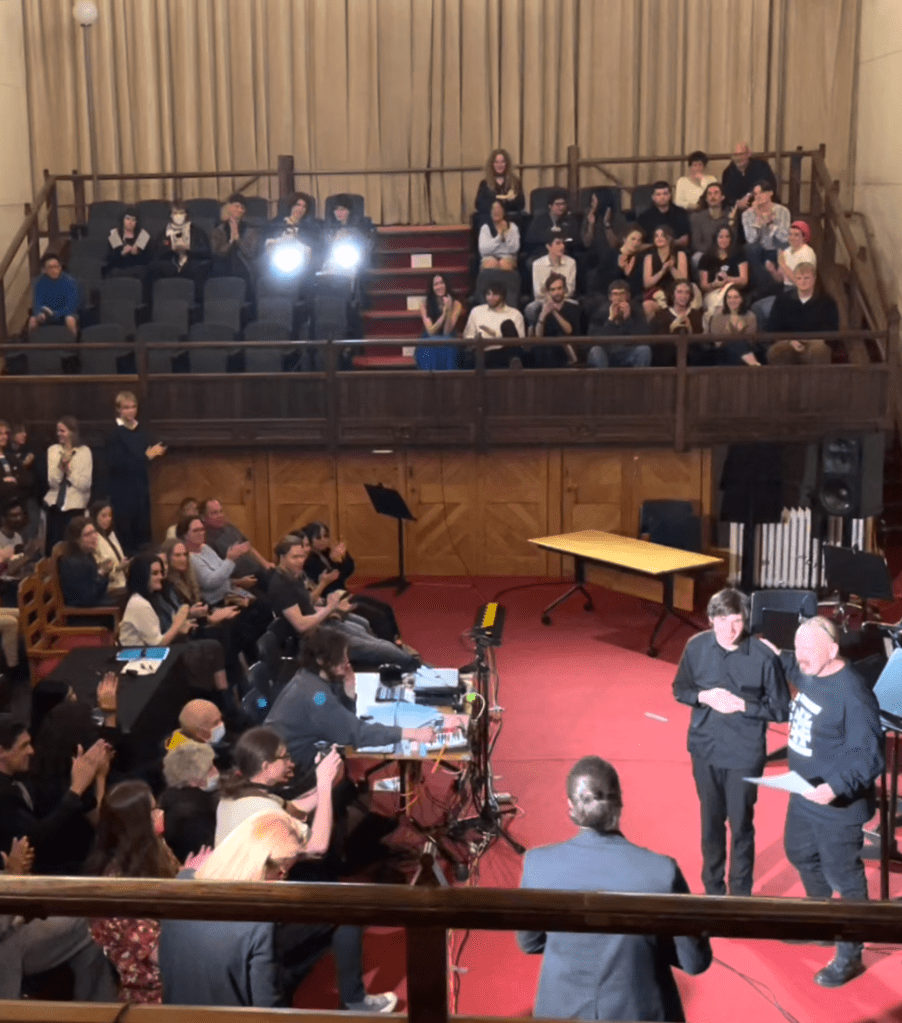
Week three starts on a Saturday. I have been asked to be one of three ‘adjudicators’ for the annual Lilburn Trust NZSM Composers Competition. An adjudicator is a fancy word for judge. I’m to provide insight in determining the pieces of music to receive the annual awards! There are 14 compositions in total, from an array of various university music departments, from classical composition to electronics using AI, from jazz to somber to pop.  The selections have been pre-selected from students at differing stages  of their study.

We are given the scores to the music to read during the performance. I am unable to do this. It’s a skill I’ve never learned, but I am able to listen attentively. The things I rate are: 

  • the aliveness of a performance
  • the interactions between performers
  • the things the performance does to me – what does it evoke?
  • those things that take me by surprise
  • those things that don’t
  • the before’s and after’s of the performance
  • the self-responsibility and consideration of stage management-or lack-there-of
    and
  • does the performance match the text/hype of the program 

I realise my years of gigging and touring have taught me a great lot of skills that may not be so obvious from the academic tradition. Things that I realise are not so considered here.  And I am sure there will be many things I am missing precisely because I have one set of experiential skills instead of an other, more formal, set. The other judges all look at the quality of the script, how the performance adheres to the composition, and how the composition follows certain musical conventions that I am 100% ignorant of.

After hearing the 14, we three have a rapid and robust deliberation deciding on where the awards will go.  Happily, a diverse range of performances are selected, acknowledging technical ability, compositional quality, consideration of stage and space, performance bravery, and adventurousness of the composer. But all the performers and composers are deserving of acknowledging and commendation. My final encouragement would be to keep pushing the boat out!!

Best Performer award to Nathan Parker

There is additional newness for me this week. I have a rehearsal space available now every Tuesday, at Toi Pōneke. These are now my main recording days. They also come with a specific focus on collaboration. I invite Chrissie’s project DSLB in, I am safe in her tolerance as I may need to troubleshoot unexpected technical hiccups.  The main challenge is to ensure that the right technical equipment is on hand to enable the best recording … it seems to be sufficient. To support this, I have access to some nice microphones from the NZSM. It all works perfectly and after a full day of intense playing, we collect two and a half hours of recorded material. 

Near the end of the day, we are both become aware of the fatigue from exertion and concentration. I encourage ‘one more piece’. A lot of sound-ground has been covered. The instruments have been put through the routine of the first familiar and then unfamiliar explorations into sound territories. We both feel a bit spent. But we do it, one more lap around the racetrack. Finishing up, and listening back, what we have hauled in is a lush, atmospheric, angular piece of wonderfulness. it’s going to be exciting to share this work soon.

One of the proposed outcomes of this residency is the making of a V.M.A album. I’ve already done a fair bit of loose, improvised, and searching noodling playing to settle in.  This week a framework has started to appear, a framework from which I can hang ideas for the next 9 weeks and beyond.

Almost all of the albums I have been part of in the past have been made during tight times squeezed in and around the rest of ongoing-life. Having slow time to mull on ideas, to consider structure and dynamics, and to explore with dedicated intention is a new and unfamiliar space; luxurious and wonderful.

This time also presents a confronting opportunity. It says  ‘here is the time, what do you want to say?’. Brevity and seriousness can flatten playfulness and curiosity. Playfulness and curiosity can distract from the serious act of completion. Somewhere in between there is a middle ground, a place that teeters, a foot-in-both-camps space, and a pivot point that never settles into complacent stillness. It is a sweet spot of creative precariousness and I feel confident that for a time on Tuesday, we were visiting that place.

May this shifting ground hold me up.

SOUNDBITES:

  1. The melody is guiding my eyes. I become aware, during the performance, that with each change in the music, so too my gaze alters. I’m look upward as the saxophone goes into the higher register. The higher the note, the higher the view. My vision takes in the floor as the lower notes are blown. It’s as if my eyes alone are dancing. The observation of observing my eyes from the inside.
  2. We wake before the shake. It’s a gut sound, a frequency outside, the house, and our hearing. It is registered in the third-ear of the diaphragm. Guitars bounce on the walls, and the resonance of strings wakes as Richter waves roll through the house. We’re waiting for the next one, with deep and attentive listening in impending silence.
  3. A cafe house-stereo is playing a grandiose metronome. The three on my right are talking, and I’m inadvertently listening in. I think the words are familiar, but doubt suggests that it’s not my tongue they are speaking in. A dialectical similarity, maybe? Maybe from somewhere else? Is it my hearing loss at fault? Or the terrible acoustics?[but excellent for privacy] Maybe it just their enunciation? Maybe it’s none of my business.
  4. As the crow flies, we are as close as 9100kms apart, but you ask, ‘Can you hear the busy street?’ You say next to the alleyway of your home is one of the cities main transport arteries. Also, you say, beneath the path in front of your home, is one of the old cities canals. ‘Can we hear it?’ I can hear my belly rumble for dinner, while, perhaps, yours is sleeping just after lunch. This time next year, we will be Here. Then we shall hear.
  5. The flue of the fireplace is becoming a home for a bird. Claws, like a record players’ stylus, resonating on the circular stainless steel. Each morning, during coffee, we hear its movement. When we move, it stops. Perhaps the chimney acts as a two-way telephone, like old tin cans and string. Or an early-warning stethoscope into our room, alerting the blackbird of downstairs-action. It’s a precarious position to bring kin into the world. We will now be avoiding fires while DJ Blackbird scratches around up top.
The Chimney minus bird

Ice water in a Warming World

First ideas are warm water. Comfortable and mediocre. Acceptable in filling a void, ok in start-making, and welcoming if tentative in water-testing. But the breathlessness of a leap into cold water has greater urgency, it’s magnificently immediate.

However, finding a constant pace in that extremity is a challenge. The thrill of the goosebump will come. I can afford myself this warm time, keeping the pending destination of a bracing uncertain front and centre. An aim is to not get swamped in predictable comfort.

It’s a rare gift to have a committed, and funded, length of time available to explore sound-making. There’s a shadow of apprehension, a flavor of imposter-syndrome, a snivel of a sense that I will make minimal more than mediocrity. I remind myself that the brain is a liar, deceitful, it fears failing. But this brain’s gravity also tends towards risk-taking and experimentation. To make something from nothing, to draw out a silhouette that pokes at the psychology of pattern recognition. To make ice water in a warming world.

This chill of being creatively lost is where I’m aiming; to be lost in thought, from habit, in someplace unfamiliar and pregnant with discovery. And I have three months to do this. I am to make recordings, to develop a show for June 2025, and to continue to discover the voice of this project. In order to do this, I’m given space at Toi Pōneke Arts Centre as part of the 2024 Creative New Zealand/NZSM/Toi Pōneke Sonic Artist-in-Residence position I hold till the end of 2024. I have a generous west facing room, a wall of windows, and three to hang pictures. A desk for drawing and a desk for musical gear. The building contains scattered occupants who I occasionally meet as they take rest from their own creative endeavours. 

A first flower.

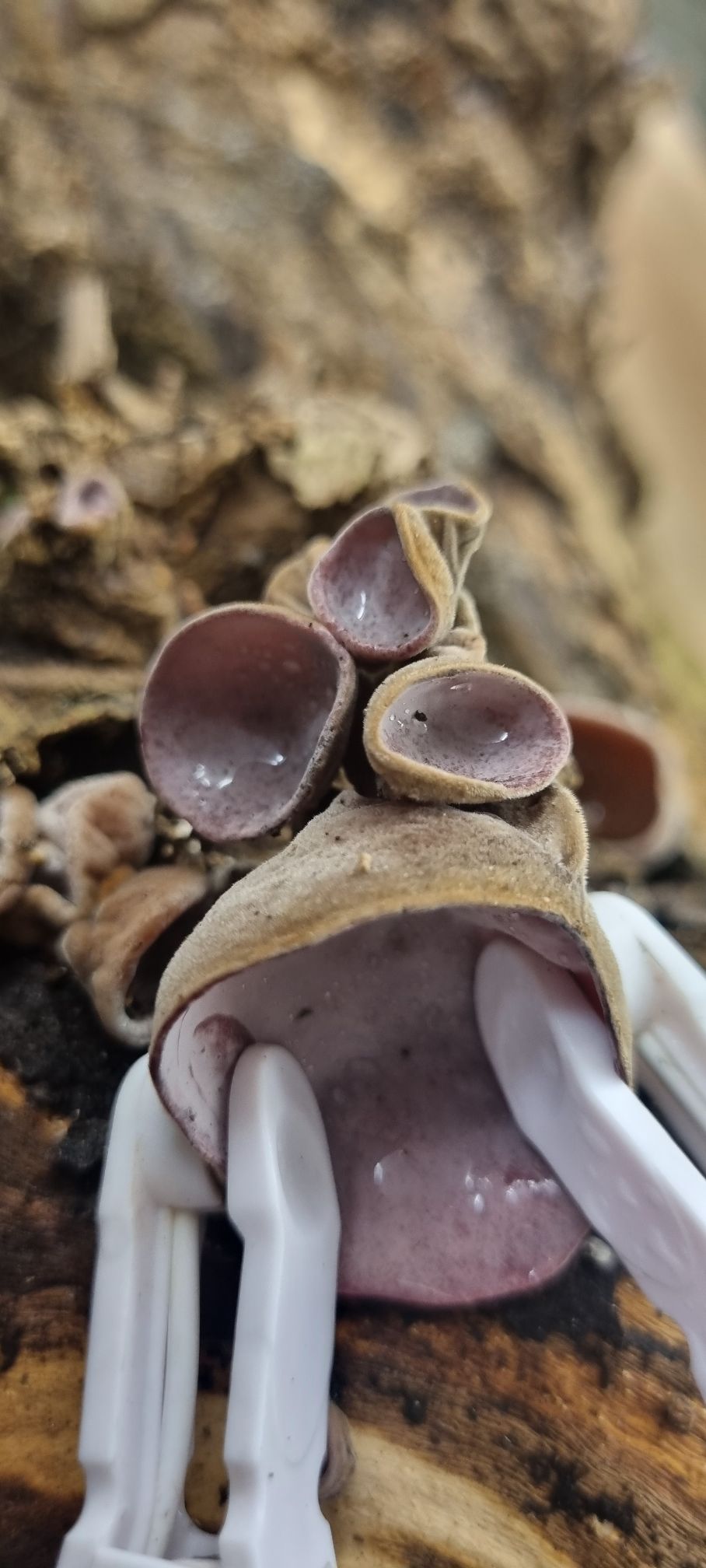
The only plant I have at present is a Peace Lily, recently repotted. It is the sole active non-human participant in sound-making so far, displaying a dynamic voltage that interacts inside the sound modules of the synth. The first recordings are encouraging. It was given to us over 15 years ago from the real estate agent who sold us our home. I noticed this morning that, in the entire time we [me and the lily] have lived together, it is about to flower for the first time

Toi Pōneke is located at the edge of the CBD. Theres two more blocks till Webb Street, with a Bypass that intersects. Toi Pōneke came into existence, at least in my memory, as a trade off between the Wellington City Council and the significant Anti-Bypass protest movement in the early 2000’s. For nearly 40 years people had opposed the mass destruction of a vibrant corner of the city which housed many artists, musicians, and oddballs. The protests took the form of squats, lock-ons, community gardens, fund-raising gigs, festival, publications and more. Many were arrested, some were hurt. It was from these community organisings that events like the Cuba Street Carnival evolved. I was involved in number of ways back then, and I opposed the council’s trade off of an Arts Centre Vs Community. But as it’s said in The Hitchhikers Guide to the Galaxy, ‘You’ve got to build bypasses’. The length of road happened. It cost millions, saving only a multiple of seconds on the journey from the motorway to the airport. 

So here I sit. Ruminating on this part of my past. Hoping these digestions are nutritious and enabling for whatever comes next. I have learned a lot in developing the vegetable.machine.animal project, and one such notion is the idea of ongoingness in contested, damaged, and troubled areas. Sounds a bit like everywhere these days. The dead weight of cynicism does not free us from the challenges ahead. It offers no resistance or option against a Powers sense of immobility. New stories are necessary, new directions are essential, new actions for these times. And I hope in my own small way, through this project, to contribute in this new mode, towards always something better, bracing, and uncertain.