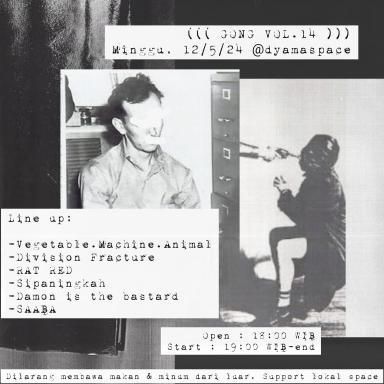
Neil Robert’s Day is just around the corner, and it’s pretty big this year. We’re putting on two fundraiser shows – this one here in Pōneke and one in Whanganui. Come see FOUR sweeeet bands and one alright DJ! Doors at 9pm Displeasure Retaliator Side Eye vegetable.machine.animal DJ Suave
NO stink cunts policy will be strictly enforced.
–
Neil Roberts was a punk anarchist who died in an act of explosive defiance, with the Wanganui Computer as the target, on 18 November 1982. Located in the city of Whanganui, the computer was the NZ government’s first digital database of accessible information on citizens, used by police and other surveillance services. His act is seen as a protest against the government’s growing surveillance mechanisms.
Film maker Russel Campbell has written about the events of the act and on some documentation that took place afterward.
There are sensors connected to a plant at one end. At the other of the sensors is a plug inserted into a box that is a mess of cables and flashing lights. Speakers play sounds corresponding to interactions with the plant. Someone else is listening. I’m waving my arms around, fishing for words, trying to reel in some shape of comprehension.
I cannot think of a single instance, while demonstrating this project, that I experienced indifference. Typically, people’s fascination towards this budding idea that there is a perceivable, inter-actable, response from a species who hasn’t even been afforded the notion of agency, let alone complex life, in any form.
It’s exciting when people become intrigued. They want to ask questions. I can almost see cognition kicking in, lights going on. I do not mean this in a way that could be construed as patronising, quite the opposite, a curious and inquisitive human is a wonderful thing.
The sound comes from the speakers. They ask, “Is this what the plant sounds like?”. No must be the answer. Anything else would be a lie.
It’s an understandable question, when stepping towards the unimaginable. The imagination projects onto this non-human entity a humanness: “Maybe in some near-sci-fi way we will be able to ‘communicate’ with plants? Maybe it will be like a First Contact moment from an alien-encounter story?” I explain that what we are hearing is the result of the plants voltage only, it’s internal electricity, a biological signal which is measured between two sensor points. BUT, I emphasise, this is no less remarkable. We can interact and hear how the change of electrical signal changes the sounds coming from the machine. These are examples of signs of life, small recognitions that this entity, this plant, is detecting changes in the environment. And in response, changes in biosignals become audible. Caution is needed here, intention and meaning can not be interpreted from this moment anymore than a clinician is able to ascertain something about your personality from an ECG. It is impossible.
Online, I’ve seen examples of people making music with plants, presenting something that looks like a spiritual connection, a musical synergy. Most of the time, I think it’s an illusionary moment that is fraught with moral garbage. I would argue that such fantasy is unnecessary. We can be amazed at the astounding complexity of life without the bullshit.
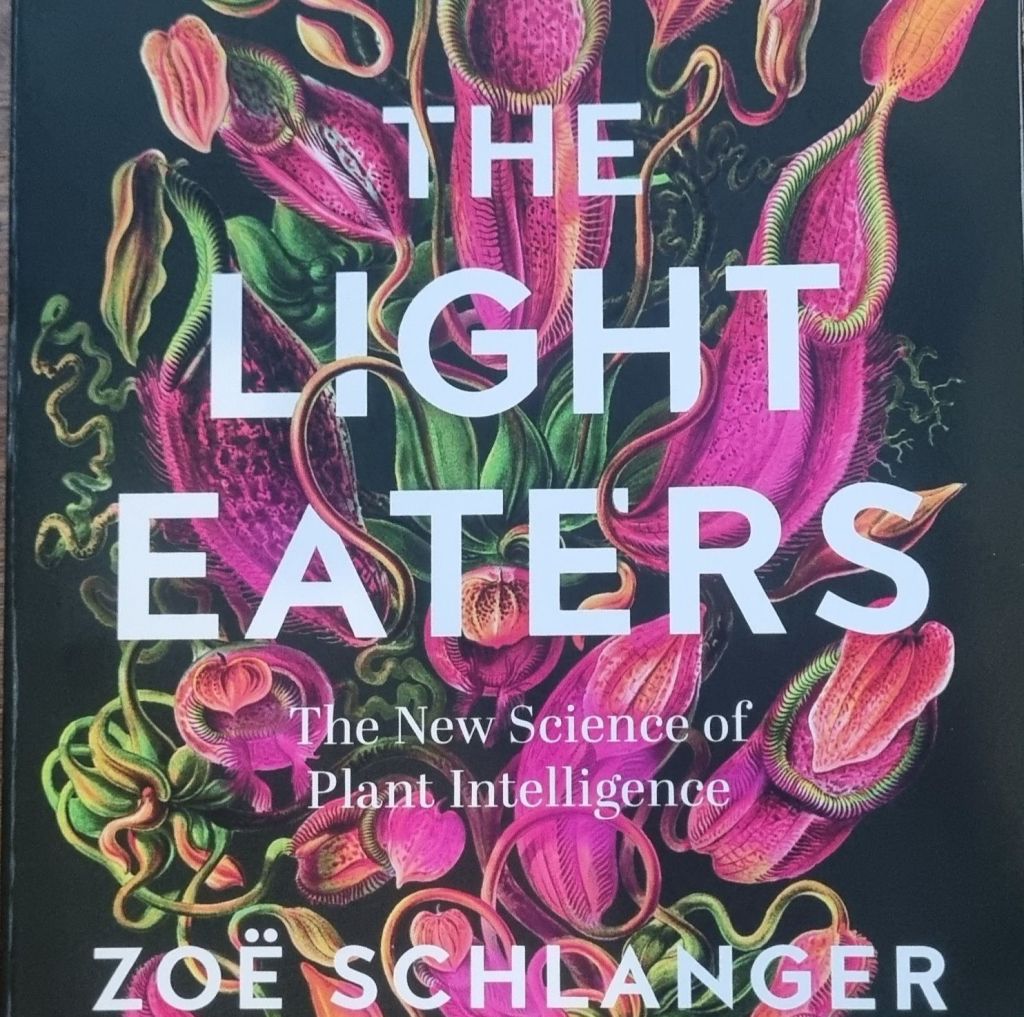
Zoë Schlanger’s book ‘The Light Eaters’ (2024) is an exploration of the recent science on plant intelligence, plant communication and plant memory. Ideas that had once been decried and ridiculed are now undergoing a rethink in light of new research and repeatable experiments. “Contaminated by Humanness” is an idea from Schlanger’s book. This idea of Humanness is a polite way to announce Anthropocentrism. Anthropos is Greek for Human. Anthropocentrism is the placing of the human experience and perspective central to all. For example, for things to be understood, hold value and meaning, they must be translatable into a position relevant to the Human. Failing to ‘See’ other positions, other Others, as of value, meaning, and importance has brought ‘Humans’ of modernity to the worst versions of ourselves. Schlanger’s suggests that there are many more perspectives of the world that may remain truly unimaginable, yet remain alongside us, permanently in co-existence.
In this project I describe the sound-making devices of the synth as akin to Google Translate. It enables us to perceive, attempt to comprehend, and engage with the signal of the lifeiness of non-human others. In this awareness-making moment perhaps perspective might shift. What’s been seen cannot be unseen, so too what has been heard can not be unheard. I think it’s important to not corral these sounds into a classical framework of what music is. I want the unexpected musicality to hold its own space. And then we can decide to simply participate without overlaying some limited conceptual idea such as music definitions. We can start by learning to have bigger ears.
Writing this makes me think of an early, and very formative, event. I can pinpoint the moment my ears expanded.
Sometime in the late 80’s I hitchhiked to Christchurch. One day I was walking in the square in the city centre. I had just brought a cassette called 2X4, a collection of live recordings from a German industrial group, Einstürzende Neubauten. I had read about them in fanzines but had never heard them. Invercargill was a long way from Berlin. Until today.
Walking through the Square, Cathedral to the Left, the pub Warners ahead, my ears were confounded and lost by these raw, unfamiliar sounds on my cassette Walkman. What I heard gave me NO reference to help me understand the sound. Percussive machinery, confronting angular rhythms, and Bargelds’ high-pitched vocalisations felt indigestible. Even though it was both fascinating and disconcerting I had to stop listening for a moment, just to catch my breath.
Removing the headphones the perplexity remained as I felt like I was STILL listening to the band.
All around the Square was the sound of construction sites, building projects in various forms of ascent. Skeletal towers full of labourers beating frames into shape. Concrete-mixers, angle grinders, hammers, saws, power tools and brute force all at work. I heard it all.
I also heard, I realised, what I needed in order to listen to the cassette. The builders had no pretense on being musicians, but the musicians used the tools of construction and destruction to create songs and entertainment. Tools containing specific utility, identity, became challenging in the hands of another. Not so much bending it out of shape, but into a newer shape. A shape that encompassed both this world of construction and also that world of creative exploration. The building world became contaminated by a musicness.
Many of these building never survived the earthquakes 30 years later. But I still hear ‘music’ where it isn’t.
First ideas are warm water. Comfortable and mediocre. Acceptable in filling a void, ok in start-making, and welcoming if tentative in water-testing. But the breathlessness of a leap into cold water has greater urgency, it’s magnificently immediate.
However, finding a constant pace in that extremity is a challenge. The thrill of the goosebump will come. I can afford myself this warm time, keeping the pending destination of a bracing uncertain front and centre. An aim is to not get swamped in predictable comfort.
It’s a rare gift to have a committed, and funded, length of time available to explore sound-making. There’s a shadow of apprehension, a flavor of imposter-syndrome, a snivel of a sense that I will make minimal more than mediocrity. I remind myself that the brain is a liar, deceitful, it fears failing. But this brain’s gravity also tends towards risk-taking and experimentation. To make something from nothing, to draw out a silhouette that pokes at the psychology of pattern recognition. To make ice water in a warming world.
This chill of being creatively lost is where I’m aiming; to be lost in thought, from habit, in someplace unfamiliar and pregnant with discovery. And I have three months to do this. I am to make recordings, to develop a show for June 2025, and to continue to discover the voice of this project. In order to do this, I’m given space at Toi Pōneke Arts Centre as part of the 2024 Creative New Zealand/NZSM/Toi Pōneke Sonic Artist-in-Residence position I hold till the end of 2024. I have a generous west facing room, a wall of windows, and three to hang pictures. A desk for drawing and a desk for musical gear. The building contains scattered occupants who I occasionally meet as they take rest from their own creative endeavours.
A first flower.
The only plant I have at present is a Peace Lily, recently repotted. It is the sole active non-human participant in sound-making so far, displaying a dynamic voltage that interacts inside the sound modules of the synth. The first recordings are encouraging. It was given to us over 15 years ago from the real estate agent who sold us our home. I noticed this morning that, in the entire time we [me and the lily] have lived together, it is about to flower for the first time
Toi Pōneke is located at the edge of the CBD. Theres two more blocks till Webb Street, with a Bypass that intersects. Toi Pōneke came into existence, at least in my memory, as a trade off between the Wellington City Council and the significant Anti-Bypass protest movement in the early 2000’s. For nearly 40 years people had opposed the mass destruction of a vibrant corner of the city which housed many artists, musicians, and oddballs. The protests took the form of squats, lock-ons, community gardens, fund-raising gigs, festival, publications and more. Many were arrested, some were hurt. It was from these community organisings that events like the Cuba Street Carnival evolved. I was involved in number of ways back then, and I opposed the council’s trade off of an Arts Centre Vs Community. But as it’s said in The Hitchhikers Guide to the Galaxy, ‘You’ve got to build bypasses’. The length of road happened. It cost millions, saving only a multiple of seconds on the journey from the motorway to the airport.
So here I sit. Ruminating on this part of my past. Hoping these digestions are nutritious and enabling for whatever comes next. I have learned a lot in developing the vegetable.machine.animal project, and one such notion is the idea of ongoingness in contested, damaged, and troubled areas. Sounds a bit like everywhere these days. The dead weight of cynicism does not free us from the challenges ahead. It offers no resistance or option against a Powers sense of immobility. New stories are necessary, new directions are essential, new actions for these times. And I hope in my own small way, through this project, to contribute in this new mode, towards always something better, bracing, and uncertain.
Today is a milestone. Kieran begins 3 months as the Creative New Zealand/NZSM/Toi Pōneke Sonic Artist-in-Residence 2024. You can guarantee that this funded watershed will result in a proliferation of work in sound, in music, and in painting and will foster a clutch of unexpected collaborations with makers in a myriad of disciplines.
The knock-on of Kieran’s relocation to Toi Pōneke, is I get to stretch into an empty house for 3 months. So I feel I have scored the inaugural Happy Valley/skirted Records Sonic Artist-in-Residence 2024. Who knows what this gift of time and space will generate?
We both aim is to keep you posted as we would if we were on tour. Subscribe if you’d like to follow along.
Awhiworld: a “…transdiciplinary project [that] brings together artists, scientists, makers, hackers, and more to tackle complex issues and generate alternative realities.”
bioSignals, a part of the Awhiworld research, is an “…international collaboration between Awhiworld, the Phillipines and the UK. …bioSignals collects, processes, and transmits signals from local plant life growing at each site, embodying a shared vision of connecting isolated entities, fostering resiliance, and addressing climate change and biodiversity loss challenges.”
Toi Pōneke Arts Centre and Victoria University’s New Zealand School of Music—Te Kōkī (NZSM) are delighted to announce Kieran Monaghan as the 2024 Creative New Zealand/NZSM/Toi Pōneke Sonic Artist-in-Residence.
Kieran Monaghan (he/him) is predominantly, and persistently, a drummer and percussionist of found sounds. He calls Te Whanganui-a-Tara/Wellington home. His first crude musical steps were in the late 1980s, playing drums in southern punk rock bands. Heading north in the 1990s opened new musical domains such as theatre with Red Mole, and its little sister Roadworks, and the diverse arrangements of free jazz that tumbled from venues such as The Space. While continuing to play assertive music, alongside developing confidence in improvisational arenas, necessity also dictated that income be made by playing multiple pub circuits in working bands.
His project, vegetable.machine.animal (VMA), is the newest iteration of ongoing musical expression. It explores the intersections between spontaneous playing, electronic music, and science-informed inter-species collaboration.
He co-runs the skirted Records label with domestic and performative partner Chrissie Butler. Together they were the core of the outsider punk group mr sterile Assembly, and Nick Bollinger named them as one of the ten great rhythm sections of New Zealand. Monaghan has toured internationally many times with the Assembly, and more recently with VMA. He has a long catalogue of solo, band, and collaborative recordings. He is a semi-regular DJ on RadioActive.FM. He remains happily hitched, and is a father to three daughters and one mokopuna.
The Creative New Zealand/NZSM/Toi Pōneke Sonic Artist-in-Residence 2024 is a three-month position that runs from 23 September to 15 December 2024. During this time, Kieran will develop a body of innovative and substantial work in the domain of sound art. His work will include a new album, performances and an installation of vegetable.machine.animal. He will become an employee of Victoria University of Wellington for the duration of the residency and may use NZSM facilities and recording equipment over that period. In addition, he will be provided with studio space at Toi Pōneke and his residency will culminate in a 4-week exhibition in June 2025 at Toi Pōneke Gallery.
Mundane 1: of, relating to, or characteristic of, the world 2: characterised by the practical, transitory, and ordinary – Some mundane online dictionary
Utopia “…we should reinvent utopia, but in what sense? There are two false meanings of utopia. One is this old notion of imagining this ideal society we know will never be realised. The other is the capitalist utopia … of new perverse desire that you are not only allowed but even solicited to realise. The true utopia is when the situation is so without [solution], without the way to resolve it within the coordinates of the possible, that out of the pure urge of survival you have to invent a new space. Utopia is not [a] kind of a free imagination, utopia is a matter of inner most urgency, you are forced to imagine it, it is the only way out, and this is what we need today.” – Slavoj Žižek, Public lecture at Universidad de Buenos Aires
What could utopia sound like? What if the mundane babble of things simply going about their livingness was how it sounded? Not in a state of idealised perfection, but a continuous and dynamic state of balancing. What if we could perceive this?
This installation aims to make audible a little piece of what is already, has been, and will continue to go on for a very long time. Just beyond ‘our’ world is the world of everything else, unfolding in its ordinary, continuous, mundane way. The machine in this exhibition holds the place of a translator. It detects signals of ongoing, other-aliveness and converts into crude signals audible to human anatomy. It is an unsophisticated interpretation. It provides no comprehension, but does enable us to perceive something that is not of us, in a way that may make some sense to us.
And how shall we interact with this. The ‘other’ knows when we are here, we can hear its signal change with interaction: touch, adding water, being neglected and dehydrating, and shining UV as if we pretend to be daylight. A mundane utopia for troubled and damaged times exists already, it’s not waiting for us.
—–
Opens: Thursday 13 June, 5.30pm, with refreshments by Liberty Breweries Hours: 12 – 4pm, Tuesday – Saturday Closes: Saturday 6 July
Public events: Friday 14 June, 8pm @ Whammy Backroom vegetable.machine.animal live in concert Tickets here More info here
Saturday 15 June, 1pm @ Audio Foundation Kieran Monaghan Office Ambience performance and artist talk More info here
Saturday 15 June, 5pm @ Audio Foundation, free Film Screening: Jogja Noise Bombing (Indonesia) More info here
I share the shower with a cockroach. It’s done. This is the day after the last show, and the end of the tour. We both go about our daily business, not minding the other.
The last shows were both very nice.
The first show is in Tangerang, a western city in the greater city of Jakarta. I come straight to the venue from the airport, leaving Malang this morning. The show is in a small room on the top floor of a cool cafe. A cozy crowd hug close to the performers. Five acts, three noise acts, one person playing homemade percussion and stringed instruments, and myself. The Jakarta noise acts were interesting in that there was a lot more use of ambient space, quietness, within the sets. Whereas Malang’s style seemed to be an unrestrained intensity.
The following days show is in the city of Serang. I think it’s close by but I’m wrong. It’s about three hours all up in travel. Two taxis and two trains are required from Jakarta to Serang. The venue is reported to once upon a time belong to the first recognised academic from this city. A historian who specialised in history of this area. The building now is sparse. It is in the early days of establishing as an art space, a gallery, and an adjoining performance space. It’s the first time I see serious rain.
Stylistically, it is the most diverse show of the tour. Again, five acts. A solo vocalist producing vocal loops and building beautiful layers over the top. This is accompanied by two dances who circle each other with markers between teeth and toes, making marks on both floor and face of the other.
I perform second and have the chance to play 30 minutes. I can tell I’ve grown into this act. It feels like it’s establishing a solid confidence that can hold this length of space. Third was a more ambient trio, one playing computer and keyboard, a second percussing time on a series of clay gourd-like instruments that I do not know the name of. The third played wind instruments, sung, possibly in a Koranic style, and added movement. BootyCall on fourth, plays a short, sharp, and blistering blast in contrast to the previous. The final act, a nine-piece band, playing their first ever show, and get the place jumping. I think they are essentially playing covers versions of a local act. Everyone seems to know the words to every song. Maybe it’s fun a local past pop band, with a groovy Dungdut feel throughout.
And that’s it. Over. As successful as I dare not hope for. Time seems to have traveled slowly in these days. It feels like a long two and a half weeks in the best way. The apprehension of the baggage discussed in that first post did not appear. This feels like an excellent milestone moment.
So what have I learned? Practical things like that the infrastructure upgrade in Indonesia over the last few years has made it that much easier to travel around. I’m told some services like Gojek have taken a much more central place since covid. They were unexpectedly prepped and ready to deliver contactless deliveries swiftly and are now an established and trusted service, as well as a massive employer across the nation.
Some personal learnings are around how to develop this musical project. The positive affirmations received after performances certainly give a confident boost to this idea. I don’t think I can say I saw anything similar to what i was presenting. The next step is simply to throw everything at this project to see where it can go, and what it might be capable of. I feel like the scope has opened and am excited to see how it develops.
And I’m pleased to also learn that the connections made while traveling and playing continue to be something I want to experience. Close to the last show, I had a conversation with someone about how to identify ‘what is enough’. This question explores the motivations and expectations, reality studies vs hopeful ambitions, and the practical successes that may be achieved when experimenting in this space.
And I think to myself that there really is not too much more that I could want. What this trip has provided has been absolutely enough. Now, all I want is more of it, please.
—————
Leaving the city for the airport, the GoJek driver turns the stereo on and plays a Bryan Adam’s album. It’s cheesy and confounding-ly fitting. Syrupy in the cab, while outside the taxi window, the perpetual sound, the essence of noise bombing, of the existence of Jakarta, is everywhere.
————— Notes : As I leave, looking out to the left, there is a large black and triangular kite, with a long black tail, fly over the blue and yellow tiled roof of a Masjid. There is a faint belt of smog on the horizon. The rest of the sky is blue and clear. The sun is full and orange, at in the direct and opposite direction. ———– There is a packet of scented something hanging from the rear view mirror in the taxi. It has the name Stella printed on it.
Seems like a good time as any to start something new.
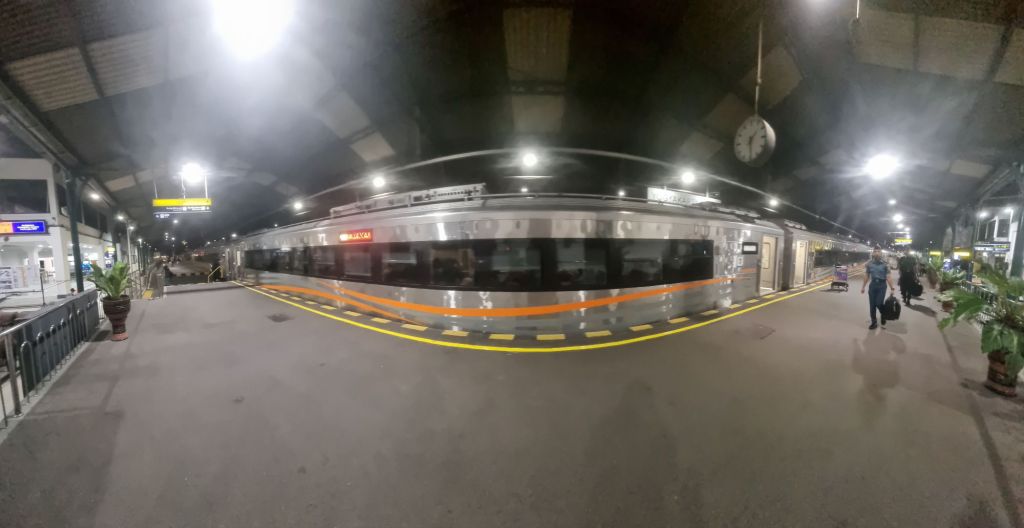
It’s 23 past midnight. I’m meant to be on a train, but it turns out that it left the station 24 hours and 12 minutes ago, and I wasn’t on it. So much for well organized.
So I threw away my paid for piece of printed paper and went to buy a new ticket. I was a little apprehensive that there might not be a train for the holidays tomorrow (today). The train with the same time as last night was sold out but the 0131 had seats still available, and the bloke said, though a distorted speaker, if I say and waited for 30 minutes the price would halve I wasn’t going anywhere.
I went to get a drink from the automatic drink dispenser, enter confusion Round Two. Money inserted, drink received. But it didn’t give change and still had quite a number on the dial. So I inserted another 5000 rupiah to get one more drink and 0000 on the meter. Except I put in 50000 [ NZ$5] ! Drinks on the house for the porters!! They seemed appreciative.
I hope sleep also arrives with the train. Tomorrow’s show starts at 11 am. It’s a seven hour journey.
The last couple of days after Noise Bombing have been semi-relaxed.
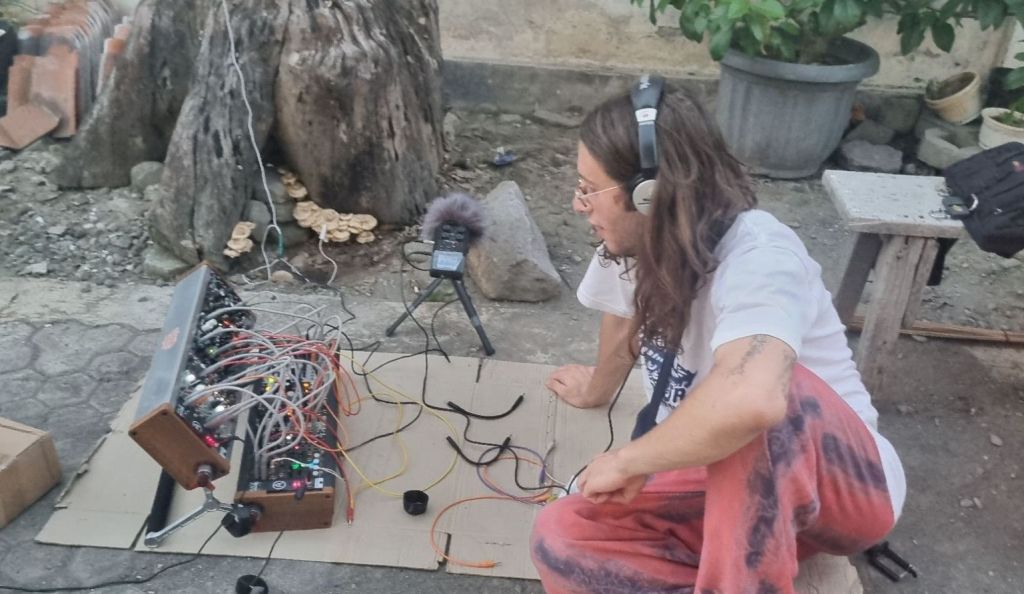
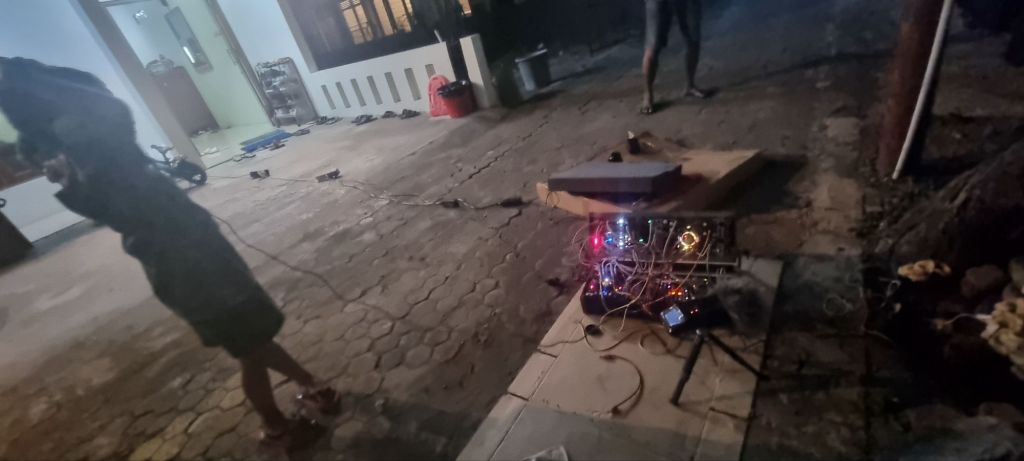
Monday was a day out and about the city. I returned to Krack Gallery, the venue from last Friday, to discuss buying a piece of art I had my eye on. Then off to the Yes No Wave shop. Yes No Wave is a local label that releases amazing music. The Nyege Nyege of South East Asia. Then I walk home.. the wrong way. Realizing my ability to get lost, I stopped and caught a Gojek scooter back to the homestay. Gojek is an uber equivalent that has a huge scooter division. Returning to the homestay, I set up my synth, and with the help of the documentary maker, Mattie, i record a lovely fungal cluster sprouting from a stump just in front of the homestay entrance. We gain the attention of nearby residents and kids who we invite to listen to these freaky sounds. It’s all very entertaining.
Later, I go out to see Gorz, one of the touring bands, playing a hastily organized show at a local poetry reading. I’m told these nights are a regular event, so rural workers and farmers can read their writings. Gorz sounds great tonight, a much fuller guitar sound.
Tuesday ( when I should have been preparing to leave) was instead dedicated to rest and writing. So low-key. But by mid afternoon, I felt much more energized and went out to two shows. The first is Deathless, which I responded to in the previous post. Then, across town to a second show of a more noisy disposition.
And today’s been relaxed. Finished writing an interview for some local magazine and a video interview with Mattie about the what’s and why’s of my project.
Then, home to pack and depart. It’s been a lovely stay. The homestay seems to be a family affair, warm, friendly, and good humored. One of the children, maybe 4, is very comfortable coming forward. He’s started calling me uncle.
I then head out to one last noise show. The venue is a 15-minute walk to the train station. It’s around 11 when I noticed my error. And here I am. There’s a train coming in, but I’m not sure if it’s mine… nope, too early.
The rising and falling from the two tones of the street vendors bell wakes me. A little ropey seems like a first description of how I feel after yesterday’s travel, but it’s OK, cos I’m in Jakarta! My one and only mission today is to get to the city of Cirebon by train.
Local coffee and fruit are offered for breakfast, and it’s perfect and unhurried. I had different accommodation booked to where I ended up. While in Sydney, an old friend, Chris, from Jakarta, made contact and offered me a bed at his place. A very welcome welcoming.
The train departs Jakarta at 11, Chris advises I get a taxi at 9. We are some distance from the train station, Pasar Senen. It’s good advice. As it transpires, nearly the entire two hours are required … I get on the train with only minutes to spare.
Economy class is perfectly comfortable. The biggest relief, other than being onboard, is that each seat has a power point. This means the phone remains charged. It is the most essential piece of equipment. I am reminded again how much I like Google Translate.
I am also reminded of my näievity, and honest ignorance in being somewhere where daily interactions and engagements are beyond me. I am without local spoken language. I do not speak bahasa, Saya tidak barbicara bahasa Indonisia. I hope that people can make sense of my pidgin bahasa, my arm waving, and that I also encounter people who are gracious enough to help. I have met nothing by kindness so far. A serving of humility can go a long way.
The journey across land is flat. Leaving the frenetic city and the business of its active inhabitants. The unfolding country shows no less sign of activity. Every spare morsel of land I see seems to be in agriculture, mostly rice, I assume. Rectangular and flooded sections of earth to the end of what I can see. Fruit trees, banana palm, and dwellings in states of construction, habitation, and destruction. An earth in permanent transformation.
I ride the train longer than my ticket brought. I booked the wrong stop, and it is a long way from my accommodation. No one seemed to notice my freeloading, I disembark at Cirebon station.
I must look like a windfall to the gaggle who facilitate taxis. The fourth person I met in this exchange was the driver. And ‘exchange’ is an exaggeration. They talk, I can not. I let myself be sheparded into the nearest cab. It’s all plesant enough, fully at my expense, which is still actually not much. Tip for next time… Google Translate’s talk-to- text is very useful… must be online though.
Signing into the motel is more mutual. The back-and-forth of conversation via the app. While the paperwork is being completed. I show the young guy at reception a clip of me making a mushroom’ sing’. He asked if I was a scientist? A ‘strange musician’ said I.
Later, I met Wawan and friends Rinto and Alif. Wawan had been my contact for the show. We have met to eat, but first we must get two more performers the group Orqan from Italy, just arriving in the city from the train station. This maneuver is achieved from the spare room on scooters.
Later, still, somewhere near the middle of the city, perhaps, we are sitting streetside eating hot corn on the cob, and Docang, a spicy dish of vegetables and a fermented tempeh product made with coconut. It’s good.
The night ends with the others off to their accommodation and me back to mine. Alif takes me on his bike, and the streets seem quiet. And I am sated. And sleep beckons. ———— Other notes: There is a young girl on the train who has a birth mark high on her left check, just under her eye, that has the striking resemblance to a butterfly. ‐——————– We pass a train graveyard nestled in between fields of rice. I was lucky enough to be standing between carriages looking out the window at the right place and at the right time. I caught a photo of the smallest portion.
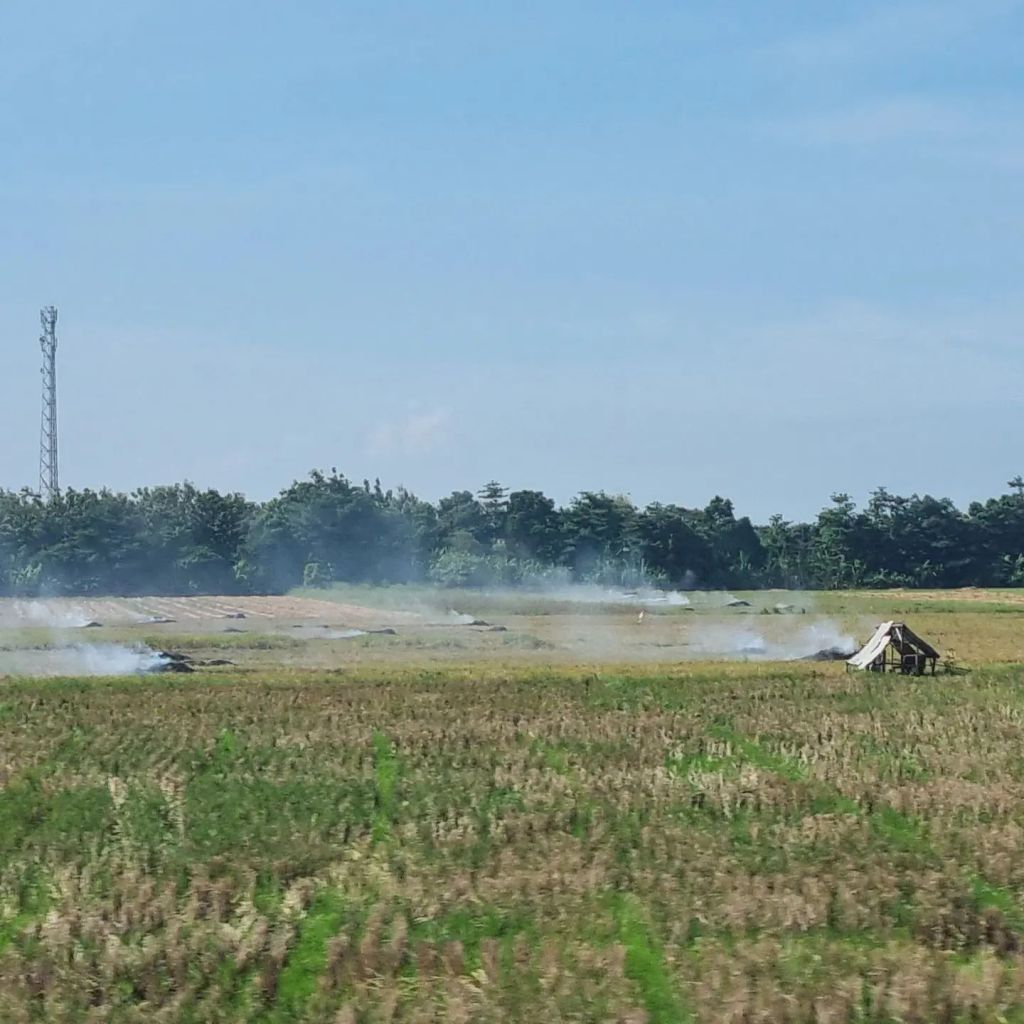
————— I don’t understand the cycle of rice growing. Perhaps it is a harvesting time? Many fields have mounds collected of plant matter, which then seems to them be burned off. Other fields contain the large blacken and burnt carcasses of previous mounds. I wonder if all that carbon aids growth. –‐————












 skirted Records