
I said flippantly, “Maybe the pattern is just a small section of something much bigger and actually random’. For example, if I take a small section from an ECG reading of my heart, I might see something very patternesque. But if I could see the ECG of my hearts entire lifespan, it would show something unique and unrepeatable. I’d wager that no two ECG’s from two humans’ entire lifespans would match. They would be unique and random patterns.
Ideas of Patterns and Randoms seems to be a thread that weaves its way through this week’s various conversations. The notion of a brain’s ability to find patterns, an imaginary line, between two points [and the imaginary path between them] is as old as the hills. Patterns hint of certainty, but certainty, mostly, is a pot of gold at the end of the rainbow. Is a pattern better defined as a most-likely event?
We hold to patterns in nature but these patterns have become unreliable as the climate presents one disruptive event after another. Maybe Big Random has just got smaller.
–
He was telling me of his experience visiting a natural cemetery. I’ve not visited one and was curious to hear what these new [old] developments in sending of the deceased are like. He says he was taken aback at first at how the plots were not delineated or clearly marked out. How ‘composty’ it was. There were no clearly defined plots. No permanent headstones. He could not help but think about the underground. Who was where? And how far had they been distributed? And then we talked about how the same was true of conventional plots. How the demarcation, the patterning of plots above ground, provided a psychological certainty which did not match the ongoing reality of the activity of the soil.
–
We had barely enough time to talk as I was due at another meeting. We would have had a better introduction if we had more time. I learned quickly of her research. It was investigating the indigenous relationship to certain plants, and the ‘songs’ that these peoples were able to intuit from each different plant family [apologies if this is incorrect], from a region in South America. I briefly explained my project. How I made connections with plant and fungal life in my exploration of music making with what I perceive as random signals. Almost immediately, we seemed to come at the notion of random from different directions. If I were to guess, I wonder if my idea of Random seemed contrary to her research findings? Was her research presenting patterns? Time ticking meant I could not stay. We could have talked for so much more, I hope we do again.
Thinking about it now, I would try to clarify what I mean a bit more. Random, in this sense, is Unexpected and Unpredictable. I am not attempting to interpret these signals as conveying meaning or communication. Other more robust research methodologies have detected signals traveling the mycellial network as a mode of transferring information from one point to another. Some have even broadly termed these as words.
–
It’s funny to me that the electronic world has become part of my regular environment. I’ve never really had a love for electronic music, still don’t.
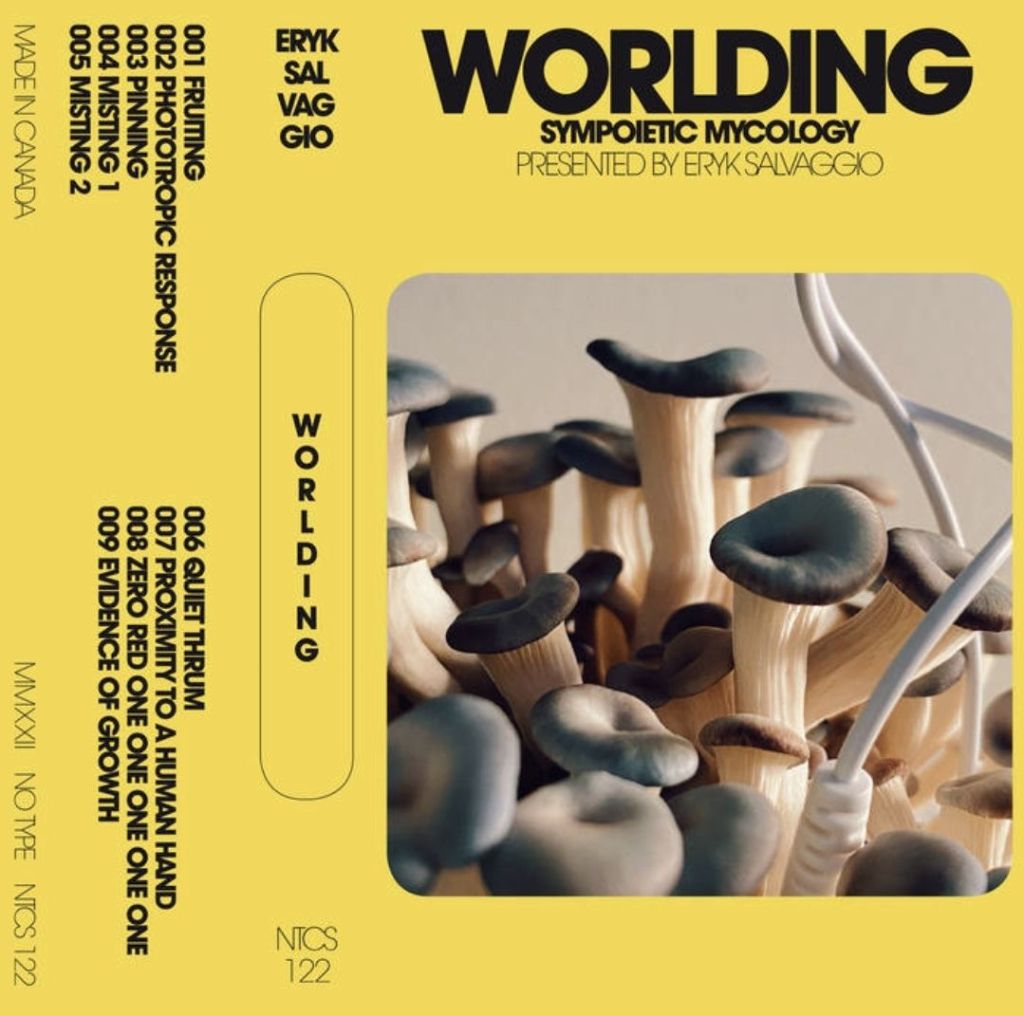
I was explaining again this past week, how it was the electronic album Worlding by Eryk Salvaggio, which stole my ears and sent me on this current path. Salvaggio’s process used a modular synthesiser that was then connected to correct the biosignals of mushrooms. This is a process that I have attempted to emulate and develop. Worlding was on rotate for such a long time, for a period it became the only thing I listened to. ‘How does this music make sense to me?’, I wondered. “Why do these pieces feel like ‘songs’? Why can I hear time and tempo in these pieces when it does actually exist? There is not a line between these two beats but a hook. And a different hook briefly establishes between this and the next beat. Is this how Organic sounds? Why does this electronic instrument, when plugged into the actual world, sound more fascinating to me?”
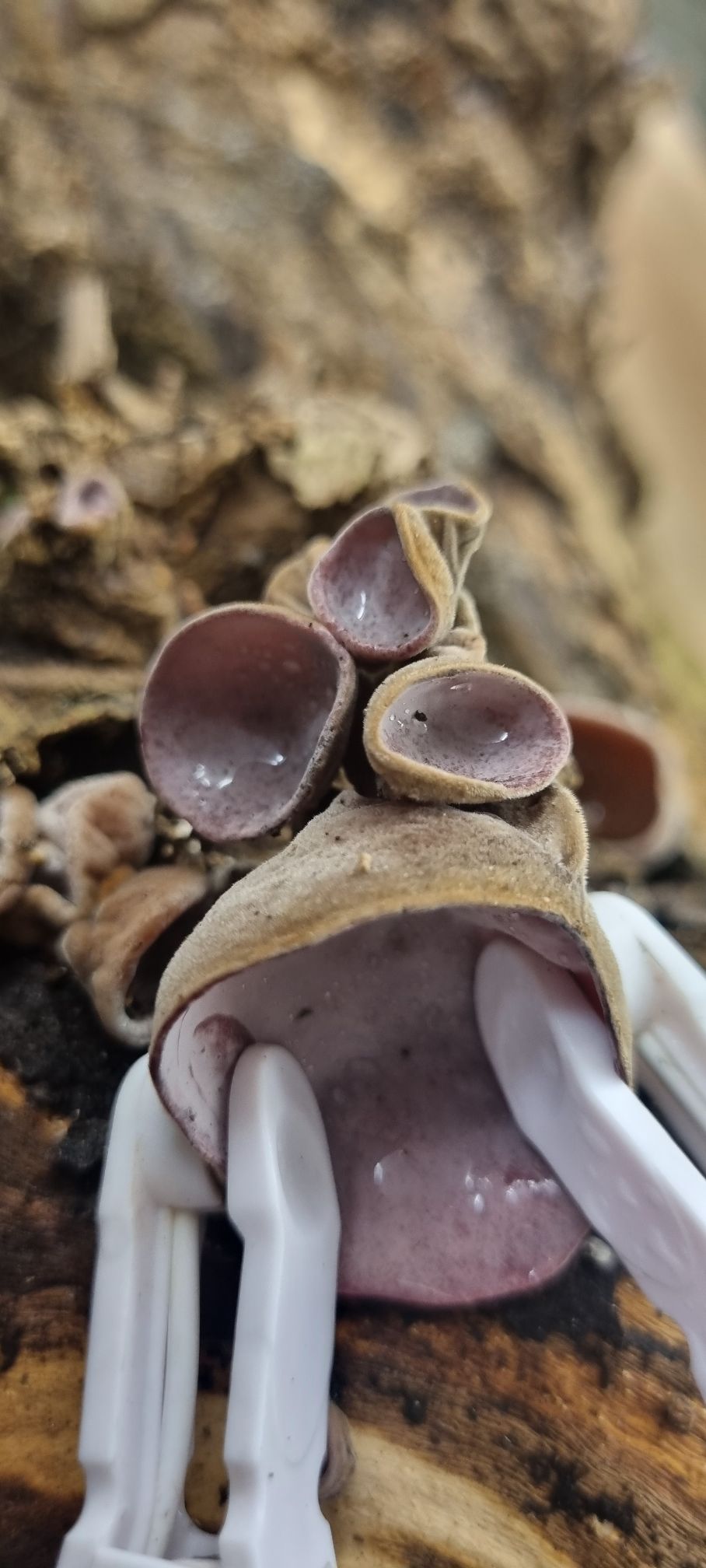
I was drawn first to this album by its name. Worlding is a concept I first encountered in the Donna Haraway book Staying with the Trouble. To paraphrase, Worlding is something akin to the idea that the World is always in a process of being made, at all places, by all things, human, non-human, and all the rest of it, all the time. A world of unfolding patterns and unfolding randoms. Co-existent and in-extractable from each other. This is a world where trees communicate with trees via the intermediary of the mycellial network below ground, the threads and hyphe of the object that bears the mushroom fruit. The distributed and active networks that recognise no borders or plots. That explores and connects, which may exchange or attack, that find modes of adaption and survival in both healthy and toxic environments.
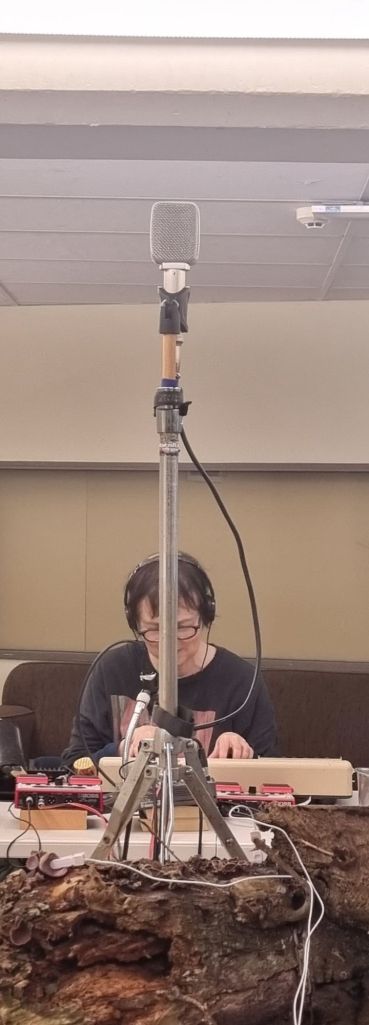
An idea from a book roped me into Salvaggio’s album. That music tangled me into an electronic project. The project currently has me entangled into the networks of Toi Pōneke and the New Zealand School of Music – Te Kōkī. The threads of this had me at a table last night talking about different underground activities. What if this is random? What if this is a pattern? I will follow these lines to where.
Soundbitten:
- Noise canceling off. The train can accompany the tune. Drone against drone. Pitch lowers as brakes engage. The electric hum of the door. A ticket collector’s new lyric, “Snapper?”. Ascension of acceleration, crescendo of the effort on the hill. It is a singalong to public transport, a chorus to communal travel. Where does music start? Where do the tracks stop
- By car for convenience. Slish, slish of wiper. Is that a rumble in the fender? It’s just things in the boot making racket. Slow. stop. Collect and hold those offenders. Next new sounds. Schlubb, schlubb. Schlubbing sound but two octaves down. From where the rumble was. Three times therclunk. Slow. Stop. Strain and clack of tyre iron, free the tyre, change the flat.
- Left, breath warmed sound, the boombox sounds chill. Right, can’t hear the walls echo. Diaphragm flutters, 90 degrees to gourds low tones. Feet hear cello first. Over head abuzz with scooter. Lie down, stone floor from unknown quarry. Up, four bass cables, earthquakes bracing jazz. Four flies fly, one moth dances, and nine blue suns in the sky of Ruby’s world.
- The Eye follows the Ear. The aural nerve is faster than the optic. Listen forward, listen to the back, listen up, listen down, listen near and at distance. Vision is at the center of In Front. I hear you first then catch your gaze. The Ear is older than the Eye. Things were heard before they were seen. We hear before we see. I hear you in the amniotic sea, I see you in the air.
- The kid wakes singing. From slumber to songbird in a blink of an eye. Is there anything more angelic than this unadulterated effervescence? Even before the feet touch the floor, the joy of the little one can be heard throughout the house. The only prayer I want to say is May I never be too old, too tired, too grown up to not recognize this wonderousness for what it is.




 skirted Records