Tag Archives: vma

The Physics of the Swing

“How do you stop the paper twisting?”, he asks.

It’s something I’ve been thinking about for a while as I prepare some pictures for an exhibition. I want them to float off the wall, hanging from each other at 40mm distance, and have a breath-like flutter. Flutter is not the right word, I’m after a rigidity of movement, something like an articulation. If the paper is too paperly and the connections are lightweight, then the overall assemblage twists. I want to be able to dictate the physics of the swing.

The architecture of the paper needs to be bolstered. On the back of the sheets, disassembled bamboo mats become the near- invisible framing. For the pictures to hang from each other, I make something like a big staple from sturdier wire, which has less intrinsic movement. These are then spray painted with a bright orange to light the mood of its weightiness. It achieves what I’m looking for.

Tuesday. I can not make it work. I’ve spent the last 90 minutes trudging this equipment downstairs, setting it up to record, and now nothing. Has it been damaged it in the move? Why is that always the first thought? It was working fine before but now only silence. For 10 minutes, all the lights have been flashing like a trashy disco, but not a peep of sound. Check cables, sensors, connections, and power supplies. I look for the obviously simple reasons before catastrophising options arrive. 

However, the answer to this issue is simpler. It appears that the fungi are withholding their signals. Sleepy fungi. I spray a bit of water onto the mushrooms. The moisture improves the transfer of signal-to-sensor. I reconnect the sensors to the damp flesh and sound bursts into life, with life, from life. 

I’ve made this mistake before.

In the beginning, before this project was a project, I had no idea what a modular synthesizer was. When my first modules arrived, I could not make them work. I leaned on the wisdom of Issac, the only person I knew locally who was informed about such arcane things. He generously lent me gear and knowledge.

Perhaps it was during the second ‘lesson’.

Isaac came over home one evening. Huddling over the equipment, watching closely as he looked skillful in his extraction bleeps and bloops of sound. We were completely focused on the machinery. At some point, though, without obvious reason, sound stopped. I watched on as Issac problem-solved – checking cables, connections, etc. He appeared mystified, I was beyond lost and unable to help. Some inkling prompted him to poke the plant. Then, as if re-energised, sound returned. Should I anthropomorphize the moment, I would think it was the plant playing tricks on us, going, “Oi!! … I’m here as well, get your head out of your geek, and pay attention!!” Such rude foliage. But it’s got a point.

This was a small act of relearning, of where ‘else’ to place attention and consideration. That it needs to be in more places than one. How often do I need to be reminded that invisible things have influence? The world is haunted by unseen things and their own connections. We are at the mercy of the obscure and opaque.

Back to Tuesday. With the sound issues resolved, I set about re-recording a piece from last week. I didn’t have enough microphone stands, so I dangled cables from the aluminum framing holding up the suspended ceiling. I suspended two microphones, one over the rack tom and the other over the floor tom. If I clumsily bump the mic, it will start to swing over the drum. The movement of the mic collected the sounds emanating from the skin as it approached, traveled across, and departed from the drum as it swung through its arc.

I realise I can use this clumsy action with good effect. I reset the mics over the drums and let them swing.  I press record and capture the movement in action. Timing, linked with tempo, are cornerstones in the act of metronomic drumming.  But in this instance, the timing is determined by the physics of the swing. As momentum diminishes from the swings’ natural reduction in distance, there is an audible increase in frequency of the beats.  I record several takes this way, using different mics and drums, building up a set of tracks that feels like it has some sort of regularity. I know it doesn’t.

[Later the Youtube algorithm shows me a piece of music by musician Steve Reich. He had used microphones in the same way but over guitar amps, playing with the feedback. I think I like my version more.]


In the afternoon I’m joined by visual and sound artist and guitarist Gemma Thompson. Gemma is also a regular inhabitant of Toi Pōneke. We have only recently met. We have chatted a couple of times in the kitchen, and have never heard of each others’ music, other than a short clip she played to me from her phone of a recent concert. It is an interesting way to meet someone through sound rather than words. There is a confidence required to be able to let go in the company of a stranger, the urge to self-censor, and self-limit can hobble opportunities like these. It’s a good practice to work against these things.
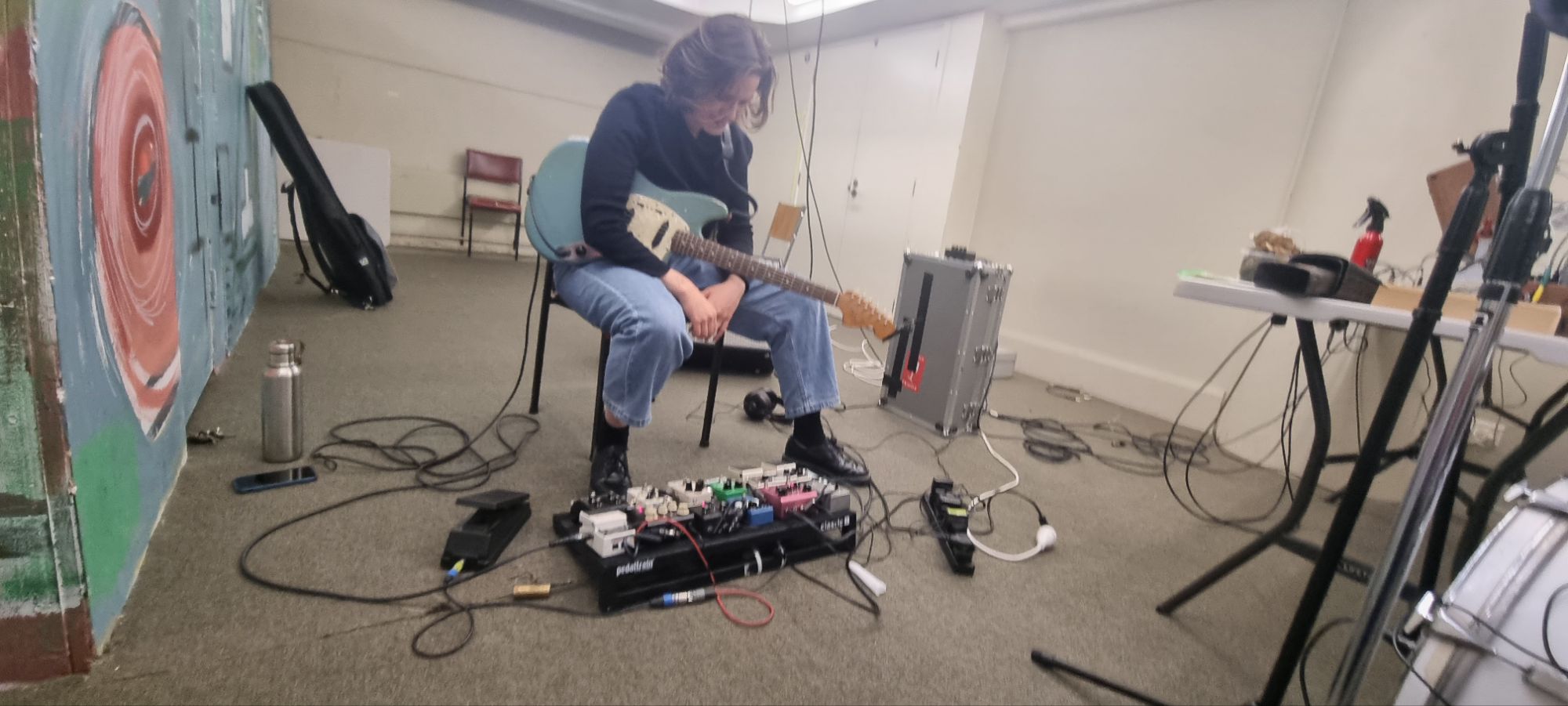
I host an open studio on Wednesday evening. It’s an open invitation to present the current work-in-progress. And I get to demonstrate how the machine/plants work together. I am both surprised and heartened at the number of people who come through. There seems to be genuine interest in the project,  and many are willing to take part in the chance to interact with sound making. 

One demonstration that gathers attention is where I place one sensor onto the plant/fungi and the other onto a persons’ finger. No sound is made until the circuit is closed by the person with the sensor connecting with the plant. We expand this by bringing in extra people, as long as they hold hands with the person connected to the sensor and the person at the end of the line touch the plant/fungi. It’s possible to hear audible changes in the sound from this bigger loop. Sometimes, it seems to take a little longer for sound to register, and the rapidity of the signal changing seems slower. But there seems to be something awe-inspiring for people when they have the chance to become part of an organic loop, part of a connection that makes this sound. It is almost as if the connection is more important than the aesthetic.

The week wraps up with a lichen-influenced mechanism playing metal chopsticks on a snare drum. It was a useful distraction as the swing states gave Trump his victory. So much had been written already with an air of certainty about what will come.  I’m no soothsayer, I’m making no predictions. I trust the fact that Trump is not breaking the rules of physics. Negative does not exist in a vacuum. For there to be a negative-in-charge, somewhere there exists a positive.  I’ve no idea what it is. It seems invisible. But if I must remind myself of one thing, it is that the invisible also has influence, and most things deemed certain never are.

SOUNDBITTEN:

  1. One door over, a Kango hammer bites into concrete. A metal tooth drumming on the solidity of the wall, intermittent in attack, dusty in effect. It has a jangle in it’s voice, bells chime as the engine powers up. Another machine over another fence chews into spring grass. It’s a two-stroke throatiness, undulating in pitch, as it works against the resistance of rapid weeds.
  2. A bird sings twice. First from the bough high up in the Eucalyptus, air astringent with fragrance. The second as the echo returns from the bricked house opposite. The quickest reverb. Sharp like a smell, piercing to the ear like molecules to the nose. Reminds me of a text that says the smell of fresh cut grass is, in the language of the garden lawn, screaming.
  3. The show was over 20 years ago. I’d been to plenty that had left my ears ringing in the past, it usually stops after two or three days. Not this time. Loud laptops, pure digital tone, my drums in the crosshairs of the P.A. I hear it now. I’ve got strategies to cope with the constant background sound. Stress is a volume knob, a red flag, a siren’s call to attend to some inner need if the ringing starts screaming.
  4. There were only partitions between the bed bays in the long corridor that slept 80. Mine is next to the Dorm master’s door. No privacy. No quiet space. Lights out. I would hide the walkman undercovers, listen to the Sex Pistols on headphones. Lights on. Dorm master had me on display to all, getting six of the best for my sonic indiscretion. It won’t stop me.
  5. I make mixtape for road trips in the car, all the favorite songs in one place. Pack the kids and go south for summer. Along the coast, the song Motorhead comes on. At the same time, kid 2 throws up. We stop, clean up, and carry on. Down the road Motorhead returns. And like an allergic reaction, kid 2 throws up again. Stop, clean up, put the tape away, and carry on.
Open Studio: Toi Pōneke

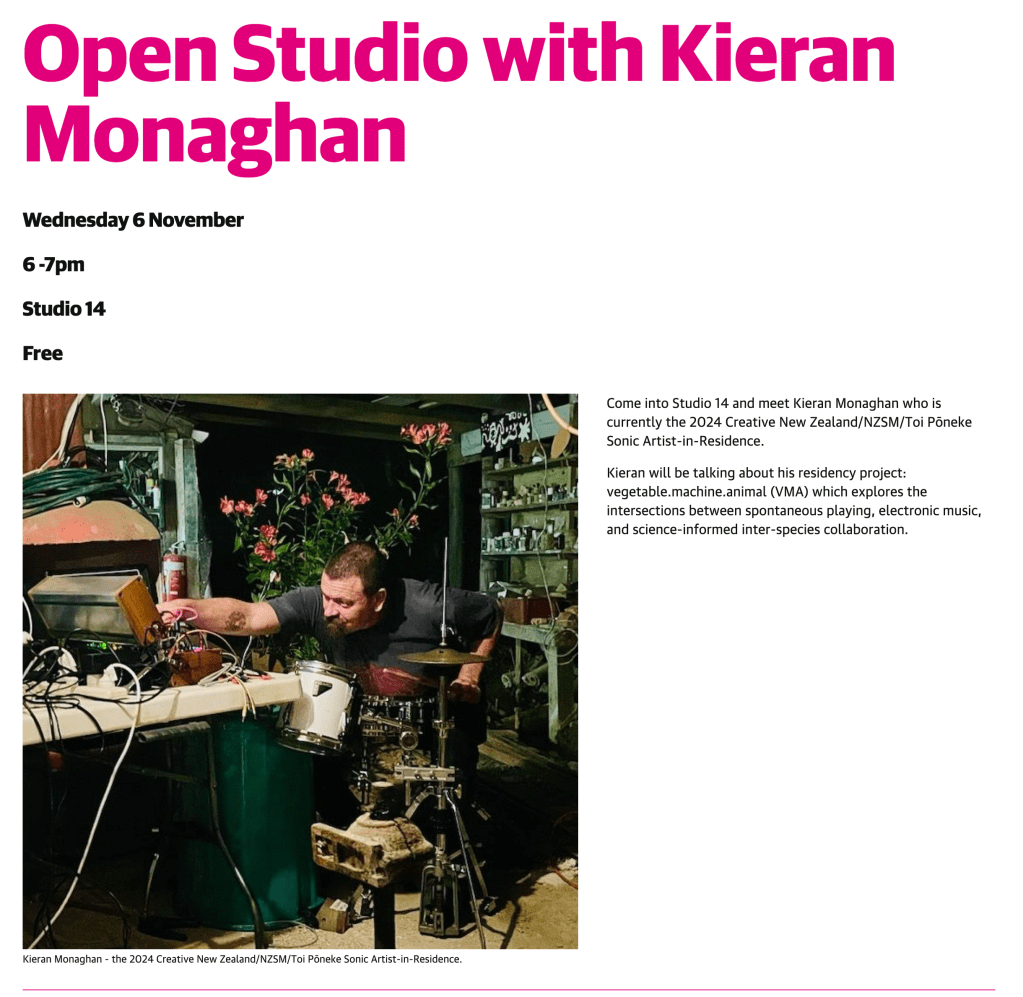
Screenshot of the Toi Pōneke website. Top text: Open Studio with Kieran Monaghan, Wednesday 6 November, 6-7pm, Studio 14, Free.
On the left is a photo of Kieran reaching over his drumkit to make adjustments on the modular synth on the table in front of him. His action bends him towards the left. There is a large flowering plant behind him. The location is in an open, but covered, space at night at the Driving Creek Railway in Coromandel. 
Text on the left of the image says:
Come into Studio 14 and meet Kieran Monaghan who is currently the 2024 Creative New Zealand/NZSM/Toi Pōneke Sonic Artist-in-Residence.

Kieran will be talking about his residency project: vegetable.machine.animal (VMA) which explores the intersections between spontaneous playing, electronic music, and science-informed inter-species collaboration.

Kia ora all. This is an open invite to come and visit me in Studio 14 on Wednesday 6 November, between 6 – 7pm, to check out what Im up to.

I will be happy to offer sound demonstrations of the project at work , discuss questions you might have, be confounded at the same time if I don’t have answers, offer you some kai to nibble. Will be 100% family friendly. Studio 14 is located on the second floor, lift access is available.

FACEBOOK EVENT
Toi Pōneke original LINK

Neil Robert’s Day – Pōneke Fundraiser

FROM FACEBOOK:

Nau mai! Haere mai!

Neil Robert’s Day is just around the corner, and it’s pretty big this year. We’re putting on two fundraiser shows – this one here in Pōneke and one in Whanganui.
Come see FOUR sweeeet bands and one alright DJ!
Doors at 9pm
Displeasure
Retaliator
Side Eye
vegetable.machine.animal
DJ Suave

NO stink cunts policy will be strictly enforced. 

Neil Roberts was a punk anarchist who died in an act of explosive defiance, with the Wanganui Computer as the target, on 18 November 1982.  Located in the city of Whanganui, the computer was the NZ government’s first digital database of accessible information on citizens, used by police and other surveillance services. His act is seen as a protest against the government’s growing surveillance mechanisms.

Film maker Russel Campbell has written about the events of the act and on some documentation that took place afterward.

Contaminated by Humanness

Picture painted by Kieran,  contains the words Contaminated By Humanness. An idea from the book The Light Eaters by Zoë Schlanger.

There are sensors connected to a plant at one end. At the other of the sensors is a plug inserted into a box that is a mess of cables and flashing lights. Speakers play sounds corresponding to interactions with the plant. Someone else is listening. I’m waving my arms around, fishing for words, trying to reel in some shape of comprehension.

I cannot think of a single instance, while demonstrating this project, that I experienced indifference. Typically, people’s fascination towards this budding idea that there is a perceivable, inter-actable, response from a species who hasn’t even been afforded the notion of agency, let alone complex life, in any form. 

It’s exciting when people become intrigued. They want to ask questions. I can almost see cognition kicking in, lights going on. I do not mean this in a way that could be construed as patronising, quite the opposite, a curious and inquisitive human is a wonderful thing.

The sound comes from the speakers. They ask, “Is this what the plant sounds like?”. No must be the answer. Anything else would be a lie. 

It’s an understandable question, when stepping towards the unimaginable. The imagination projects onto this non-human entity a humanness: “Maybe in some near-sci-fi way we will be able to ‘communicate’ with plants? Maybe it will be like a First Contact moment from an alien-encounter story?” I explain that what we are hearing is the result of the plants voltage only, it’s internal electricity, a biological signal which is measured between two sensor points. BUT, I emphasise, this is no less remarkable. We can interact and hear how the change of electrical signal changes the sounds coming from the machine. These are examples of signs of life, small recognitions that this entity, this plant, is detecting changes in the environment. And in response, changes in biosignals become audible. Caution is needed here, intention and meaning can not be interpreted from this moment anymore than a clinician is able to ascertain something about your personality from an ECG. It is impossible.

Online, I’ve seen examples of people making music with plants, presenting something that looks like a spiritual connection, a musical synergy. Most of the time, I think it’s an illusionary moment that is fraught with moral garbage. I would argue that such fantasy is unnecessary. We can be amazed at the astounding complexity of life without the bullshit.

Image of the cover of the book The Light Eaters by Zoë Schlanger.

Zoë Schlanger’s book ‘The Light Eaters’ (2024) is an exploration of the recent science on plant intelligence, plant communication and plant memory. Ideas that had once been decried and ridiculed are now undergoing a rethink in light of new research and repeatable experiments. “Contaminated by Humanness” is an idea from Schlanger’s book. This idea of Humanness is a polite way to announce Anthropocentrism. Anthropos is Greek for Human. Anthropocentrism is the placing of the human experience and perspective central to all. For example, for things to be understood, hold value and meaning, they must be translatable into a position relevant to the Human. Failing to ‘See’ other positions, other Others, as of value, meaning, and importance has brought ‘Humans’ of modernity to the worst versions of ourselves. Schlanger’s suggests that there are many more perspectives of the world that may remain truly unimaginable, yet remain alongside us, permanently in co-existence.

In this project I describe the sound-making devices of the synth as akin to Google Translate. It enables us to perceive, attempt to comprehend, and engage with the signal of the lifeiness of non-human others. In this awareness-making moment perhaps perspective might shift. What’s been seen cannot be unseen, so too what has been heard can not be unheard. I think it’s important to not corral these sounds into a classical framework of what music is. I want the unexpected musicality to hold its own space. And then we can decide to simply participate without overlaying some limited conceptual idea such as music definitions. We can start by learning to have bigger ears.

Writing this makes me think of an early, and very formative, event. I can pinpoint the moment my ears expanded.

Sometime in the late 80’s I hitchhiked to Christchurch. One day I was walking in the square in the city centre. I had just brought a cassette called 2X4, a collection of live recordings from a German industrial group, Einstürzende Neubauten. I had read about them in fanzines but had never heard them. Invercargill was a long way from Berlin. Until today.

My ancient copy of 2x4 by the German industrial band Einstûrzende Neubauten. I thought it no longer played due to too much beer spoiled on it, but tonight, the spools rolled fine... still as noisy as ever

Walking through the Square, Cathedral to the Left, the pub Warners ahead, my ears were confounded and lost by these raw, unfamiliar sounds on my cassette Walkman. What I heard gave me NO reference to help me understand the sound. Percussive machinery, confronting angular rhythms, and Bargelds’ high-pitched vocalisations felt indigestible. Even though it was both fascinating and disconcerting I had to stop listening for a moment, just to catch my breath. 

Removing the headphones the perplexity remained as I felt like I was STILL listening to the band.

All around the Square was the sound of construction sites, building projects in various forms of ascent. Skeletal towers full of labourers beating frames into shape. Concrete-mixers, angle grinders, hammers, saws, power tools and brute force all at work. I heard it all.

I also heard, I realised, what I needed in order to listen to the cassette. The builders had no pretense on being musicians, but the musicians used the tools of construction and destruction to create songs and entertainment. Tools containing specific utility, identity, became challenging in the hands of another. Not so much bending it out of shape, but into a newer shape. A shape that encompassed both this world of construction and also that world of creative exploration. The building world became contaminated by a musicness.

Many of these building never survived the earthquakes 30 years later. But I still hear ‘music’ where it isn’t.

The artists are in residence

Kieran sitting in new studio at Toi Pōneke

Today is a milestone. Kieran begins 3 months as the Creative New Zealand/NZSM/Toi Pōneke Sonic Artist-in-Residence 2024. You can guarantee that this funded watershed will result in a proliferation of work in sound, in music, and in painting and will foster a clutch of unexpected collaborations with makers in a myriad of disciplines.

The knock-on of Kieran’s relocation to Toi Pōneke, is I get to stretch into an empty house for 3 months. So I feel I have scored the inaugural Happy Valley/skirted Records Sonic Artist-in-Residence 2024. Who knows what this gift of time and space will generate?

We both aim is to keep you posted as we would if we were on tour. Subscribe if you’d like to follow along.

2024 Sonic Artist in Residence Announcement


Toi Pōneke Arts Centre and Victoria University’s New Zealand School of Music—Te Kōkī (NZSM) are delighted to announce Kieran Monaghan as the 2024 Creative New Zealand/NZSM/Toi Pōneke Sonic Artist-in-Residence.

Kieran Monaghan (he/him) is predominantly, and persistently, a drummer and percussionist of found sounds. He calls Te Whanganui-a-Tara/Wellington home. His first crude musical steps were in the late 1980s, playing drums in southern punk rock bands. Heading north in the 1990s opened new musical domains such as theatre with Red Mole, and its little sister Roadworks, and the diverse arrangements of free jazz that tumbled from venues such as The Space. While continuing to play assertive music, alongside developing confidence in improvisational arenas, necessity also dictated that income be made by playing multiple pub circuits in working bands.

His project, vegetable.machine.animal (VMA), is the newest iteration of ongoing musical expression. It explores the intersections between spontaneous playing, electronic music, and science-informed inter-species collaboration.

He co-runs the skirted Records label with domestic and performative partner Chrissie Butler. Together they were the core of the outsider punk group mr sterile Assembly, and Nick Bollinger named them as one of the ten great rhythm sections of New Zealand. Monaghan has toured internationally many times with the Assembly, and more recently with VMA. He has a long catalogue of solo, band, and collaborative recordings. He is a semi-regular DJ on RadioActive.FM. He remains happily hitched, and is a father to three daughters and one mokopuna.

The Creative New Zealand/NZSM/Toi Pōneke Sonic Artist-in-Residence 2024 is a three-month position that runs from 23 September to 15 December 2024. During this time, Kieran will develop a body of innovative and substantial work in the domain of sound art. His work will include a new album, performances and an installation of vegetable.machine.animal. He will become an employee of Victoria University of Wellington for the duration of the residency and may use NZSM facilities and recording equipment over that period. In addition, he will be provided with studio space at Toi Pōneke and his residency will culminate in a 4-week exhibition in June 2025 at Toi Pōneke Gallery.

Text verbatim from Toi Pōneke website

Remix like a Plant

I googled to see if there had been examples of music anywhere remixed by plants. All I found was a lot of Robert Plant and Plant Vs Zombies.

When putting the album My Daughter the Spider together I thought about making some tapes at home. Turns out our tape deck is not up to the task.

After a few experiments at dubbing I accepted that the quality just stank, and abandoned that idea. But then another more interesting thought came along.

What if I played the dodgy audio back through the synth? What if I had a plant also connected to the synth and had it wired up in such a way that it would change the audio coming out? What if I got the plant to do a remix??

The text of Eryk Salvaggio is really useful in helping to understand how this can work:

Living things produce electrical signals on their surface, whether it’s human skin or the cap of a blooming mushroom [or in this case a photosynthesising plant] . A synthesizer can be designed to read this signal as voltage. The voltage can then control the synthesizer by moving through its components according to a specific structure. The structure is shaped by circuits, which usually assembled and sold as “modules” in a modular synth. The signal’s path between those modules is possible through the patchwork of wiring between those modules. 

The [plant] is not the core of our concern. The centerpiece of this machine is electricity. Once the [plant] “gets into the system,” you can direct it in all kinds of ways, depending on where the wires connect to those modules. If you have never tried to do this, you might assume it’s like hooking up a stereo, where wires have a right place to be. That’s not the case. Instead, you have to make decisions about where the electricity needs to go in order to do the thing you need it to do; every hole in the module is an eligible candidate and there is really no way of knowing what it will do in combinations with other parts of that chain. 

It’s not a sound system. It’s an electrical ecosystem. “Sound” is just what happens afterward.

The technical Part:

The first module is a bio-feedback module, this converts plants electrical signal in a way that the synth can use. The Synth also has a Loop module, this captures and repeats edits of sound moving through it. The Loop also has a GATE [controlled by the plants electricity] meaning when the biofeedback module is active, the GATE opens and lets a new piece of sound into the looper and deletes the previous sample. And this is where I thought the remix would come form. Not a reinterpretation but a method that a piece of established music could be affected into new and unexpected ways.

And then I started the recording of the remix. I decided once the recording had started that I would not manipulate anything on the synth. I did allow myself to interact with the plant, like touching the plant, spraying water and creating shade. These physical interactions change the signals being sent from the plant to the synth. But it seems like there is no way to control or preempt what the changes might be.

Does it sound any good?

Is it a technique worth exploring?

It’s a fascinating way to apply reimagining to a piece of music via a truely random method. There is no suggestion that the remix is based upon plant-intention or consciousness. It does seem like an interesting result from what Salvaggio calls an Electrical Ecosystem and well worth exploring more.

Below is the remix – have a listen, leave a comment, we’d love to know what you think.

My Daughter the Spider album release

Square over artwork for the vegetable.machine.animal album My Daughter the Spider.
Top left is the vegetable.machine.animal logo
Bottom left ais the album title My Daughter the Spider
Top right corner contains the top half of an elongate photo of the preforming trio - in this section the view is as if looking down from the roof onto the modular synthesiser on a table top, next to the synth is a Sarracenia Pitcher plant - connected to the synth via connecters.
The bottom right portion of the photo is a overhead view looking down on drummer Kieran Monaghan

Horizontal through the centre of the cover is a collection of colourful synth cables - adding a strong horizontal feature to the cubic design

We are very pleased to be able to post this new release today the new album My Daughter the Spider by the project vegetable.machine.animal – an interspecies trio [non-human(of fungal and photosynthesizing variation), modular synth, human] creating

My Daughter the Spider contains 11 tracks – 9 tracks collected over the last 6 months- then an imaginary cassette version, and then a remix of the imaginary cassette version conducted by Plant!

vegetable.machine.animal : an interspecies trio of non-human, technological and human collaboration developing generative and engaging sonics at this meeting point of three worlds. 

Via mycelium, wires and neurones signals are made, sent, received and interpreted in ways that make sense to each from its own perspective 

non-human/machine: 
The non-human is connected to the machine via a biofeedback module which converts living electrical signals into ‘data’/machine-processable information – these signals moves through the network of the various modules of the synth altering parameters such as pitch, time, volume, sensitivity. 

machine/human: 
Aesthetic Synth sounds to the human ear are identified by manipulation of the parameters of oscillators, sequencers, EQ’s’ and settled on once the general ‘voice’ being produced seems ‘right’ for the moment. 

human/non-human: 
When the drumming/recording starts no further human manipulation is made to the synth. 

The only physical interaction happens once playing commences is between the non-human/human – this may be touch, talking, spraying water, making shade etc – these interactions also appear to have an affect on the incoming/outgoing signal of the synth. It also seems that the plant appears to responds to the volume of sound of the drums/speakers, further changing the dynamics of the audible sound. 

The 9 tracks recorded at various locations, home studio, live [Pyramid Club] and at the Audio Foundation- Tāmaki Makaurau/Auckland – many thanks to AF!! 

Track 10 is an edited compilation for a 20 minute imaginary cassette. 

Track 11 is track 10 that has been played back into the synth with the plan to develop a ‘Remix’ via a Sarracenia Pitcher Plant. 

The biofeedback signals of the plant influenced various gates and effects of the synth. The sensitivity/intensity of these signals determined the parameters of the audio output. For example A looping module would collect a snapshot of audio depending on the signal received. The duration of this playback was held until a new signal directed the machine to discard the sample and collect a new soundbite to loop/process for a plant-determined time, until the next signal arrived. 

Once recording started the human interacted only with the non-human. 
These interactions in turn affected the outcome from the synth which generated this essentially plant-based remix. 

The concept of the plant remix is the topic of the next post

Album available from Bandcamp