Tag Archives: vegetable.machine.animal

The Floor Holds

Somewhere in my post-viral fuzziness, I lose all my keys to all the doors I need to open. Later, I make so many trips up and down the stairs because I forget one thing after another. I am not fastidious enough when plugging cables into boxes and discover later that I have recorded one channel of audio and one channel of silence. I tell myself to be careful with the marker while doing measurements around the pictures, a purple line glaringly appears unwelcome in a margin. I download some footage I captured to make a video, I manage to lose it all in the process, and only realised after I had deleted from my photo. Argh!

That’s how a week starts. Small and inconsequential irks when held in comparison to the big issues of the day.  In a doubtful moment, I ask, “What is this for?” “What does my art add in the scheme of things?” In a world of fear, anxiety, murder and massacre art can seem like a folly, a luxury, a something that’s “nice-to-have” as one politician recently spewed.

It makes me ask of myself:

  • What ways should I think about what Im doing?
  • Am I making escapism? 
  • Am I making something that helps me/we/us step outside of the pressures of the practical issues of today? 
  • Is my thinking captured or critical? 
  • Am I making something in context or am I decontexturalizing? 
  • Am I making a brand? 
  • Am I making something meaningful or grandiose? 
  • What do I think now that that gatekeeping position has shifted?
  • What in my work addresses the bread and butter issues of the day?

Big naval gazing questions. In fact sometimes the only response to questions such as these is a big ‘Fuck it and Fuck Off’. They have a time and a place. But if it’s inertia they create then it’s not welcome. A reflective pause is different from the dead air of being inert.

The last post contained a photo of the Bread and Puppets manifesto. I hadn’t really thought too hard about why I added it other than I think the words are good. Today, I think differently. It states ‘Art soothes pain, Art fights against War & Stupidity, Art is like good bread, Art is like green trees’.

Art is like Green Trees. It makes something that makes it easier to breathe. 

It amazes me how easily something so ephemeral can remind us that we CAN imagine something different, sweeter, better, and fully welcoming. Everything constructed we see starts in the imagination. If it can be thought of, then it can be done. The algorithm of feeds, the corralling of ‘If-it-bleeds-it-leads’ news reporting, the shouting of opinionated anybodys online sucking up airspace, and the limitations of the corporate storytellers shut down the notion that the world remains full of options, opportunities and alternatives. Here we say, “Fuck it and Fuck off!”

Dunedin, 1988

I think of my own experience. Music has always made sense to me, captured and captivated me. It ‘spoke’ to me before I could speak for myself or even figure myself out. It gave me a hand up when I needed help. If you knew the young adolescent me you would have known I was trouble, or trouble was on its was to find me. But music gave me an option. In fact, I think music gave me my first real confidence. When my own mental world was at it’s bleakest, most slippery, I could always find some purchase in some musical expression to grasp. 

And I would never meet the makers of these sounds. Or in some random rare and precious moment I might. But on the whole they would never, ever, know the tiny but deeply meaningful impact they installed in this small life. And the way we obsess about things like bands, books, and such, I’m feeling confident that it happens all over the place, all the time. Small individual acts of making things better. That’s a gift to give. So massive thanks, love, applause and appreciation to all those, everywhere, who give without expectation of return.

If you’re a maker, keep making! 

Soundbites:

  1. Clocks! I hear clocks. The kind with hands and mechanisms making noise. Big ones. Ticking away in seconds. They sound close, overhead, omnipresent, inside my head. Your poor house has no clocks like these. There’s a timekeeper on the oven only. I am being haunted by time, hallucinating time, imaging time as if it were there. It’s just the solvent talking.
  2. Listen back to recording, time wobbles. A snare hit’s untidy. Out of Time. I demand the snare’s attention! To human time. Timed time. My Time. But here’s the But. What did I hear that threw my strike? Distracted tight time? Mmpatient time? Glide time. I listen to something in its Own time. Can I be brave and accept organic time? Messy time? Not My-time.
  3. Sounds like the ocean. The wet is beer and sweat. I am driftwood on a wave in a moshpit. Together it’s both dangerous and safe. I look for the band. I’ve lost the song. I cannot tell where we are or what comes next. Beats flails after beats. The bass is a weighted blanket. The guitar is the Cheshire Cat’s grin. The music holds me. It is ferocious and full of smiles.
  4. She listens small. There’s something inside it. A fragment of action, a shout from friction. If she can find the start, that doesn’t exist, and the end, that doesn’t exist, she will have made something that does exist. And repeat. Turn fractal into pattern, turn figment into rhythm. Something that was not there. But she could hear it, she just needed to find it. Here it is.
  5. I fell in love with Foley through Star Wars. I saw a demonstration of how the sounds of stormtrooper blasters was made. Somewhere in a desert, large pylons were anchored with cables, securing them to the earth. Hit the wound steal, cymbals made of metal strings. Zap! The ordinary everydayness of things became the sounds of the future.
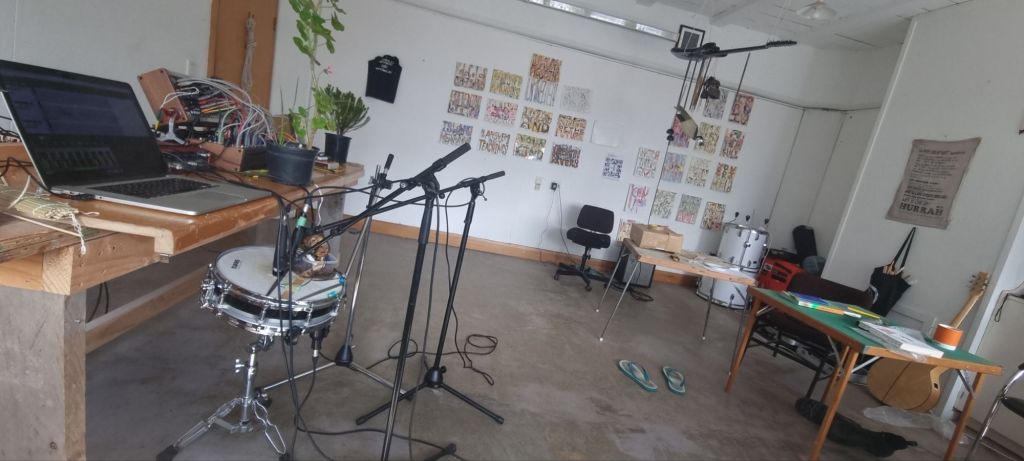
Modular synth, Peace Lily and drum kit set up for recording.
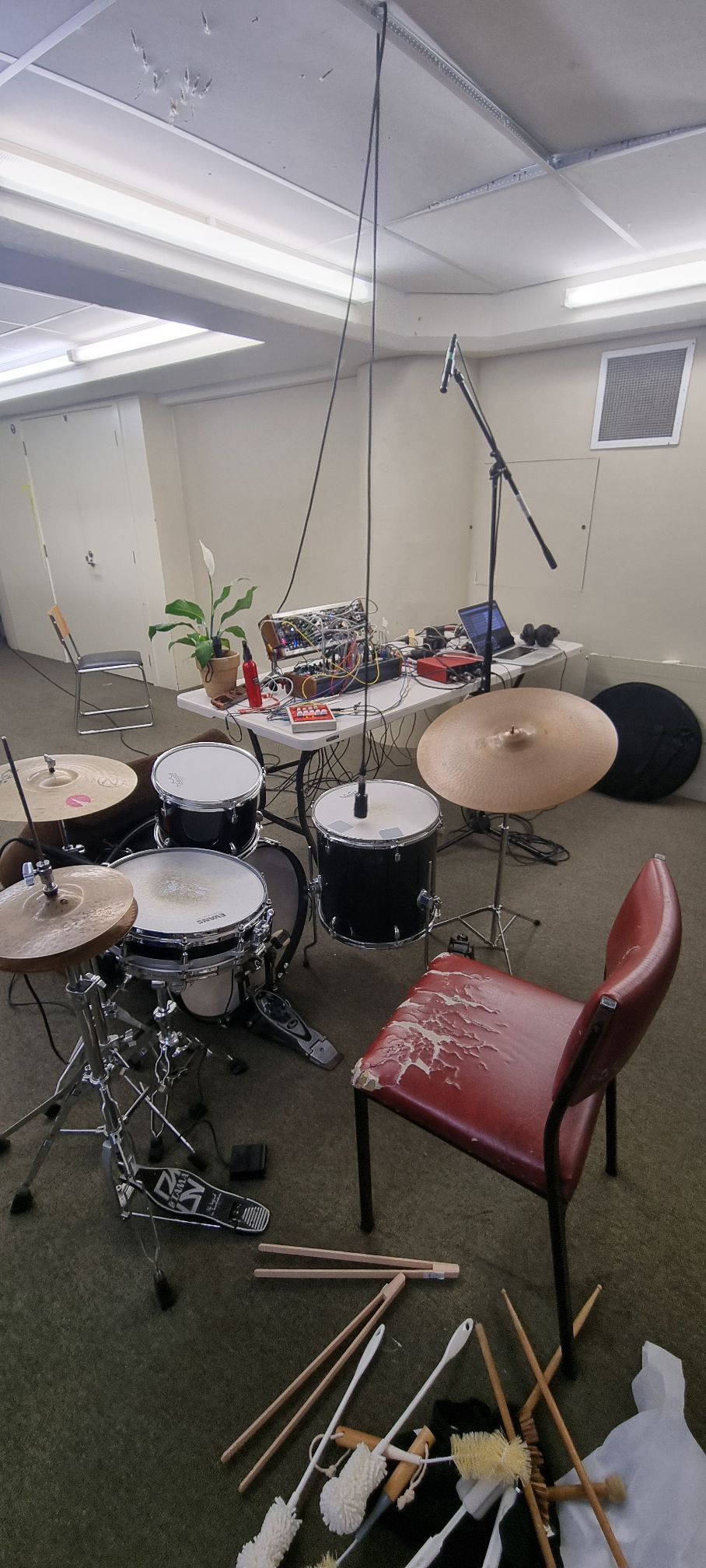
V.M.A recording set up with swinging mic.

Moat of Rest

Quietly, we go into the week. a lot of sound waves were generated last week, in studio and at shows. Some calm is welcome. There are some practical tasks to complete.

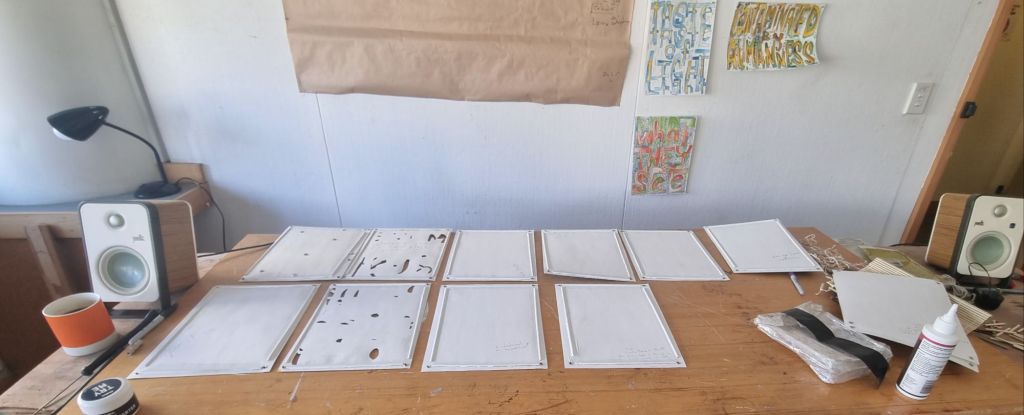
I have been invited to contribute a set of posters for an exhibition, opening in December. The gallery is called Te Atamira, a purpose-built ‘community arts and cultural space’ in Queenstown. I spend Monday figuring out the logistics of hanging when I am unable to assist with the physical installation. I want the posters to have some movement as they hang out from the wall. Hanging/floating parallel to the wall, I want the space between the paper and the surface to contract and expand, but not twist.

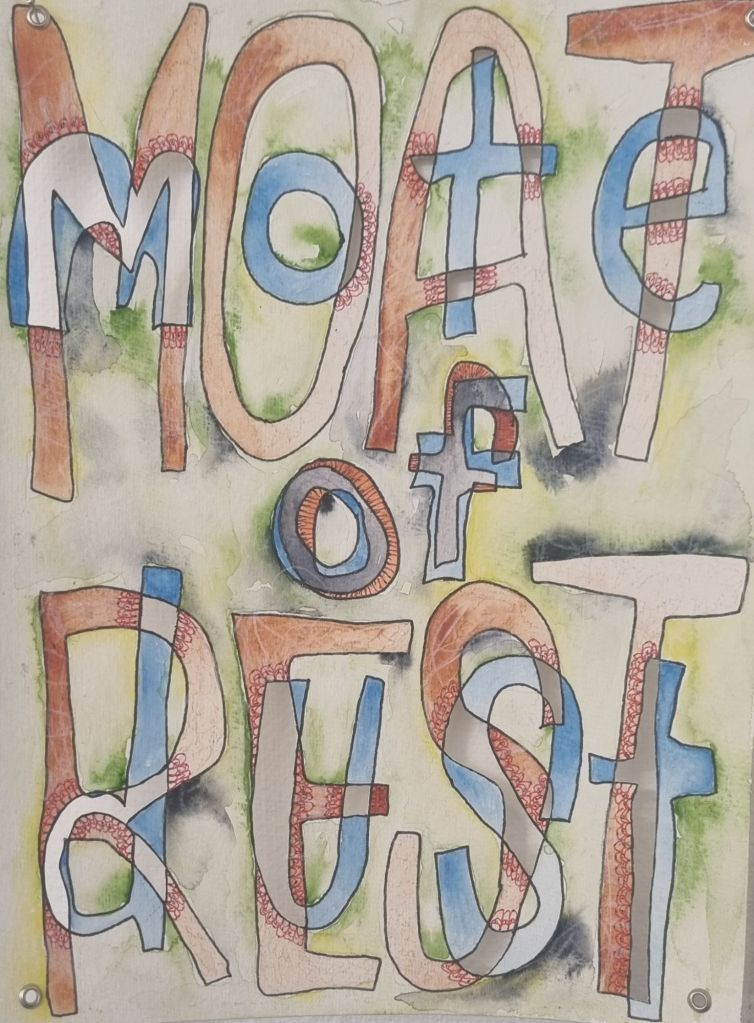
Adding structural integrity to the paper

The drawing project developed as an accidental pastime during the DCR residency, November 2023. It was never intended to become a thing. I had just planned to take some paper and paints to doodle in the downtime. I haven’t had the inclination to write big songs like we sung in sterile, committing 3-4-5 words to a piece of paper seemed satisfying enough.

It was a pastime without expectation. I enjoyed scratching out the blockiness of the letters. Abstracted shapes presented themselves when I wrote the second text over the first, I’ve always had a thing for negative space.  I like the vagueness and flexibility of context and interpretation when punctuation is removed. And the chance to just play with colour brought it’s own pleasure.

Many of the phrases came from text that I was reading, descriptors that had extra possibilities tucked inside when lived out of the original context, multiple meanings presenting from a very economic sentence.

This will be the third time I have been able to display publicly this year, not bad for an accident.

And then I became inhabited. The last week or so has been more social than usual. Maybe someone from a bus ride, a cafe, or an audience was feely poorly, perhaps, or maybe not, was harboring a virus that has made me home. Nothing too bad, not CoVID, according to the RAT, but it’s bad enough for me to isolate at home for a few days.

It’s made some space to catch up on the accumulated recordings so far. Re-listening is a time-intensive task that requires a distant objectivity, not always easy to maintain. If listening back is too close to the recording session, then the excitement of the experience can get in the way of discernment. Things that were called mistakes at the time of recording may still sound like errors. With some distance, though, those ‘errors’ may blur into something more inspired, an accident of greater interest. Errors may be hypercritical reflections from a fragile ego. Inspired accidents may be discovered when the ego is belted down firmly in the backseat. These unexpected musical deviations can often be the thing that captures and maintains interest over multiple listens.

Also, ideas start to swirl in relation to the exhibition to be installed in June 2025 at Toi Pōneke. First ideas are not final ideas, but I’m often in a much more comfortable space once I have something to edit. 

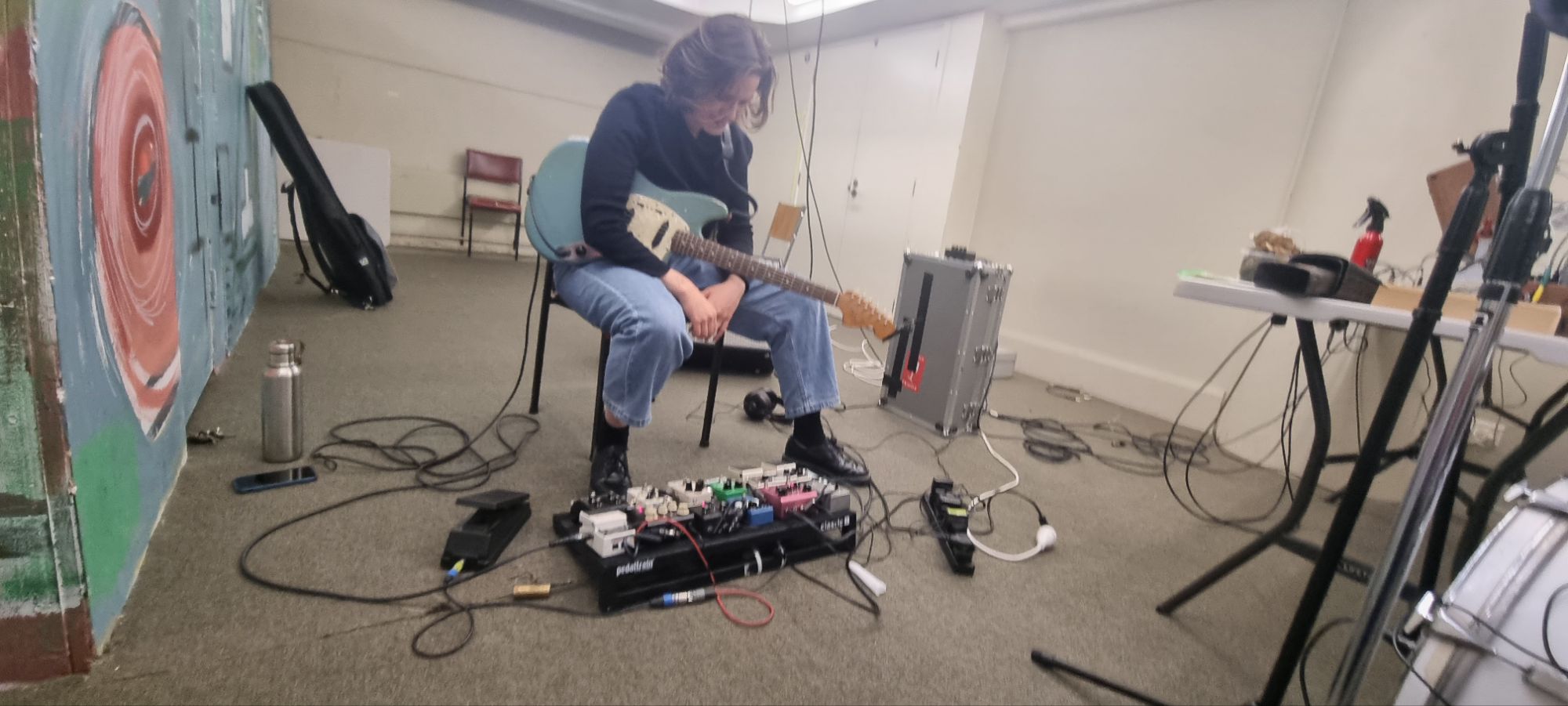
DSLB v.m.a setup

Patience for admin has never been a strong streak. When the motivation is brewing, all i want to do is just get on with the doing. However, this unplanned pause from the studio has actually been pretty helpful. For example, I was listening to the collaborated recordings with Chrissie and her DSLB project today. To be honest, I was uncertain about them directly after, I didn’t think my playing was as interesting as it could have been. But on listening today, with a good few weeks in between, I hear new patterns, textures, bursts of interest, and surprise. I have a few more sessions planned to add to this collaboration project. It’s off to a great start.

However,  all that said, I’m over the calm, I’m ready to get back the studio.

Soundbites

  1. Trees roil like kelp in a sea of wind. Birds swim in currents. I wonder, do fish hear the bull-kelp roar? It’s night’s middle, listen to the norwester, crest first, then bear down. Whipping all tall growth that stands above scrub. Every leaf and branch a wood/wind reed. Everything that rattles will. I feel pressure change from an ocean of air inside ears.
  2. Chest Sounds: wheeze, stridor, crackles, rhonchi. rasp, pleural rub. Auscultation – play the skin of drum, hear the resonance and density from percussion. An ear to a wall, listen for the In’s, the out’s, the rate and delay, for wet sounds, other sounds, no sound. Pay attention when Cheyne-Stokes sings, the song of the lungs soon end.
  3. Susurration is a burble in rainfall. It shimmer in choir as puddles, rivers, Oceans return. The chatter of uncountable billions when surface tension meets matter. The blurred accents of drops on wood, earth, tin, skin, wing, and kin. Wet squall murmurate, shift, accommodate the fluid response to gust, current, and eddy. Sleep well inside weathers lullaby.
  4. Guns at the front door of the farmhouse, none in the new home in town. I make a replica of wood. Find a single bullet in the garage. “That’ll look cool”! Make it fit, hit with hammer.                      !Silence!              Mum calling, runs to me, eyes up, I hear Nothing. Absolute Quiet. Did hearing return? Yes. In time to be berated, rightly so, as she digs pellets from skin with a pin.
  5. The night wind has hands, it lifts liberated cans, and throws down the road. Notes are released, tuned into the tin dents from kicks and wheels. Hear patterns: settled, gusts, roll… duk duk duk..duk….duk! Long, flat streets are best. On main drags, like Dee or Don, you could hear extended canned music. If lucky, it echoes. If extra lucky, power poles wire add their voice in unison.

Open Studio: Toi Pōneke

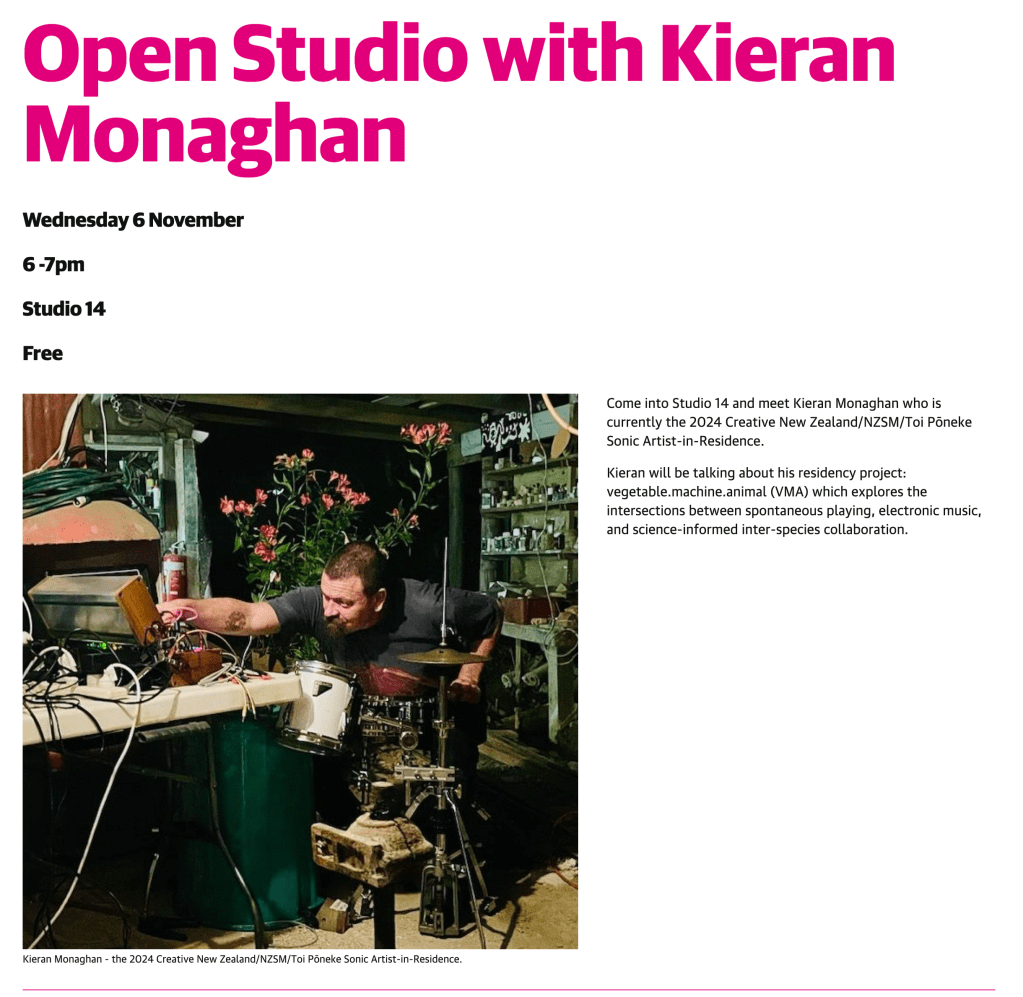
Screenshot of the Toi Pōneke website. Top text: Open Studio with Kieran Monaghan, Wednesday 6 November, 6-7pm, Studio 14, Free.
On the left is a photo of Kieran reaching over his drumkit to make adjustments on the modular synth on the table in front of him. His action bends him towards the left. There is a large flowering plant behind him. The location is in an open, but covered, space at night at the Driving Creek Railway in Coromandel. 
Text on the left of the image says:
Come into Studio 14 and meet Kieran Monaghan who is currently the 2024 Creative New Zealand/NZSM/Toi Pōneke Sonic Artist-in-Residence.

Kieran will be talking about his residency project: vegetable.machine.animal (VMA) which explores the intersections between spontaneous playing, electronic music, and science-informed inter-species collaboration.

Kia ora all. This is an open invite to come and visit me in Studio 14 on Wednesday 6 November, between 6 – 7pm, to check out what Im up to.

I will be happy to offer sound demonstrations of the project at work , discuss questions you might have, be confounded at the same time if I don’t have answers, offer you some kai to nibble. Will be 100% family friendly. Studio 14 is located on the second floor, lift access is available.

FACEBOOK EVENT
Toi Pōneke original LINK

Neil Robert’s Day – Pōneke Fundraiser

FROM FACEBOOK:

Nau mai! Haere mai!

Neil Robert’s Day is just around the corner, and it’s pretty big this year. We’re putting on two fundraiser shows – this one here in Pōneke and one in Whanganui.
Come see FOUR sweeeet bands and one alright DJ!
Doors at 9pm
Displeasure
Retaliator
Side Eye
vegetable.machine.animal
DJ Suave

NO stink cunts policy will be strictly enforced. 

Neil Roberts was a punk anarchist who died in an act of explosive defiance, with the Wanganui Computer as the target, on 18 November 1982.  Located in the city of Whanganui, the computer was the NZ government’s first digital database of accessible information on citizens, used by police and other surveillance services. His act is seen as a protest against the government’s growing surveillance mechanisms.

Film maker Russel Campbell has written about the events of the act and on some documentation that took place afterward.

Contaminated by Humanness

Picture painted by Kieran,  contains the words Contaminated By Humanness. An idea from the book The Light Eaters by Zoë Schlanger.

There are sensors connected to a plant at one end. At the other of the sensors is a plug inserted into a box that is a mess of cables and flashing lights. Speakers play sounds corresponding to interactions with the plant. Someone else is listening. I’m waving my arms around, fishing for words, trying to reel in some shape of comprehension.

I cannot think of a single instance, while demonstrating this project, that I experienced indifference. Typically, people’s fascination towards this budding idea that there is a perceivable, inter-actable, response from a species who hasn’t even been afforded the notion of agency, let alone complex life, in any form. 

It’s exciting when people become intrigued. They want to ask questions. I can almost see cognition kicking in, lights going on. I do not mean this in a way that could be construed as patronising, quite the opposite, a curious and inquisitive human is a wonderful thing.

The sound comes from the speakers. They ask, “Is this what the plant sounds like?”. No must be the answer. Anything else would be a lie. 

It’s an understandable question, when stepping towards the unimaginable. The imagination projects onto this non-human entity a humanness: “Maybe in some near-sci-fi way we will be able to ‘communicate’ with plants? Maybe it will be like a First Contact moment from an alien-encounter story?” I explain that what we are hearing is the result of the plants voltage only, it’s internal electricity, a biological signal which is measured between two sensor points. BUT, I emphasise, this is no less remarkable. We can interact and hear how the change of electrical signal changes the sounds coming from the machine. These are examples of signs of life, small recognitions that this entity, this plant, is detecting changes in the environment. And in response, changes in biosignals become audible. Caution is needed here, intention and meaning can not be interpreted from this moment anymore than a clinician is able to ascertain something about your personality from an ECG. It is impossible.

Online, I’ve seen examples of people making music with plants, presenting something that looks like a spiritual connection, a musical synergy. Most of the time, I think it’s an illusionary moment that is fraught with moral garbage. I would argue that such fantasy is unnecessary. We can be amazed at the astounding complexity of life without the bullshit.

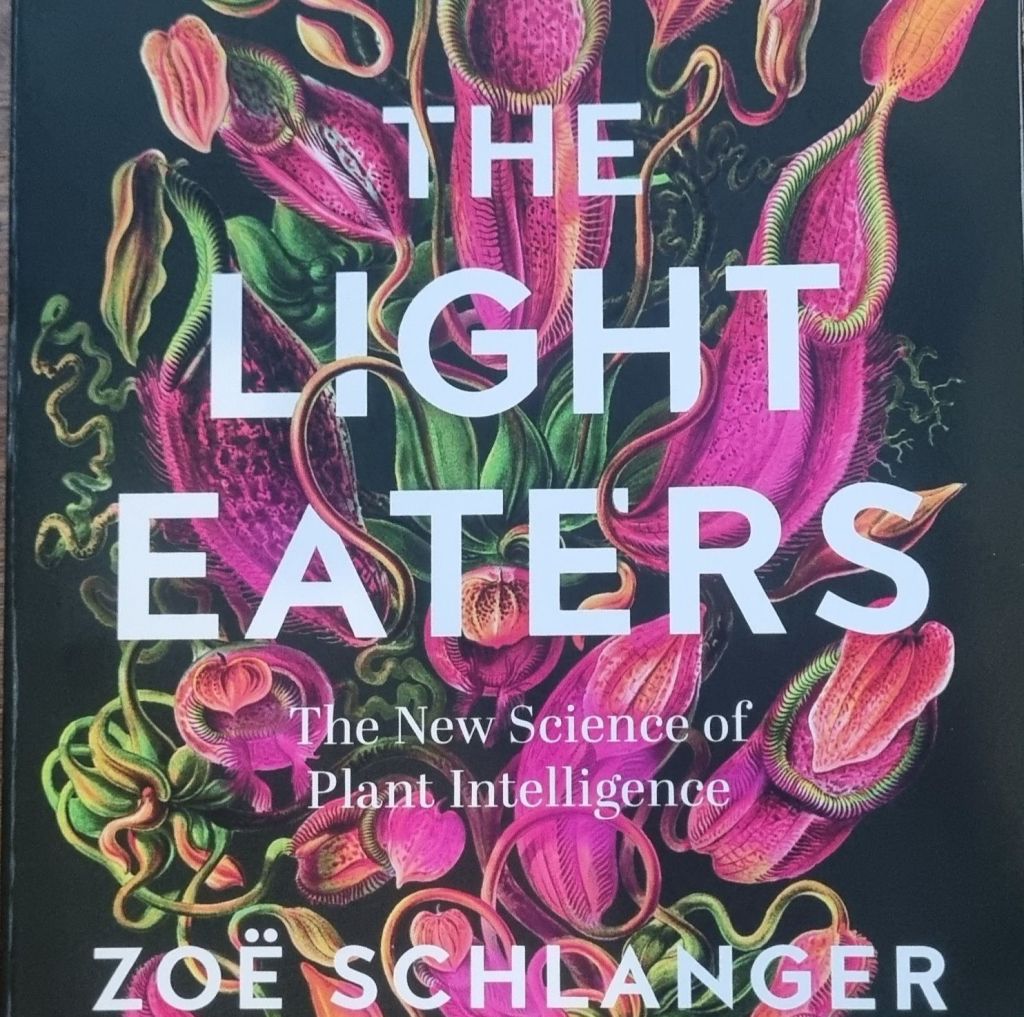
Image of the cover of the book The Light Eaters by Zoë Schlanger.

Zoë Schlanger’s book ‘The Light Eaters’ (2024) is an exploration of the recent science on plant intelligence, plant communication and plant memory. Ideas that had once been decried and ridiculed are now undergoing a rethink in light of new research and repeatable experiments. “Contaminated by Humanness” is an idea from Schlanger’s book. This idea of Humanness is a polite way to announce Anthropocentrism. Anthropos is Greek for Human. Anthropocentrism is the placing of the human experience and perspective central to all. For example, for things to be understood, hold value and meaning, they must be translatable into a position relevant to the Human. Failing to ‘See’ other positions, other Others, as of value, meaning, and importance has brought ‘Humans’ of modernity to the worst versions of ourselves. Schlanger’s suggests that there are many more perspectives of the world that may remain truly unimaginable, yet remain alongside us, permanently in co-existence.

In this project I describe the sound-making devices of the synth as akin to Google Translate. It enables us to perceive, attempt to comprehend, and engage with the signal of the lifeiness of non-human others. In this awareness-making moment perhaps perspective might shift. What’s been seen cannot be unseen, so too what has been heard can not be unheard. I think it’s important to not corral these sounds into a classical framework of what music is. I want the unexpected musicality to hold its own space. And then we can decide to simply participate without overlaying some limited conceptual idea such as music definitions. We can start by learning to have bigger ears.

Writing this makes me think of an early, and very formative, event. I can pinpoint the moment my ears expanded.

Sometime in the late 80’s I hitchhiked to Christchurch. One day I was walking in the square in the city centre. I had just brought a cassette called 2X4, a collection of live recordings from a German industrial group, Einstürzende Neubauten. I had read about them in fanzines but had never heard them. Invercargill was a long way from Berlin. Until today.

My ancient copy of 2x4 by the German industrial band Einstûrzende Neubauten. I thought it no longer played due to too much beer spoiled on it, but tonight, the spools rolled fine... still as noisy as ever

Walking through the Square, Cathedral to the Left, the pub Warners ahead, my ears were confounded and lost by these raw, unfamiliar sounds on my cassette Walkman. What I heard gave me NO reference to help me understand the sound. Percussive machinery, confronting angular rhythms, and Bargelds’ high-pitched vocalisations felt indigestible. Even though it was both fascinating and disconcerting I had to stop listening for a moment, just to catch my breath. 

Removing the headphones the perplexity remained as I felt like I was STILL listening to the band.

All around the Square was the sound of construction sites, building projects in various forms of ascent. Skeletal towers full of labourers beating frames into shape. Concrete-mixers, angle grinders, hammers, saws, power tools and brute force all at work. I heard it all.

I also heard, I realised, what I needed in order to listen to the cassette. The builders had no pretense on being musicians, but the musicians used the tools of construction and destruction to create songs and entertainment. Tools containing specific utility, identity, became challenging in the hands of another. Not so much bending it out of shape, but into a newer shape. A shape that encompassed both this world of construction and also that world of creative exploration. The building world became contaminated by a musicness.

Many of these building never survived the earthquakes 30 years later. But I still hear ‘music’ where it isn’t.

Ice water in a Warming World

First ideas are warm water. Comfortable and mediocre. Acceptable in filling a void, ok in start-making, and welcoming if tentative in water-testing. But the breathlessness of a leap into cold water has greater urgency, it’s magnificently immediate.

However, finding a constant pace in that extremity is a challenge. The thrill of the goosebump will come. I can afford myself this warm time, keeping the pending destination of a bracing uncertain front and centre. An aim is to not get swamped in predictable comfort.

It’s a rare gift to have a committed, and funded, length of time available to explore sound-making. There’s a shadow of apprehension, a flavor of imposter-syndrome, a snivel of a sense that I will make minimal more than mediocrity. I remind myself that the brain is a liar, deceitful, it fears failing. But this brain’s gravity also tends towards risk-taking and experimentation. To make something from nothing, to draw out a silhouette that pokes at the psychology of pattern recognition. To make ice water in a warming world.

This chill of being creatively lost is where I’m aiming; to be lost in thought, from habit, in someplace unfamiliar and pregnant with discovery. And I have three months to do this. I am to make recordings, to develop a show for June 2025, and to continue to discover the voice of this project. In order to do this, I’m given space at Toi Pōneke Arts Centre as part of the 2024 Creative New Zealand/NZSM/Toi Pōneke Sonic Artist-in-Residence position I hold till the end of 2024. I have a generous west facing room, a wall of windows, and three to hang pictures. A desk for drawing and a desk for musical gear. The building contains scattered occupants who I occasionally meet as they take rest from their own creative endeavours. 

A first flower.

The only plant I have at present is a Peace Lily, recently repotted. It is the sole active non-human participant in sound-making so far, displaying a dynamic voltage that interacts inside the sound modules of the synth. The first recordings are encouraging. It was given to us over 15 years ago from the real estate agent who sold us our home. I noticed this morning that, in the entire time we [me and the lily] have lived together, it is about to flower for the first time

Toi Pōneke is located at the edge of the CBD. Theres two more blocks till Webb Street, with a Bypass that intersects. Toi Pōneke came into existence, at least in my memory, as a trade off between the Wellington City Council and the significant Anti-Bypass protest movement in the early 2000’s. For nearly 40 years people had opposed the mass destruction of a vibrant corner of the city which housed many artists, musicians, and oddballs. The protests took the form of squats, lock-ons, community gardens, fund-raising gigs, festival, publications and more. Many were arrested, some were hurt. It was from these community organisings that events like the Cuba Street Carnival evolved. I was involved in number of ways back then, and I opposed the council’s trade off of an Arts Centre Vs Community. But as it’s said in The Hitchhikers Guide to the Galaxy, ‘You’ve got to build bypasses’. The length of road happened. It cost millions, saving only a multiple of seconds on the journey from the motorway to the airport. 

So here I sit. Ruminating on this part of my past. Hoping these digestions are nutritious and enabling for whatever comes next. I have learned a lot in developing the vegetable.machine.animal project, and one such notion is the idea of ongoingness in contested, damaged, and troubled areas. Sounds a bit like everywhere these days. The dead weight of cynicism does not free us from the challenges ahead. It offers no resistance or option against a Powers sense of immobility. New stories are necessary, new directions are essential, new actions for these times. And I hope in my own small way, through this project, to contribute in this new mode, towards always something better, bracing, and uncertain.

The artists are in residence

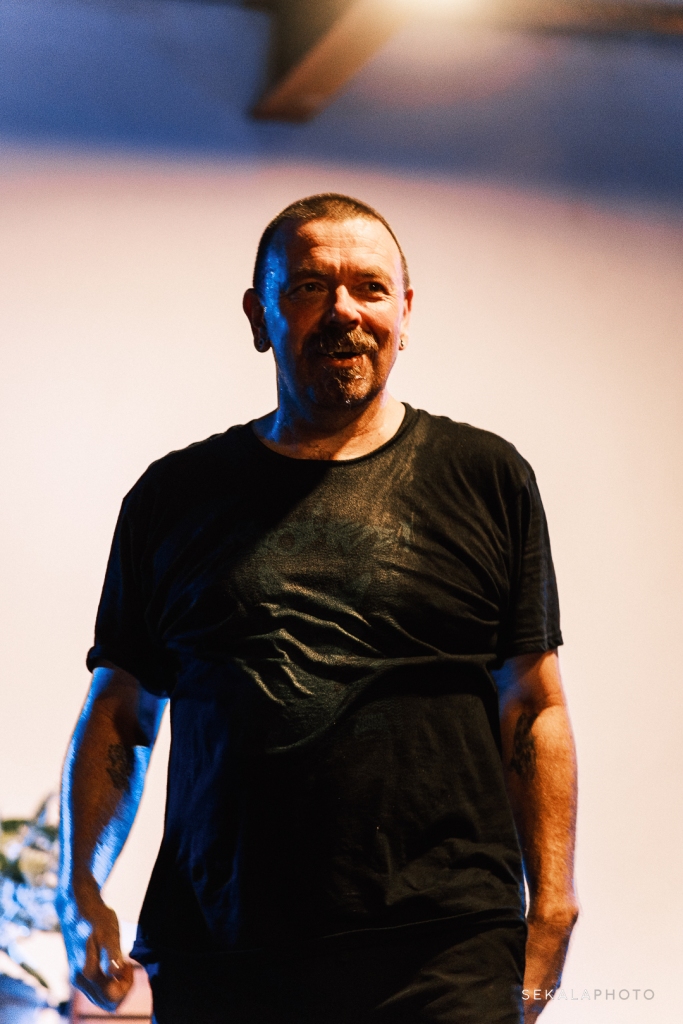
Kieran sitting in new studio at Toi Pōneke

Today is a milestone. Kieran begins 3 months as the Creative New Zealand/NZSM/Toi Pōneke Sonic Artist-in-Residence 2024. You can guarantee that this funded watershed will result in a proliferation of work in sound, in music, and in painting and will foster a clutch of unexpected collaborations with makers in a myriad of disciplines.

The knock-on of Kieran’s relocation to Toi Pōneke, is I get to stretch into an empty house for 3 months. So I feel I have scored the inaugural Happy Valley/skirted Records Sonic Artist-in-Residence 2024. Who knows what this gift of time and space will generate?

We both aim is to keep you posted as we would if we were on tour. Subscribe if you’d like to follow along.

bioSignals: Interview

I recently had the pleasure to be interviewed by Dr Maggie Buxton of Awhiworld and bioSignals.

Awhiworld: a “…transdiciplinary project [that] brings together artists, scientists, makers, hackers, and more to tackle complex issues and generate alternative realities.

bioSignals, a part of the Awhiworld research, is an “…international collaboration between Awhiworld, the Phillipines and the UK. …bioSignals collects, processes, and transmits signals from local plant life growing at each site, embodying a shared vision of connecting isolated entities, fostering resiliance, and addressing climate change and biodiversity loss challenges.”

2024 Sonic Artist in Residence Announcement


Toi Pōneke Arts Centre and Victoria University’s New Zealand School of Music—Te Kōkī (NZSM) are delighted to announce Kieran Monaghan as the 2024 Creative New Zealand/NZSM/Toi Pōneke Sonic Artist-in-Residence.

Kieran Monaghan (he/him) is predominantly, and persistently, a drummer and percussionist of found sounds. He calls Te Whanganui-a-Tara/Wellington home. His first crude musical steps were in the late 1980s, playing drums in southern punk rock bands. Heading north in the 1990s opened new musical domains such as theatre with Red Mole, and its little sister Roadworks, and the diverse arrangements of free jazz that tumbled from venues such as The Space. While continuing to play assertive music, alongside developing confidence in improvisational arenas, necessity also dictated that income be made by playing multiple pub circuits in working bands.

His project, vegetable.machine.animal (VMA), is the newest iteration of ongoing musical expression. It explores the intersections between spontaneous playing, electronic music, and science-informed inter-species collaboration.

He co-runs the skirted Records label with domestic and performative partner Chrissie Butler. Together they were the core of the outsider punk group mr sterile Assembly, and Nick Bollinger named them as one of the ten great rhythm sections of New Zealand. Monaghan has toured internationally many times with the Assembly, and more recently with VMA. He has a long catalogue of solo, band, and collaborative recordings. He is a semi-regular DJ on RadioActive.FM. He remains happily hitched, and is a father to three daughters and one mokopuna.

The Creative New Zealand/NZSM/Toi Pōneke Sonic Artist-in-Residence 2024 is a three-month position that runs from 23 September to 15 December 2024. During this time, Kieran will develop a body of innovative and substantial work in the domain of sound art. His work will include a new album, performances and an installation of vegetable.machine.animal. He will become an employee of Victoria University of Wellington for the duration of the residency and may use NZSM facilities and recording equipment over that period. In addition, he will be provided with studio space at Toi Pōneke and his residency will culminate in a 4-week exhibition in June 2025 at Toi Pōneke Gallery.

Text verbatim from Toi Pōneke website

Mundane Utopia: Installation @Audio Foundation, Tāmaki Makaurau/Auckland

Photo: by Wawan Sutiawan, Cirebon, Java, Indonesia.
Photo say 13 June - 6 July
Kieran Monaghan presents
vegetable.machine.animal
Mundane Utopis.
There is an image of Monaghan hunched over the modular synthesizer, parts of a drum kit are behind him, in the foreground is a plant and then a lot of cables and equipment. This photo is taken from a performance in Cirebon,. Java, May 2024.
Further text
Opens 5.30pm, Thursday 13 June
Live Performance, Friday 14 June, Whanny Backroom, 8pm.
Offience Ambience artists talk, Saturday 14 June, Audio Foundation, 1pm.
Jogja Noise Bombing Screening, Saturday 15 June, Audio Foundation, 5pm.

The Audio Foundation is located at 4 Poynton Terrace, central Auckland. It is open Tuesday to Saturday from 12 to 4 pm.

Mundane
1: of, relating to, or characteristic of, the world
2: characterised by the practical, transitory, and ordinary
– Some mundane online dictionary

Utopia
“…we should reinvent utopia, but in what sense? There are two false meanings of utopia. One is this old notion of imagining this ideal society we know will never be realised. The other is the capitalist utopia … of new perverse desire that you are not only allowed but even solicited to realise. The true utopia is when the situation is so without [solution], without the way to resolve it within the coordinates of the possible, that out of the pure urge of survival you have to invent a new space. Utopia is not [a] kind of a free imagination, utopia is a matter of inner most urgency, you are forced to imagine it, it is the only way out, and this is what we need today.”
– Slavoj Žižek, Public lecture at Universidad de Buenos Aires

What could utopia sound like? What if the mundane babble of things simply going about their livingness was how it sounded? Not in a state of idealised perfection, but a continuous and dynamic state of balancing. What if we could perceive this?

This installation aims to make audible a little piece of what is already, has been, and will continue to go on for a very long time. Just beyond ‘our’ world is the world of everything else, unfolding in its ordinary, continuous, mundane way. The machine in this exhibition holds the place of a translator. It detects signals of ongoing, other-aliveness and converts into crude signals audible to human anatomy. It is an unsophisticated interpretation. It provides no comprehension, but does enable us to perceive something that is not of us, in a way that may make some sense to us.

And how shall we interact with this. The ‘other’ knows when we are here, we can hear its signal change with interaction: touch, adding water, being neglected and dehydrating, and shining UV as if we pretend to be daylight. A mundane utopia for troubled and damaged times exists already, it’s not waiting for us.

—–

Opens: Thursday 13 June, 5.30pm, with refreshments by Liberty Breweries
Hours: 12 – 4pm, Tuesday – Saturday
Closes: Saturday 6 July

Public events:
Friday 14 June, 8pm @ Whammy Backroom
vegetable.machine.animal live in concert
Tickets here
More info here

Saturday 15 June, 1pm @ Audio Foundation
Kieran Monaghan Office Ambience performance and artist talk
More info here

Saturday 15 June, 5pm @ Audio Foundation, free
Film Screening: Jogja Noise Bombing (Indonesia)
More info here